
Rapport Building With Clients: A Practical Guide for Counselors

Rapport with a client is a working relationship built on trust, respect and shared goals. You build it by being warm and genuine, listening before advising, agreeing on what therapy is for, and checking in often about how the work feels to the client. It starts in the first session and needs attention for as long as you work together.
This guide covers what the research says rapport is, what to do in the first meeting, which skills make clients feel understood, how to handle reluctant clients, how to adapt across cultures and over video, and what to do when the connection slips.
TL;DR
- Rapport is the bond, agreed goals and agreed tasks that make up the therapeutic alliance, and a stronger alliance is linked to better outcomes.
- The alliance is largely formed in the first session, so greet warmly, explain roles and ask what the client wants.
- Empathy, positive regard, genuineness and collaboration matter more than any single technique.
- With reluctant clients, slow down, reflect their words and validate their reasons before suggesting change.
- Ask for feedback regularly and repair ruptures without defensiveness.
Table of Contents
- What rapport is and why it matters
- Building rapport in the first session
- Skills that make a client feel understood
- Reluctant or resistant clients
- Adapting to cultural and identity differences
- Building rapport over teletherapy
- Checking whether rapport is growing, and repairing it
- Our perspective
- Support for clients and for clinicians
- FAQ
- Sources
What rapport is and why it matters
Rapport is a mutually trusting and respectful helping relationship. One teaching text defines it as a relationship of agreement, mutual understanding or empathy that makes communication possible. The same chapter stresses that it is an ongoing process counselors must attend to, not something that simply happens.
The evidence for its value is solid. A 2020 meta-analysis of 60 independent samples and 6,061 participants found moderate alliance-outcome correlations (r = .23 to .31), and these held after adjusting for intake characteristics and other treatment processes.
The APA’s task force on evidence-based relationships, drawing on 16 meta-analyses, concluded in 2019 that agreeing on goals, collecting client feedback and repairing ruptures are at least as vital to a good outcome as the choice of treatment method. Researcher Adam Horvath described the relationship as the horse that comes before the carriage of interventions.
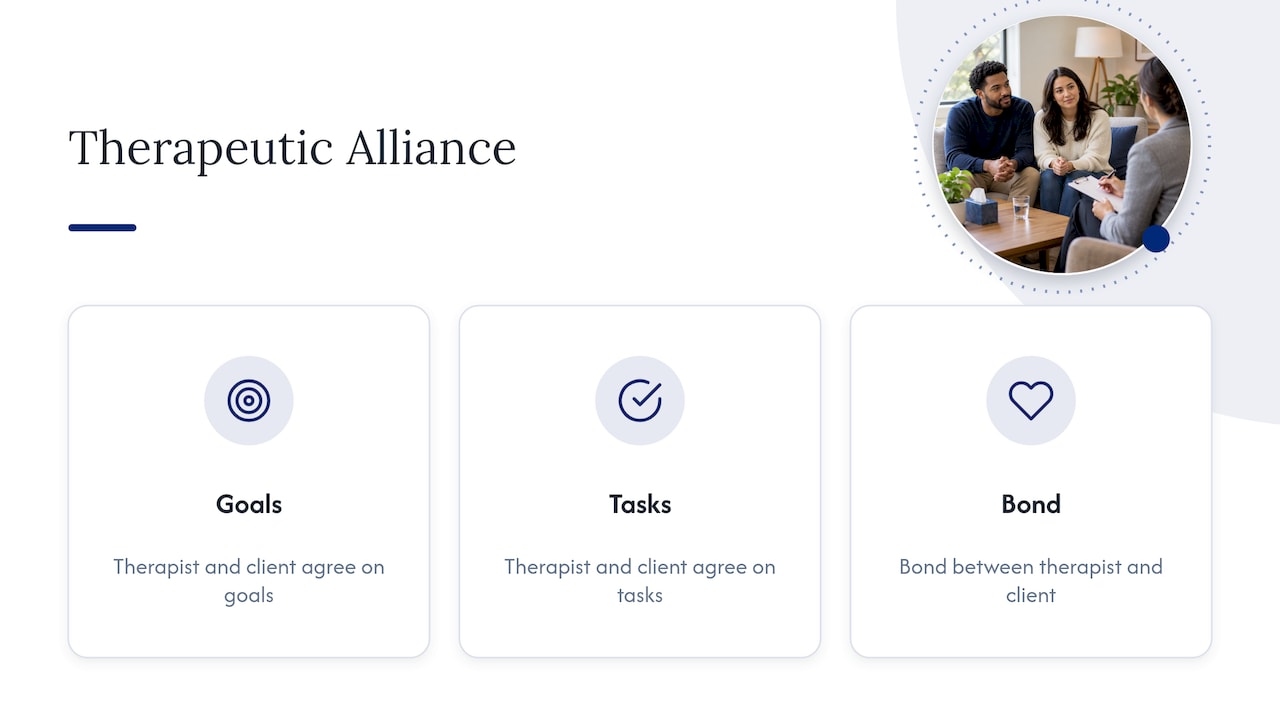
The British Association for Counselling and Psychotherapy breaks the alliance into three parts: agreement on goals, agreement on tasks, and the bond between therapist and client. That is a useful checklist. If a client seems stuck, ask which of the three is weak.
Building rapport in the first session
Research from Spain suggests the alliance is largely forged in the first session and stays relatively stable afterward. The first hour deserves real preparation.
Start before the client speaks
The welcome counts: your greeting, your tone, the room or the video frame, and how clearly the client knew what to expect. Practical guidance for first sessions recommends a warm greeting with genuine eye contact, asking about the client’s history with therapy, and explaining the roles of both parties.
A simple first-session sequence
- Greet by name and orient. Say how long the session is, what you will cover and what happens at the end.
- Explain confidentiality and its limits in plain words. Clients who are unsure what stays private will hold back. Our article on confidentiality in counseling shows how to frame it.
- Ask what brought them in, and why now. Let them tell it their own way before you gather history.
- Ask about past therapy. What helped? What did they dislike? This tells you how to work with them.
- Name a first goal together. Even a rough goal gives the alliance something to stand on.
- Close by checking in. Ask what stood out and whether anything felt off.
Horvath points to a shift toward mutuality: therapist and client as partners rather than director and patient. Collaborating on goals is, in his account, another strong relationship builder. Treat the first session as a conversation, not an intake interrogation.
Skills that make a client feel understood
The BACP identifies collaboration, empathy, positive regard and genuineness as the ingredients of an effective relationship. It defines empathy as understanding a client’s thoughts, feelings, experience and meaning from the client’s own perspective. Here is what each looks like in the room.
Listening that does not rush
The same document notes that attentive, non-judgmental therapists are perceived as more empathic than those who interrupt, advise and talk a lot. If you notice yourself reaching for a solution in the first ten minutes, reflect instead. Say back the feeling and the meaning, not just the facts.
Tentative empathy
Empathic responses land better when offered tentatively and with humility, leaving room for the client to correct you. Compare two responses to a client describing a fight with a spouse:
- You must feel furious.
- It sounds like part of you felt dismissed. Am I close, or is it something else?
The second invites the client to refine your understanding, and that refinement is where connection forms.
Validation and genuineness
Validation means acknowledging that a feeling makes sense given the client’s experience, without having to agree with every conclusion. Genuineness means you are not performing warmth. Clients notice scripts. Use your own words, admit when you did not follow, and be consistent in what you say and do.
Nonverbal basics
Open posture, an even voice, steady but not fixed eye contact and a pace that matches the client’s all support the verbal work. Mirroring a client’s energy level is natural. Copying every gesture is not, so let it happen on its own.
Reluctant or resistant clients
Many people in anger or conflict work arrive because someone else insisted: a partner, a court, an employer, a school. Resistance is information about how safe the room feels, not a flaw in the client.
- Give time and avoid rushed conclusions. Guidance for practitioners suggests reflecting the client’s words and emotions so they feel heard.
- Stay calm and patient. Calm, non-defensive responses help the client see you as safe.
- Validate the reasons for staying the same. In motivational interviewing, a client’s reasons for not changing are called sustain talk. Validating them without dismissing them helps clients feel heard and can gently shift them toward change talk.
- Ask permission before giving advice. It keeps the partnership intact.
Example: a man sent to anger management by his wife says, This is a waste of time. A rapport-first reply is not a defense of the process. Try: It makes sense you’d feel that way, since this wasn’t your idea. What would make the time worth it for you? The answer usually reveals a goal you can work with.
Adapting to cultural and identity differences
No checklist makes you competent in every client’s world. Research on teaching rapport describes cultural humility as a core strategy: staying open to learning from each client’s unique identity and experience, practicing humble curiosity and examining your own biases. It is an ongoing effort, not a certificate.
In practice:
- Ask clients how they would like you to understand their background, rather than assuming.
- Ask what role family, faith and community play in how they handle conflict.
- Notice where the client’s trust in institutions, including therapy, may have been shaped by history.
- Correct yourself openly when you get something wrong.
We write more on this in seven habits for navigating cultural differences, on cultural considerations in couples therapy and on counseling for Black families.
Building rapport over teletherapy
Video takes away the shared room, so you have to build the sense of presence deliberately. The U.S. Department of Health and Human Services telehealth guidance recommends:
- Explaining how the technology works and answering questions.
- Reassuring the client about privacy and security.
- Allowing time for casual conversation.
- Asking open-ended questions and repeating key phrases to confirm information.
- Expressing empathy through verbal and visual cues.
- Appearing open and calm.
Look at the camera lens at key moments, keep your face well lit, and say aloud what you would usually show with a nod. Begin by confirming the client can speak privately, and agree on what to do if the connection drops.
Checking whether rapport is growing, and repairing it
Signs of a strengthening alliance include a client who brings difficult topics, disagrees with you openly, shows up on time, and refers back to earlier sessions. Signs of strain include vague answers, sudden cancellations, politeness that feels flat, or a client who stops offering feelings.
The BACP says that regularly asking for feedback, attending to the relationship and working non-defensively to repair ruptures promote better outcomes. It also states that routine, one-size-fits-all interventions are less effective than focusing on the relationship.
A repair conversation can be short:
- Name what you noticed: I sense that last week’s session may have felt off.
- Invite the client’s view and listen without defending.
- Acknowledge your part.
- Agree on what to adjust.
Clinicians at the Beck Institute note that repairing ruptures can foster safety, resilience and authenticity in therapy. A rupture handled well can deepen trust more than a smooth stretch.
Our perspective
We see rapport as the foundation of every service we offer, from anger management to couples work to clinical supervision. Whatever the framework, clients change when they feel respected, understood and treated as a partner in their own progress.
Our approach blends clinical rigor with practical tools. A tool only works if the client trusts the person handing it over. That is why we spend time on goals, expectations and feedback before technique, and why we ask clients early and often how the work feels to them.
We also believe rapport has to be culturally informed. We serve women, men, teens, couples and families, including Black and African American clients, and we treat each person’s background as expertise we learn from, not a variable to manage. Online sessions let us extend that care well beyond the Carolinas and Florida.
If you are a clinician, treat rapport as a skill you can practice and refine with a mentor. It improves with deliberate attention and honest feedback.
Carlos
Support for clients and for clinicians
If you are a counselor who wants to sharpen these skills, we offer clinical mentoring and clinical supervision for mental health practitioners. If you are a client looking for a relationship-centered approach, the same page lists counseling for couples, women, men and teens, and anger management counseling, including online options.
Couples can also see our couples packages, where sessions are $175 per hour. For anger management classes, see our online classes, starting at $24.99 for the 1 Hour Anger Management Class.
FAQ
How long does it take to build rapport with a client?
There is no fixed timeline, but the first session matters most. Research suggests the alliance is largely forged in that first meeting and tends to stay relatively stable afterward. Keep tending it through regular check-ins rather than assuming it is done.
What are the best rapport-building techniques in therapy?
The best-supported ingredients are empathy, positive regard, genuineness and collaboration. In practice that means active listening, reflecting feelings, validating experience, agreeing on goals and tasks, and asking for feedback. Techniques like mirroring help only when they come from real attention.
How do you build rapport with a client who does not want to be there?
Acknowledge that the visit was not their idea, give them time, and reflect what they say without arguing. Validating their reasons for resisting, a motivational interviewing approach, helps them feel heard and makes room for them to voice their own reasons to change.
Can you build rapport over video?
Yes. Explain the technology, address privacy, allow a little casual conversation, ask open-ended questions and show empathy in words and facial expression. Federal telehealth guidance supports each of these steps.
What should you do when rapport breaks down?
Name it gently, invite the client’s view, and respond without defensiveness. Acknowledge your part and agree on what to change. Repairing a rupture can strengthen the relationship.
Sources
- How to Build Rapport With Clients: 18 Examples & Questions
- Assessing the alliance-outcome association (PMC, 2020)
- Relational Practices: rapport (Pressbooks)
- Better relationships with patients lead to better outcomes (APA Monitor, 2019)
- What works in counselling and psychotherapy relationships (BACP)
- The first session is the one that counts (PMC, 2022)
- First Therapy Session: A Therapist’s Guide
- Ultimate Guide to Client Communication in Private Practice
- How to use Motivational Interviewing (Australian Psychological Society)
- Build rapport and collect data: a teaching resource (Springer, 2022)
- Cultivating trust and building relationships during a telehealth visit (HHS)
- When Clients Protect Themselves (Beck Institute)