
Conflict Resolution the Gottman Way: Skills That Work

The Gottman approach to conflict resolution starts from a surprising idea: the goal is not to stop fighting or to win. It is to fight in a way that leaves you understanding each other better. The Gottman Method is a research-based form of couples therapy developed by John Gottman and Julie Schwartz Gottman, and its conflict work rests on the Sound Relationship House. In practice that means a gentle start to hard conversations, real listening, accepting your partner’s influence, calming down when you are overwhelmed, and repairing when things go wrong.
Below is a plain-language walkthrough of those skills, how to practice them in a real argument, and how to tell when it is time to bring in a professional.
TL;DR
- Gottman-style conflict resolution is about managing disagreement well, not eliminating it. Many couple conflicts are ongoing differences, and the skill is talking about them without damage.
- Start soft: describe your feelings, one specific situation and a positive need, without blaming or attacking your partner’s character.
- Listen, summarize and validate before you defend, and let your partner’s view change yours.
- If your body is flooded, take an agreed break, soothe yourself, and come back at a set time.
- If criticism, contempt, defensiveness or shutting down keep repeating and repair is not happening, couples counseling is the next step.
Table of Contents
- What the Gottman method says about conflict
- Manage some problems, resolve others
- The core skills, step by step
- The Four Horsemen to watch for
- A worked example
- Perspective from our practice
- When to get professional help
- How we can help
- Keep learning
- FAQ
- Sources
What the Gottman method says about conflict
The Gottmans built their model from decades of watching real couples talk. The Sound Relationship House is the framework: a set of layers, from knowing each other’s inner world up to shared meaning, with conflict management as one of the floors. Its central aims include reducing destructive communication, increasing respect and affection, and building empathy and understanding.
Two ideas matter most for anyone searching for how to handle arguments.
Conflict is not the enemy. According to NPR’s report on the Gottmans’ work, many arguments contain hidden dreams and important beliefs. “Fighting to understand” turns an argument from a contest into a way to get closer. That reframing changes how you walk into the room.
Ratio matters more than absence. The University of Washington reported that Gottman’s five-to-one finding came from videotaped couple conversations with physiological measurements, and that couples who fell below the ratio of positive to negative interactions were more likely to run into relationship trouble. Warmth outside the argument is what makes the argument survivable.
Manage some problems, resolve others
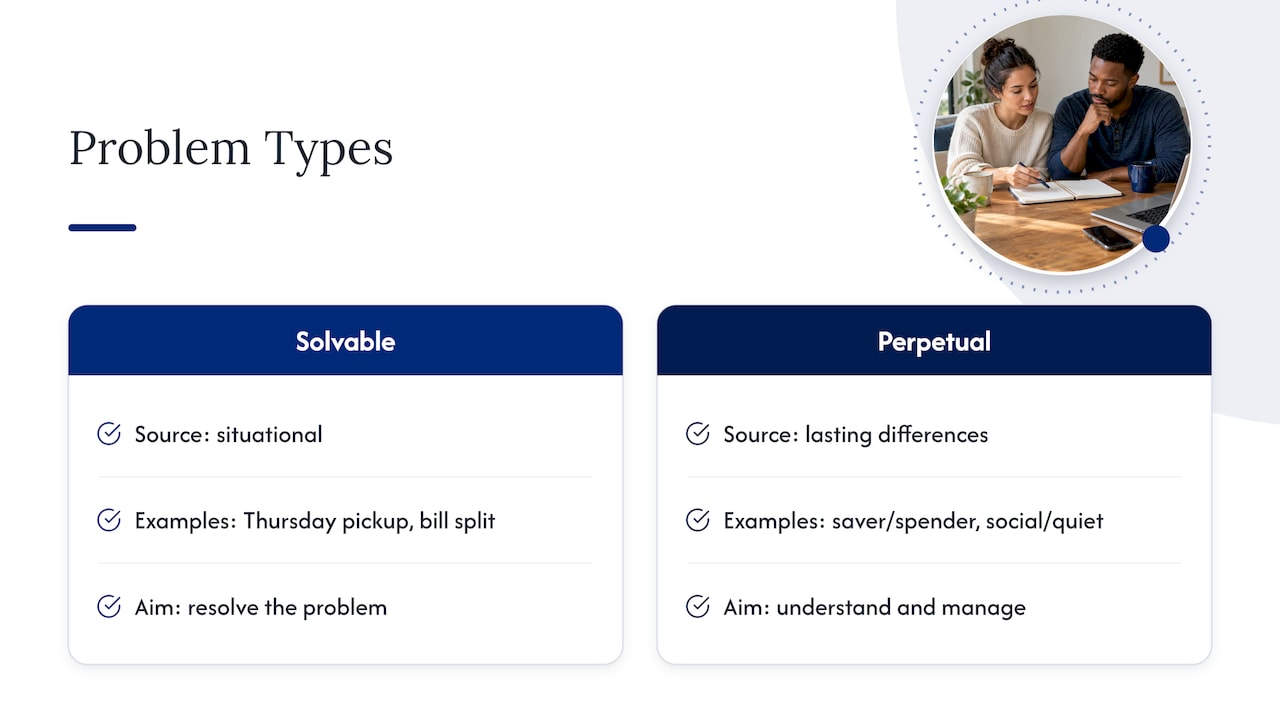
One of the most useful Gottman distinctions is between solvable problems and perpetual ones. A solvable problem is situational: who picks up the kids on Thursday, how to split a bill. A perpetual problem comes from lasting differences in personality, values or needs: one of you is a saver and the other a spender, one needs lots of social time and the other needs quiet.
Gottman’s research is often summarized as finding that most couple conflicts are of the perpetual kind. The reason the approach favors managing them is simple. If you treat a difference in temperament as a puzzle with one right answer, each conversation becomes a fight over who is right, and the same argument returns every few weeks. If you treat it as a difference to be understood, you can talk about it with humor, curiosity and compromise, and it loses much of its sting.
This is also where couples often get stuck. They keep trying to fix the person instead of working out how to live well with the difference. A useful question for a perpetual problem is not “how do we end this?” but “what does this mean to you, and how can we make room for both of us?”
Gottman’s conflict styles
The Gottmans also describe different ways couples handle disagreement. Validating couples talk calmly and compromise. Volatile couples argue passionately and make up warmly. Conflict-avoidant couples agree to disagree and keep a lot of peace. Each can work when positive moments clearly outweigh negative ones. Trouble starts when the mix turns critical, contemptuous, defensive or withdrawn.
The core skills, step by step
The following skills appear across the Gottman-based guidance from UC Berkeley’s Greater Good Science Center and a University of Georgia relationship-education guide. Learn them one at a time rather than all at once.
1. Soften the start-up
How a conversation begins usually predicts how it ends. A softened start-up raises a concern by describing your feelings, a specific situation and a positive need, rather than blaming your partner or criticizing their character.
Harsh: “You never help around here. You’re so lazy.”
Soft: “I feel overwhelmed when the kitchen is still a mess at 9 p.m. Could we tackle it together after dinner?”
The second version names a feeling, one situation and one request. It gives your partner something to say yes to.
2. Complain without blaming
A complaint is about a specific behavior. Criticism is about who your partner is. “I was worried when you didn’t call” is a complaint. “You’re so inconsiderate” is criticism. Using “I” statements and describing what happened, without judging it, keeps the conversation open.
3. Listen, summarize and validate
When your partner speaks, your job is to understand, not to prepare a rebuttal. Listen, summarize what you heard (“So you felt left out when I made plans without asking?”), and validate the part that makes sense from their side. Validating is not agreeing with everything. It says: your experience makes sense to me.
4. Accept your partner’s influence
Accepting influence means listening respectfully, resisting defensiveness, sharing power and practicing co-decision-making rather than giving in reluctantly. The test is whether your partner’s opinion can actually move you. In healthy couples, it does, and both partners experience it as respect rather than defeat.
5. Soothe when you are flooded
When your heart is pounding and your thoughts narrow to attack or escape, you are flooded, and productive conversation is nearly impossible. The guidance is to take a break, self-soothe and agree when to return. The agreed return is what separates a time-out from stonewalling: you are not leaving, you are pausing.
A workable pattern:
- Say you need a break and name when you will be back (“I need twenty minutes, then let’s try again”).
- Do something calming and unrelated: walk, breathe slowly, listen to music. Do not rehearse your case.
- Return at the time you named and restart with a soft start-up.
6. Use repair attempts
A repair attempt is anything that keeps tension from escalating: a joke, an apology, “let me try that again,” a touch on the arm. The University of Georgia guide lists agreed time-outs with a return conversation, soothing, forgiveness and repair attempts among the practical conflict-management skills. Repairs only work if the other person can accept them, which is why warmth outside of fights matters so much.
7. Look for the deeper meaning
Under a fight about dishes or money often sits something bigger: a need for respect, security, freedom or recognition. The American Psychological Association’s account of Julie Gottman’s work presents deepening questions and empathy, rather than immediate advice, as the route to understanding and emotional bonding. Try asking: “What does this mean to you?” and “What’s the story behind that for you?”
The Four Horsemen to watch for
Gottman’s best-known warning signs are criticism, contempt, defensiveness and stonewalling. Each has a counterpart skill:
| Warning sign | What it looks like | Skill to reach for |
|---|---|---|
| Criticism | Attacking your partner’s character (“You always…”) | Soft start-up, complaint without blame |
| Contempt | Sarcasm, eye-rolling, mockery, name-calling | Building appreciation and respect daily |
| Defensiveness | Counter-complaints, playing the victim | Accepting a share of responsibility, accepting influence |
| Stonewalling | Shutting down, going silent, leaving | Agreed break and self-soothing, then return |
Everyone slips into these now and then. What matters is whether they become the default and whether repair follows.
A worked example
Imagine a couple who argue every month about visiting one partner’s parents. This is a classic perpetual problem: one partner needs close family contact, the other needs more space.
In the old pattern, one says, “You never want to see my family,” the other answers, “You always overreact,” and both end up angry.
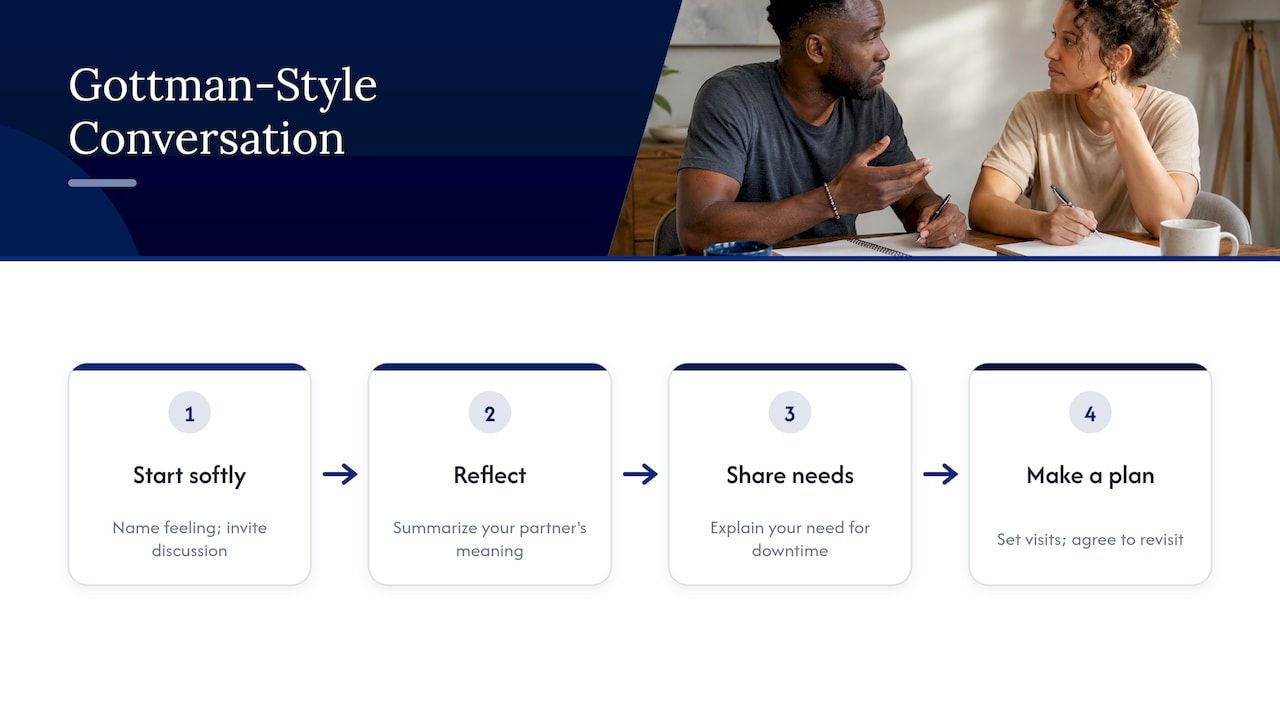
In a Gottman-style version, it starts differently: “I feel sad when we skip Sunday dinners, because my family means a lot to me. Can we talk about how often feels right?” The other partner summarizes (“You miss them and it feels like I’m pulling away”) and then shares their own side: “I feel drained after long visits and need downtime.” Both ask what the visits mean to each other. They land on a plan, maybe two dinners a month and shorter stays, and agree to revisit it. The difference between you does not vanish. The fight about it does.
Perspective from our practice
We see the same pattern again and again: couples do not come to us because they argue, they come because arguments have stopped leading anywhere. Gottman’s work gives a clear, research-based map of what to change, and we agree with its core message that how you fight matters more than whether you fight.
Our own work blends clinical rigor with tools you can use the same evening. We pay close attention to what happens in the body during conflict, because no skill works when you are flooded. We also pay attention to the person and the culture behind the argument, since the meaning of respect, family and anger differs across communities, and we serve a diverse range of clients.
Reading about skills is a good start. Practicing them with a trained guide, in real time, while your partner is in the room, is what makes them stick. If your fights keep landing in the same place, that is not a failure. It is a signal that you deserve support, and we are glad to provide it.
Carlos
When to get professional help
Self-help skills go a long way, but not always far enough. Consider couples counseling when the Four Horsemen are chronic and repair is not happening. A 2026 research overview also notes that couples therapy tends to be most effective when started early, not once the relationship is in crisis. Waiting for a crisis is the most common mistake.
Other signs it is time to get help:
- Arguments get loud, personal or scary, or one of you feels unsafe. If you are in danger, contact local emergency services or the National Domestic Violence Hotline at 1-800-799-7233.
- You avoid each other or stop talking about anything that matters.
- Trust has been broken, for example by an affair.
- Anger is spilling into parenting, work or health.
If one partner’s anger is the main driver, individual work can help alongside couples sessions. Noticing what triggers you matters too: some people find that exploring shadow work for relationships helps them spot the patterns they bring into a disagreement.
How we can help
At Mastering Conflict, our licensed team works with couples, individuals, teens and families on conflict, anger and communication, in person in the Carolinas and Florida and online through teletherapy. Depending on where you are, you can start with a single couples session at $175 per hour, or choose a more immersive format such as our 6 Hour Couples Intensive at $1,995. If trust has been broken, we also offer RESTORE infidelity recovery.
If anger is the part that takes over, our anger management classes start at $24.99 for the 1 Hour Anger Management Class, with 6 Hour ($79) and 8 Hour ($85) options as well. You can see everything we offer on our clinical services page.
Keep learning
If you want to go deeper on the skills above, these guides from our blog cover them from other angles:
- Communication skills for couples
- Conflict resolution for couples: practical strategies
- Conflict resolution skills in marriage
- Our Couples Fight School
FAQ
What is the Gottman method of conflict resolution?
It is a research-based approach from John and Julie Gottman, grounded in the Sound Relationship House. Its conflict process includes taking each other’s feelings into account, discussing problems and self-soothing when overwhelmed. The aim is understanding and connection rather than winning.
What are Gottman’s three conflict styles?
The Gottmans describe validating, volatile and conflict-avoidant couples. Validating couples compromise calmly, volatile couples argue intensely but warmly, and avoidant couples minimize disagreement. All three can be stable when positive interactions clearly outnumber negative ones, which the Gottmans put at about five to one during conflict.
Can every conflict be resolved?
No, and the Gottman approach does not expect it. Differences in personality and values tend to come back, so the goal is to discuss them with respect, humor and compromise instead of trying to end them for good. Solvable, situational problems can usually be settled with a clear plan.
What should I do if I get too angry to talk?
Say that you need a break, name when you will return, and use the time to calm your body rather than build your case. Then come back at the agreed time and begin with a soft start-up. If anger regularly takes over, a counselor or an anger management class can help you build steadier habits.
When should we see a couples therapist?
See one when the same fights repeat, contempt or shutdown has become the norm, or trust has been broken. Earlier is better: couples therapy tends to work best when it starts before the relationship is in crisis.
Sources
- The Gottman Method: Definition, Techniques, and Benefits (Verywell Mind)
- How healthy couples use conflict to grow closer (NPR)
- Math and marriage: Five-to-one ratio predicts who will stay married (University of Washington)
- How to Fight Without Hurting Your Relationship (Greater Good Science Center, UC Berkeley)
- Manage (University of Georgia relationship education)
- Lessons from the Love Lab (American Psychological Association)
- Communication in Relationships: What the Research Actually Shows (Simply Psychology)
- Shadow Work for Relationships: A Practical Guide