
The Role of a Mediator in Divorce: What They Do and Don’t

A divorce mediator is a neutral professional who helps you and your spouse talk through the decisions of separating and reach an agreement you both choose. The mediator does not take sides, does not decide for you and does not act as your lawyer. You keep the decisions. The mediator keeps the conversation structured, calm and moving.
This guide explains what that looks like in practice, where the mediator’s job stops, when mediation is not the right fit, and how to prepare. We are a conflict resolution and counseling practice, so we also say where the emotional side of divorce belongs.
TL;DR
- A mediator is an impartial facilitator: they structure discussions, identify issues, help you communicate and explore options. You and your spouse make every decision.
- A mediator does not give legal advice or replace a lawyer. Get independent legal advice before you sign anything.
- Mediation is voluntary, and you can withdraw or reject any proposal. It may be unsuitable where there is abuse, intimidation or fear.
- Mediation is not therapy or reconciliation. Avoid point-scoring and blame, and come ready to focus on the future.
- Preparation (financial information, a list of priorities, support for the emotional load) makes sessions shorter and more productive.
Table of Contents
- What a divorce mediator actually does
- The mediator is neutral, not a judge
- How a mediator helps you communicate and reach agreement
- What a mediator does not do
- What happens in a typical mediation process
- What to avoid during divorce mediation
- When mediation may not be suitable or safe
- How to prepare for your first session
- Perspective: why emotional readiness changes mediation
- Getting support before and during mediation
- FAQ
- Sources
What a divorce mediator actually does
The 2025 Model Standards for Family and Divorce Mediation, published by the Association of Family and Conciliation Courts with participating professional bodies, describe the job in plain terms. Mediators facilitate voluntary resolution, assist communication, keep attention on needs and interests, help the parties explore options and support the parties’ own agreements.
In practice, that breaks into five tasks.
- Setting the ground rules. The mediator explains how the process works, that it is voluntary and confidential, and how you will take turns speaking.
- Identifying the issues. Most divorces involve a mix of topics: children, finances, property, housing and support. The mediator helps you list them and decide the order.
- Managing communication. When emotions run high, the mediator slows things down, reframes accusations as concerns and makes sure each person is heard.
- Generating and testing options. Rather than arguing over one position each, you look at several possible solutions and ask whether they would work in real life.
- Recording the outcome. Agreements are written down so that each of you, and your lawyers, can review them.
The England and Wales judiciary’s 2024 guide to family mediation describes the same core idea: a voluntary, confidential process led by an impartial mediator, with decision-making staying with the participants. It also stresses that children’s needs come first and that the process must be safe.
The mediator is neutral, not a judge
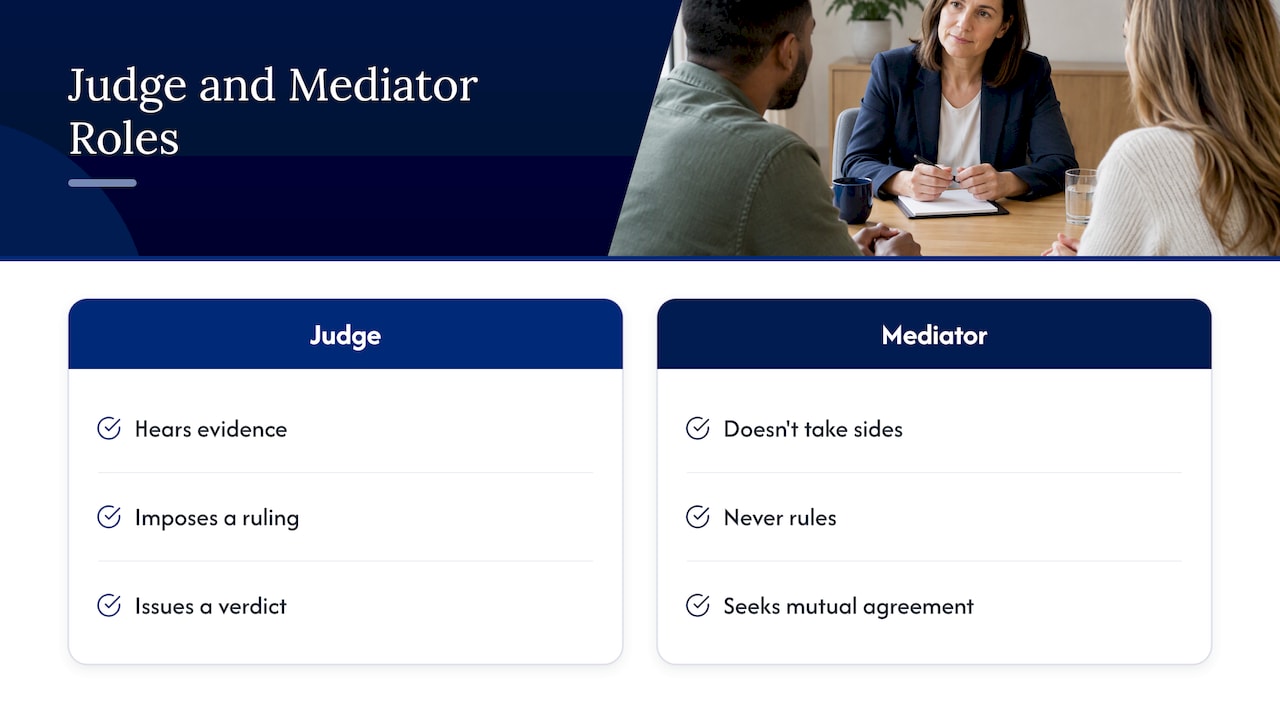
People often picture a mediator as a mini-judge. They are not. A judge hears evidence and imposes a ruling. A mediator never rules on anything. Ontario’s government guidance on family mediation says plainly that mediators do not take sides or make decisions.
That is also the answer to a question many people search: who wins in mediation? Nobody “wins” in the courtroom sense, because there is no verdict. The goal is an agreement both of you can live with. The same England and Wales judicial guide reports that 69% of cases resolve all or some issues through mediation, and it adds that mediation can improve communication and future relationships even when it does not settle everything.
Neutrality matters because trust depends on it. An international guide on resolving family conflicts from the ISS-SSI network explains that people open up when they see the mediator helping each person express their views without siding with anyone or taking over the decision.
How a mediator helps you communicate and reach agreement
The practical value of a mediator is usually less about legal technique and more about the conversation. Ontario’s guide says a mediator can help separating spouses communicate and reach agreements about support payments, property division, parenting time and decision-making responsibility for children.
The Law Society of England and Wales lists several things a mediator can do:
- identify the issues that need resolving
- help you develop options and parenting plans
- help you gather the financial information both sides need
- reality-test proposals, meaning ask whether they are workable
- bridge gaps in a negotiation
- record the outcome
Reality-testing is the part many couples find most useful. A proposal such as “the kids switch houses every three days” sounds fair until someone asks how it works with school pickup, two work schedules and a 40-minute commute. A good mediator asks those questions without judging either of you.
Mediation and children
Where children are involved, the mediator keeps the focus on their wellbeing. The model standards excerpt reproduced by the Hague Conference says parenting plans should protect parents’ and children’s physical safety and psychological wellbeing, and that mediators should discuss the child’s best interests and how to include the child’s voice.
The ISS-SSI guide adds that children may speak separately with a mediator or child psychologist, after which key points can be carefully shared with the parents. The aim is to include their perspective without making them decision-makers. If your main concern is how to support your kids through the split, our guide to parenting through divorce covers practical strategies.
What a mediator does not do
Knowing the limits protects you. A mediator does not:
- Give legal advice. Ontario’s guidance says a mediator does not take sides, make decisions or give legal advice, and does not replace a lawyer. It recommends independent legal advice before and throughout mediation and before signing an agreement.
- Make you settle. The 2025 Model Standards say parties may withdraw at any time and may accept or reject any proposal, and that the mediator must never pressure them into settlement.
- Provide therapy. The same standards state that mediation is not a substitute for independent legal advice or therapy.
- Fix the marriage. The Law Society notes that mediation is not counselling or reconciliation.
That last point deserves a closer look. Mediation deals with practical separation questions: where the children sleep, who keeps the house, how support is paid. If you are carrying grief, anger or confusion about whether the marriage is truly over, those feelings need a different kind of support. For a sense of how the two kinds of help differ, see this comparison of spiritual coaching versus therapy, or our own page on coaching vs therapy.
What happens in a typical mediation process
The exact format varies by state, provider and court. The England and Wales judicial guide outlines a sequence that is broadly recognizable elsewhere:
- Individual intake meetings. In England and Wales these are called MIAMs. Each person meets the mediator alone so the mediator can assess whether mediation is suitable and safe.
- Information gathering. Both of you share finances, schedules and priorities.
- Developing and testing options. You brainstorm, compare and refine.
- Recording proposals. The mediator writes up what you have tentatively agreed.
- Legal review. Lawyers can advise you, work alongside the mediation and advise on the proposals. Anything unresolved may go back to court.
The Law Society also describes two adaptations. In shuttle mediation, the mediator moves between you instead of putting you in the same room. In solicitor-supported mediation, your lawyer attends or supports you. Both can help when face-to-face talks are too tense to be productive.
If you want the same kind of walk-through from a conflict-resolution angle, our step-by-step conflict mediation process and family dispute resolution guide go deeper.
What to avoid during divorce mediation
The Law Society’s guidance is direct: mediation is not a place to rehearse old arguments, score points or place blame. It asks participants to be ready to listen, to forgo blame and to focus on the future. In practice, that means:
- Don’t relitigate the marriage. “You always…” statements stall the session. Say what you need going forward.
- Don’t hold back finances. Agreements built on partial information tend to unravel. Bring complete documents.
- Don’t treat the mediator as an ally. They are neutral by design. Winning them over wastes time.
- Don’t sign on the spot. Take a draft to your own lawyer first.
- Don’t use the children as messengers or leverage. The point of the process is to protect them from the conflict.
- Don’t agree to something just to end the discomfort. You will not be forced into decisions, and you can pause.
When mediation may not be suitable or safe
Mediation is not right for every family. The 2025 Model Standards say so explicitly, and say it should not proceed if a party cannot or will not take part meaningfully.
The Family Mediation Council in England and Wales updated its MIAM guidance in July 2024. It says suitability assessment should examine domestic abuse, coercive control, intimidation, harassment, addiction, mental capacity, emotional readiness and the risk of retraumatization. Mediation may be unsuitable if someone cannot disagree with or challenge their former partner without fear.
The US Model Standards go further on screening. They call for separate, confidential assessment of barriers including domestic abuse, child maltreatment, substance use, language and literacy barriers, cultural factors, financial pressure and technology access. Where barriers cannot be remedied, the mediator should explore safeguards or other dispute-resolution options.
If any of this describes your situation, tell the mediator privately at intake, not in front of your spouse. If you are in danger, contact the National Domestic Violence Hotline or local emergency services, and speak to a family lawyer about protective options before agreeing to any joint session. Safeguards such as separate rooms, shuttle mediation or support people may be possible, but that is for you and a trained professional to decide together.
How to prepare for your first session
Preparation is the cheapest way to improve the outcome.
- List your priorities. Separate what you must have from what you would like. Parenting schedules and housing often rank higher than furniture.
- Gather your documents. Pay stubs, tax returns, bank and retirement statements, mortgage and debt records.
- Book a legal consultation first. Know your rights so you can judge proposals. Ontario’s guidance, written for Canada, recommends independent advice before and throughout mediation, and the principle holds anywhere.
- Draft a rough parenting calendar. Include school, activities and work.
- Plan how you will stay regulated. Decide in advance what you will do if the conversation heats up: ask for a break, take a breath, write the point down for later.
- Line up emotional support. A therapist or counselor can carry what the mediator is not there to carry.
Perspective: why emotional readiness changes mediation
In our work with couples and families, we see the same pattern again and again. The legal and financial questions in a divorce are rarely the hardest part. The hardest part is that two people who are hurt, angry or exhausted have to make clear decisions together.
A mediator can structure that conversation. What a mediator is not there to do is help you manage your anger, process an affair or work out whether you want the marriage to end. We think those things matter, because unmanaged conflict leaks into the mediation room. Someone who arrives still raw often spends the session defending their pride instead of protecting their interests.
That is why we encourage people to treat mediation and counseling as complementary. Mediation settles the practical terms. Counseling, anger management or coaching helps you arrive calm enough to use mediation well, and helps you live with the agreement afterward. Our approach is built on practical, evidence-based tools delivered with clinical care, and it is available in person in the Carolinas and Florida and online.
If you are heading into mediation, ask yourself one question: am I ready to listen? If the honest answer is not yet, that is a reason to get support first, not a reason to delay your life.
Carlos
Getting support before and during mediation
We offer several ways to prepare for the emotional side of separation:
- Couples sessions at $175 per hour, for partners who want help communicating respectfully, whether they are working to stay together or to separate with less damage.
- Anger management classes online, starting at $24.99 for a one-hour class, for the moments when tension takes over.
- Individual counseling for men, women and teens, including support during divorce. Pricing is not published online, so reach out through the site for details.

If you are still unsure about the marriage itself, our page on marriage counseling in Charlotte, NC explains how we work. You can also read more on the role of mediation in families and what family mediation is.
FAQ
What role does a mediator play in a divorce?
A mediator is a neutral facilitator who helps you and your spouse identify issues, communicate, explore options and record agreements about children, money, property and housing. They do not decide anything. You and your spouse make the decisions, and you can accept or reject any proposal.
Can a divorce mediator give legal advice?
No. A mediator does not give legal advice and does not replace a lawyer. Ontario’s government guidance recommends getting independent legal advice before and throughout mediation and before you sign an agreement. In the US, ask a family lawyer in your state to review any draft.
What should I not do during divorce mediation?
Avoid rehearsing old arguments, scoring points and placing blame. Do not hide financial information, and do not sign anything before your own lawyer has seen it. Come ready to listen and to focus on the future, and remember you will not be forced into any decision.
Who usually wins in divorce mediation?
There is no winner, because the mediator does not rule. The aim is a shared agreement. The England and Wales judicial guide reports that 69% of cases resolve all or some issues through mediation, and that the process can also improve communication afterward.
Is mediation right if my spouse has been abusive or controlling?
Often it is not, at least not in a joint session. Professional guidance says mediators should screen separately and confidentially for abuse and fear, and may suspend mediation or consider safeguards or other options. Speak privately with the mediator and a family lawyer before you agree to anything.
Sources
- Model Standards for Family and Divorce Mediation (AFCC, 2025)
- Guide to Family Mediation for the Courts 2024 (UK Judiciary)
- Family mediation (Ontario.ca)
- Mediation (The Law Society)
- Resolving Family Conflicts: A Guide to International Family Mediation (ISS-SSI)
- Mediation and Relocation (HCCH)
- Good Practice Guidance for Mediation Information and Assessment Meetings (Family Mediation Council, July 2024)