
Stop Breathe Reflect Choose: Clinician Tools for Teen Self Regulation

Self regulation for teens means learning to manage thoughts, feelings, and actions on purpose instead of on autopilot, and research on youth interventions shows it is a skill that improves with practice and the right support, not a fixed trait teens either have or lack. This guide walks through what that skill actually involves, quick tools for hard moments, and the caregiver’s role in building it. Teens looking for something to try right now can jump to the in-the-moment section; caregivers wanting the coaching side can skip to co-regulation.
TL;DR:
- Self-regulation skills are trainable through structured practice, with the strongest evidence supporting curriculum-based programs that include repetition and skill-building.
- During emotional spikes, teens benefit from a simple sequence: stop, breathe, reflect, and choose, supported by sensory strategies and good sleep hygiene.
- Caregivers can aid regulation by managing their own stress, labeling feelings, offering choices, and supporting consistent routines without overcontrolling.
- Regular sleep routines and targeted digital interventions can improve teens’ emotional stability, making regulation tools more effective.
- Effective intervention often involves a combination of therapy, skill practice, and caregiver support, with progress varying based on consistency and individual circumstances.
Table of Contents
- What self-regulation actually means for teens
- Core skills every teen can practice
- What to do in the middle of a hard moment
- Building the skill over time, including better sleep
- How caregivers support regulation without taking it over
- What the research says actually works
- How this shows up in therapy and classes
- A clinician’s honest take on pacing and expectations
- Where to find support for your teen
- Sources
- FAQ
What self-regulation actually means for teens
Self-regulation has three working parts. Cognitive regulation is the ability to shift attention, hold a plan in mind, and resist a distracting thought. Emotional regulation is noticing a feeling, naming it, and adjusting its intensity so it does not take over. Behavioral regulation is the follow-through: stopping an impulsive action or choosing a different one even when the urge to react is strong.
Adolescence makes this harder before it makes it easier. The brain’s reward system, which drives the pull toward excitement, social approval, and risk, matures earlier than the prefrontal cortex, which handles planning and impulse control. That gap is why a teenager can understand a rule perfectly well and still break it in the heat of the moment. It is not a character flaw. It is a timing mismatch that closes gradually through the teenage years and into the early twenties.
A useful clinical sequence for handling that mismatch comes from the Regulate, Relate, Reason framework. It holds that a teen who is emotionally flooded cannot access logic yet, so the order matters:
- Regulate first: calm the body and nervous system before anything else.
- Relate second: connect with the teen so they feel heard, not managed.
- Reason last: problem-solve or discuss consequences only once the first two steps are done.
Skipping straight to reasoning with a dysregulated teen usually backfires, because the part of the brain needed to process logic is temporarily offline. Recognizing which domain, cognitive, emotional, or behavioral, is misfiring in a given moment helps a teen or caregiver pick the right tool instead of guessing.
Core skills every teen can practice
Researchers studying emotion regulation describe several families of strategy, and they do not all work at the same point in an emotional reaction. Some intervene early, before a feeling builds momentum. Others work only after the emotion has already taken hold.
Early-stage strategies change the setup before the reaction starts:
- Situation selection: choosing to skip a hangout that reliably turns into an argument.
- Situation modification: muting a group chat that spikes anxiety before a test.
- Attentional deployment: shifting focus away from a trigger, like looking away from a phone notification during homework.
Later-stage strategies work once a feeling is already active:
- Cognitive change: reframing a thought, such as turning “everyone is judging me” into “I’m nervous, and that’s normal.”
- Response modulation: managing the physical or behavioral output of an emotion once it has already surfaced, like slowing your breathing during anger.
Field research on high school and college students found that early-stage strategies, situation selection and modification in particular, produced better goal attainment than waiting until the last stage and relying on willpower alone. That is a meaningful practical point: teaching a teen to redesign their environment (put the phone in another room, avoid a known trigger, plan a study spot) tends to work better than teaching them to white-knuckle through a temptation after it hits.
On top of the process model, five skill categories show up again and again in teen-focused programs:
- Mindfulness practice: short breathing or body-scan exercises that build the habit of noticing a feeling before reacting to it.
- Cognitive behavioral thought work: catching a distorted thought and testing it against evidence.
- Problem-solving: breaking a stressful situation into steps instead of reacting to the whole thing at once.
- Planning and forecasting: anticipating a tough moment (a big game, a family gathering) and deciding a response ahead of time.
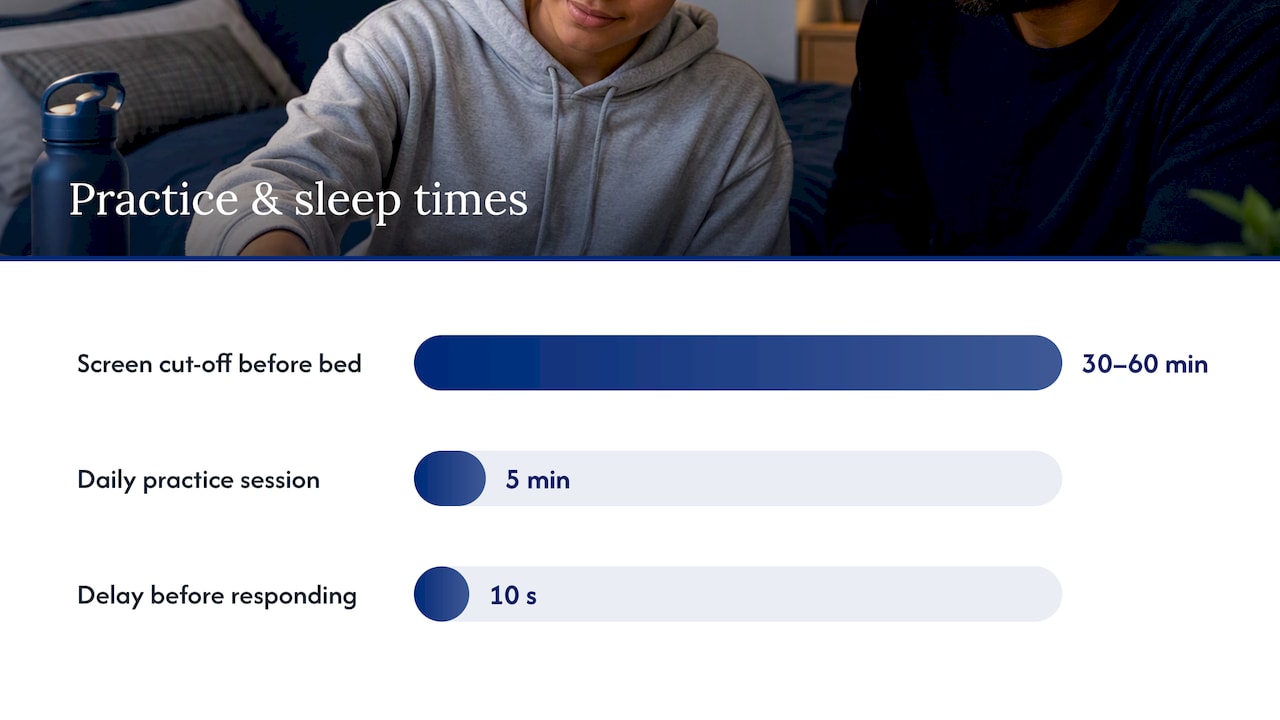
- Delay tactics: building in a pause, even ten seconds, between an urge and an action.
None of these need to happen all the time. Mindfulness and planning work best as daily habits, while cognitive reframing and delay tactics are most useful in the moment a feeling spikes.
Pro Tip: Pick one strategy from the early-stage list and one from the later-stage list to practice this week, rather than trying to overhaul every habit at once.
What to do in the middle of a hard moment
When a feeling hits hard and fast, a teen does not need a philosophy. They need a sequence they can run on autopilot, because the thinking brain is partly offline.
- Stop. Physically pause: put down the phone, step back from the conversation, or just freeze for a second.
- Breathe. Slow, deliberate breathing signals safety to the nervous system. Two options that are easy to remember under stress: 4-7-8 breathing (inhale for four counts, hold for seven, exhale for eight) and box breathing (four counts in, four counts hold, four counts out, four counts hold).
- Reflect. Ask one question: “What am I actually feeling, and what do I need right now?”
- Choose. Pick a response on purpose instead of reacting automatically, even if that response is simply “I need five more minutes before I respond.”
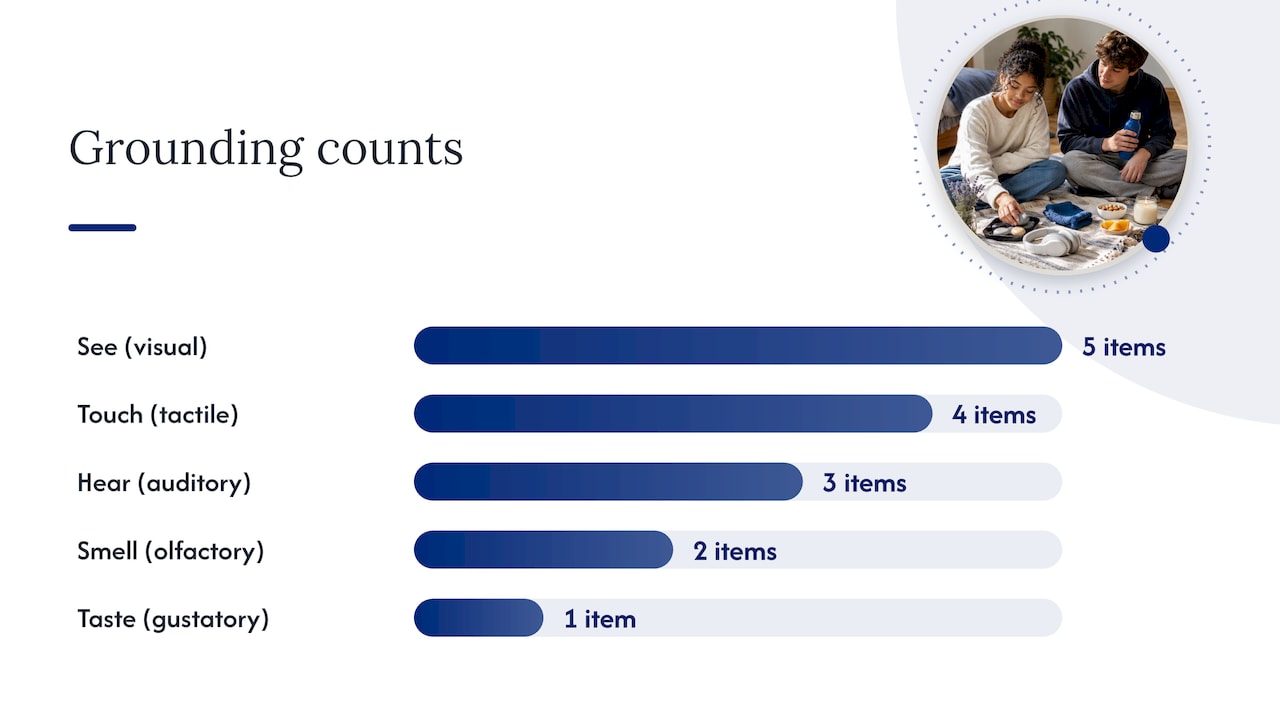
Grounding techniques help when a feeling is more anxious or overwhelming than angry. The classic version, naming five things you can see, four you can touch, three you can hear, two you can smell, and one you can taste, works by redirecting attention to the present moment instead of the spiral.
Sensory input can do similar work for teens whose bodies hold tension physically. Heavy work like carrying something weighted, pushing against a wall, or doing a set of push-ups can discharge physical agitation. Cold water on the wrists or face triggers a reflex that slows heart rate. Practical caregiver-facing examples of these sensory interventions show how simple these tools can be to set up at home, and sensory strategies built around heavy work offer additional options for teens who regulate better through movement and touch than through talking.
Sleep quality and daily emotional stability are closely linked in adolescents, with sleep disruption tied to worse emotional reactivity and weaker regulation capacity. (Systematic review on sleep and adolescent emotion) A teen running on five hours of sleep will find every one of these tools harder to use, which is part of why the next section treats sleep as a regulation skill in its own right.
A safe exit matters too. Leaving a room, a conversation, or a situation is not avoidance when the goal is to prevent escalation. It only becomes a problem if it replaces coming back to resolve things later. If a teen’s reaction includes thoughts of self-harm, harming someone else, or feeling unable to calm down no matter what they try, that is the point to bring in an adult or a professional rather than working through it alone.
Building the skill over time, including better sleep
In-the-moment tools stop a spiral. Daily routines are what make those tools available in the first place, because a well-rested, practiced brain has more capacity to regulate than an exhausted one.
Sleep deserves top billing here. A systematic review of digital sleep interventions for adolescents covering 18 randomized controlled trials found that digital cognitive behavioral therapy for insomnia significantly reduced insomnia severity and produced modest improvements in sleep quality, with cognitive restructuring and mindfulness identified as active ingredients. Better sleep is not a side note to emotional stability. It is a foundation for it.
Practical sleep hygiene steps that support regulation:
- Keep a consistent wake time, even on weekends, since irregular schedules disrupt the body’s internal clock.
- Cut screens 30 to 60 minutes before bed, replacing scrolling with a low-stimulation wind-down activity.
- Use the bed only for sleep, so the brain associates it with rest rather than scrolling or homework.
- Try a short mindfulness or breathing exercise at lights-out to lower physical arousal before sleep.
A simple weekly practice plan turns these ideas into a habit instead of a one-time effort:
| Day | Focus | Practice (5 minutes) |
|---|---|---|
| Monday | Mindfulness | Guided breathing or body scan |
| Tuesday | Cognitive reframing | Write down one distorted thought and challenge it |
| Wednesday | Planning | Identify one upcoming stressful event and plan a response |
| Thursday | Sleep hygiene | Screen-free wind-down before bed |
| Friday | Delay practice | Wait ten seconds before responding to a trigger |
| Saturday | Movement | Exercise or heavy-work activity |
| Sunday | Review | Mood checklist and reflection on the week |
Tracking does not need to be complicated. A short mood checklist (rate the day one to five, note the trigger if there was one) or a one-line practice log kept in a phone notes app is enough to notice patterns over a few weeks. If a particular exercise is not landing, swap it. The goal is consistency, not a perfect routine. More detailed exercises for home, school, and clinical settings are collected in these quick emotional regulation activities, and a broader look at how self-regulation connects to social and academic life is available in this guide to self-regulation and emotional intelligence.
How caregivers support regulation without taking it over
Co-regulation is the caregiving side of self-regulation: a calmer adult nervous system helps steady a teen’s, especially in the middle of a big reaction. It is not the same as controlling the teen’s behavior, and the distinction matters more as kids move into adolescence and need more room to practice on their own.
A few working principles:
- Regulate yourself first. A caregiver who is yelling cannot calm a teen who is yelling. Guidance on co-regulation for children and teens points out that shifting from direct control to supportive scaffolding starts with the adult managing their own reactivity.
- Label the feeling before addressing the behavior. “You seem really frustrated right now” lands better than “stop slamming doors.”
- Offer choices instead of ultimatums. “Do you want five minutes alone or do you want to talk it out now?” keeps some control with the teen.
- Scaffold, then step back. Help with the tool the first few times, then let the teen run it solo.
A few sample scripts help translate the principles into real moments. During a conflict: “I can see this matters a lot to you. Let’s both take a few minutes, then come back to it.” During a meltdown: “I’m right here. Take your time.” During school stress: “What’s the actual thing that’s stressing you out, and what’s one piece we can tackle tonight?”
What to avoid matters just as much as what to do. Punishing a teen for having an emotion, as opposed to addressing a specific behavior, teaches them to hide feelings rather than manage them. Overcontrol, jumping in to solve every problem or forcing an apology before a teen is regulated, blocks the very practice that builds the skill. A systematic review of parent-child coregulation found that behavioral coregulation, like the scripts above, supports better self-regulation, but physiological synchrony (an adult and teen mirroring each other’s stress responses) can be maladaptive in high-risk households where the shared state is chronic stress rather than shared calm. Caregivers under significant strain of their own may need their own support to avoid passing that dysregulation on. Parent-facing scripts for a wider range of situations are collected in this parent guide to teen emotional regulation, and practical conflict scripts appear in this guide to conflict resolution for adolescents.
Pro Tip: If you notice you’re more reactive than your teen in a given conflict, that is the moment to pause the conversation rather than push through it.
Social influences outside the home shape this too. Research on maternal and peer emotion socialization found that supportive responses from parents and peers predicted better daily emotion regulation and lower negative affect in adolescent girls, while unsupportive responses from peers predicted less prosocial behavior. The people around a teen, not just the teen’s own skill set, shape how well regulation develops.
What the research says actually works
The evidence on teen self-regulation interventions is more encouraging than the topic’s reputation for being vague or unteachable might suggest. A systematic review and meta-analysis of universal self-regulation interventions for children and adolescents found a pooled effect size of 0.42 across 49 studies, indicating consistent improvement in self-regulation task performance. (PubMed systematic review) An effect of that size is a solid signal that these programs move the needle, not a marginal one.
The same review breaks down improvement rates by program type:
- Curriculum-based programs showed improvement in 76% of studies, the strongest showing of any category.
- Exercise-based and social/personal-skills programs each showed improvement in 67% of studies.
- Family-based programs showed improvement in 56% of studies.
- Mindfulness and yoga-based programs showed improvement in 50% of studies.
A separate meta-analytic review of emotion-regulation-focused interventions for adolescents, covering 41 studies, found small-to-moderate pooled effects (Hedge’s g in the range of roughly .19 to .29) and concluded that emotion regulation is a malleable target across both clinical and community samples. That means these skills respond to intervention whether a teen has a diagnosed condition or is simply a typically developing kid working on impulse control.
Practically, this points toward structured, repeated practice over a single pep talk. Curriculum-based programs, ones that teach a specific skill set across multiple sessions, have the strongest track record, and combining approaches (a curriculum with a family component, for instance) tends to outperform any single method alone. Teens who are highly reactive or who face more chronic stress at home may need a higher dose or more sessions to see the same gain a lower-risk teen gets from a shorter program.
The main limitation across this research is measurement inconsistency. Studies use different tools to define and measure “self-regulation,” and populations vary widely in age, risk level, and setting, which makes it hard to say a single program works best for every teen. The honest takeaway is that structured, sustained practice consistently beats one-off efforts, even if no single format is universally superior.
How this shows up in therapy and classes
Clinical work can translate these research categories into structured sessions rather than leaving teens and families to piece strategies together alone. Teen counseling draws on the cognitive, emotional, and behavioral framework described earlier, adapting it to a teen’s specific triggers and home environment. Anger management classes teach the same Stop-Breathe-Reflect-Choose sequence and delay tactics covered above, but with structured practice and feedback across multiple sessions rather than a single article read once. Family counseling can address the caregiver side directly, coaching parents on co-regulation scripts instead of leaving them to guess.
A typical arc looks like this:
- Assessment: identify which domain, cognitive, emotional, or behavioral, is driving the most difficulty.
- In-the-moment tools: teach and rehearse a small set of quick techniques the teen can use immediately.
- Skills practice: build daily or weekly routines around the techniques that fit the teen best.
- Caregiver coaching: align the adults in the household on scripts and scaffolding so the teen gets consistent support outside sessions.
This structure mirrors the curriculum-based and family-based approaches shown to work in the research above, delivered by a licensed clinician rather than assembled from scattered advice.
A clinician’s honest take on pacing and expectations
Progress on self-regulation is rarely a straight line, and that is normal, not a sign the approach is failing. A teen might handle a stressful week beautifully and then completely lose it over something small a few days later. The skill is building even when a single moment looks like a setback.
Autonomy matters more than it gets credit for. A teen who is handed a script to follow word for word will drop it the moment it feels imposed. A teen who helps choose which tool to try, breathing versus a sensory break versus a short walk, is far more likely to actually use it when it counts.
Watch for signs that go past ordinary teenage moodiness: reactions that consistently put the teen or others at risk, an inability to calm down even hours after a trigger, or emotional shutdown that interferes with school or relationships for weeks at a time. Those are reasonable moments to bring in a therapist rather than continuing to manage it solo at home.
— Carlos
Where to find support for your teen
Reading about self-regulation gets a family only so far. Mastering Conflict offers teen counseling and family counseling built around the exact skills covered here, plus anger management classes for teens who need structured, repeatable practice rather than another conversation about calming down.

- Anger management classes, including a 1 Hour Anger Management Class ($24.99), a 6 Hour Anger Management Class ($79), and an 8 Hour Anger Management Class ($85), available online.
- Group-format anger management programs, a 4-Hour Program ($149) or 8-Hour Program ($249), for a more structured, multi-session format.
- Family counseling to coach the adults in the household on co-regulation and consistent scripts at home.
Sessions may start with a short assessment to identify which skills matter most, followed by direct practice of relevant tools. Online options can make services accessible for families outside North and South Carolina and Florida, where in-person sessions may be available. To take the next step, book a session or browse available classes to find the format that fits your teen.
Sources
- Effectiveness of universal self-regulation-based interventions in children and adolescents: a systematic review and meta-analysis
- Active components in digital health interventions for sleep among adolescents: a systematic review and meta-analysis of randomized controlled trials
- Regulate, Relate, Reason — Think:Kids
FAQ
What are the 3 R’s of self-regulation?
The 3 R’s most often referenced in clinical settings come from the Regulate, Relate, Reason model: calm the body first, connect with the person second, and only then work through logic or problem-solving. Trying to reason with a teen before they are regulated usually does not work, since the brain cannot process logic well while it is flooded with stress.
What are the 5 stages of self-regulation?
Definitions vary across frameworks, but a common version breaks self-regulation into noticing a trigger, identifying the emotion, pausing before reacting, choosing a coping strategy, and evaluating how it went afterward. These stages roughly match the Stop-Breathe-Reflect-Choose sequence described earlier in this guide.
How long does it take for a teen to improve self-regulation skills?
There is no fixed timeline, since progress depends on consistency of practice and the intensity of support. Structured, curriculum-based programs tend to show the most reliable improvement over several sessions, based on the pooled effect sizes reported across nearly 50 studies of youth interventions.
When should a teen’s self-regulation struggles involve a professional?
Professional support makes sense when reactions consistently put the teen or others at risk, when a teen cannot calm down even hours after a trigger, or when emotional struggles are interfering with school or relationships over an extended period. Mastering Conflict offers teen counseling for exactly this kind of sustained, individualized support.
Can sleep really affect a teen’s ability to self-regulate?
Yes. A systematic review on sleep and adolescent emotion found that sleep disruption is tied to worse emotional reactivity and weaker regulation capacity, while a review of digital sleep interventions found that treatments like digital cognitive behavioral therapy for insomnia significantly reduced insomnia severity in teens.