
EAP vs Private Couples Therapy: When 3–8 Free Sessions Help

When this article talks about “eap marriage counseling,” it means one specific thing: private, fee-for-service couples therapy with a licensed clinician, in person or by telehealth, not a referral through an employer benefits program. If your relationship is stuck, the most useful next step is booking an assessment with a licensed couples therapist. There are therapy options built around this kind of evidence-based clinical work.
TL;DR:
- Waiting until resentment solidifies makes therapy more difficult and slower; early intervention during persistent negative cycles or trust breaches yields better results.
- Evidence-based methods like EFT and Gottman are most effective when both partners actively participate and commit to between-session work, with success rates around 50 to 60 percent.
- Private couples therapy involves a licensed clinician working with both partners to change interaction patterns, rebuild safety, and develop conflict repair skills, often taking several months for deep issues.
- EAP marriage counseling offers quick, free sessions suitable for minor stressors, but its caps and limited therapist choices often make it inadequate for complex or long-standing relationship problems.
- Confidentiality with employer-sponsored EAP is limited and may involve sharing usage data with HR, unlike private therapy, which maintains standard legal patient-therapist privilege.
Table of Contents
- What Private Marriage Counseling Actually Involves
- Who Benefits Most, and When to Start
- The Methods That Actually Move the Needle
- How to Choose a Therapist You’re Paying For
- Your First Sessions and a Realistic Timeline
- What EAP Marriage Counseling Means (and Why It’s Different)
- How EAP Counseling Access Actually Works
- Cost and Insurance: EAP Versus Paying Privately
- Where EAP Counseling Helps, and Where It Falls Short
- Privacy Questions You Should Ask Before Using an EAP
- Mastering Conflict’s Take on Doing This Work Right
- Ready to Book Your First Session?
- Sources
- FAQ
What Private Marriage Counseling Actually Involves
Private couples therapy is a paid clinical service, and the relationship itself is the client, not just one partner’s mood or the other’s habits. A licensed therapist works with both of you to identify what keeps breaking down and why the same fight keeps returning in a slightly different costume.
Most couples show up with a familiar cluster of problems:
- Repeated conflict over the same three or four topics
- Communication that shuts down into silence or escalates into yelling
- Infidelity, whether physical or emotional
- Lost intimacy or a mismatch in desire
- Parenting disagreements or financial friction
- A pursue-withdraw pattern, where one partner chases connection and the other retreats
The core goal is changing the interaction pattern itself, not just resolving whatever argument brought you to that week. Therapists work to rebuild emotional safety, then teach the repair skills that let couples recover from conflict faster on their own.
Who Benefits Most, and When to Start
Timing matters more than most couples assume. Waiting until resentment has calcified makes the work harder and slower.
- Persistent negative cycles. If the same fight resurfaces weekly with no resolution, that’s a clear signal.
- Lost intimacy or connection. Feeling like roommates rather than partners is a common and legitimate reason to seek help.
- A breach of trust. Infidelity, financial secrets, or broken promises often need structured support to work through.
- One partner is hesitant. Individual sessions can build skills and sometimes bridge to joint work when a spouse isn’t ready to sit in a room together yet.
- Life transitions. Premarital counseling, a move, a new baby, or a career change are all preventive moments where a few sessions can head off bigger problems later.
Couples therapy isn’t only for crises. Some of the most effective work happens before things feel unbearable.
The Methods That Actually Move the Needle
Three approaches dominate the field, and knowing the difference helps you ask better questions during a consult.
Emotionally Focused Therapy (EFT) treats conflict as a symptom of insecure attachment. The therapist helps each partner recognize the vulnerable emotion underneath the anger, usually fear of disconnection, and helps couples reach for each other instead of pulling away.
The Gottman Method is built on decades of observational research into what predicts divorce. It trains couples to recognize the “Four Horsemen,” criticism, contempt, defensiveness, and stonewalling, and replace them with specific repair behaviors.
Cognitive behavioral and integrative behavioral approaches (CBT/IBCT) focus on changing behavior patterns directly while also building acceptance of differences that may never fully resolve.
Quick fact: EFT has strong trial support and typically runs about 8 to 20 sessions across many protocols, while broader clinical summaries put success rates around 50 to 60 percent, varying by issue severity and how engaged both partners are.
That range matters. Therapy is not a guarantee, and it works best when both partners actually do the between-session work, not just show up. Earlier intervention tends to produce better outcomes than waiting until a relationship is in freefall. A few practical communication exercises between sessions often accelerate that progress.
- EFT: best for couples stuck in emotional disconnection or repeated hurt
- Gottman: best for couples who want concrete, research-backed conflict skills
- CBT/IBCT: best for couples focused on specific behavior change alongside acceptance
How to Choose a Therapist You’re Paying For
You’re the buyer here, so vet accordingly. Credentials to check first: LMFT (Licensed Marriage and Family Therapist), LCSW (Licensed Clinical Social Worker), a licensed psychologist, or a CMHC (Clinical Mental Health Counselor). Beyond the license, ask whether they’ve trained specifically in EFT, Gottman, or IBCT, since general talk therapy training doesn’t automatically translate to couples work.
Bring these questions to a first consult:
- “What approach do you use for couples like us?”
- “How many couples with our specific issue have you treated?”
- “What’s your typical timeline and fee per session?”
- “Do you offer telehealth or a sliding scale?”
- “How do you handle it if one partner is reluctant to fully participate?”
Then run through logistics: session length, how often you’ll meet, the cancellation and late policy, whether they provide receipts for insurance reimbursement (most private therapists are out-of-network), a plan for safety if things get heated at home, and whether they have real experience with your cultural or religious background. A quick read of common counseling questions couples ask before booking can help you walk in prepared.
Pro Tip: Ask for a specific number, not a vague answer, when you ask how many similar cases they’ve treated. A therapist who can say “dozens” versus one who hedges tells you a lot about their actual couples-specific caseload.
Your First Sessions and a Realistic Timeline
The first meeting is rarely just venting. Most therapists start with intake forms, relationship history, and structured questionnaires, sometimes including Gottman-style assessments that map out where the relationship is strong and where it’s under stress.
- Assessment and goal-setting. Expect a longer first session, often paired with brief individual sessions so each partner can speak freely about history and expectations.
- Safety and regulation. Early sessions focus on calming escalation before tackling the hard topics. A good therapist won’t let a session turn into an unsupervised fight.
- Connection-building. Once things feel safer, the work shifts to rebuilding emotional access, learning to hear the vulnerability behind the complaint.
- Skill rehearsal and problem-solving. Couples practice new communication patterns in-session, then take them home.
Short-term focused work might run just a handful of sessions for a specific issue. Deeper pattern change, especially after infidelity or years of built-up resentment, often takes several months. Watch for early progress markers: fewer full-blown blowups, faster recovery after conflict, and a willingness to actually use the communication skills practiced in session.
What EAP Marriage Counseling Means (and Why It’s Different)
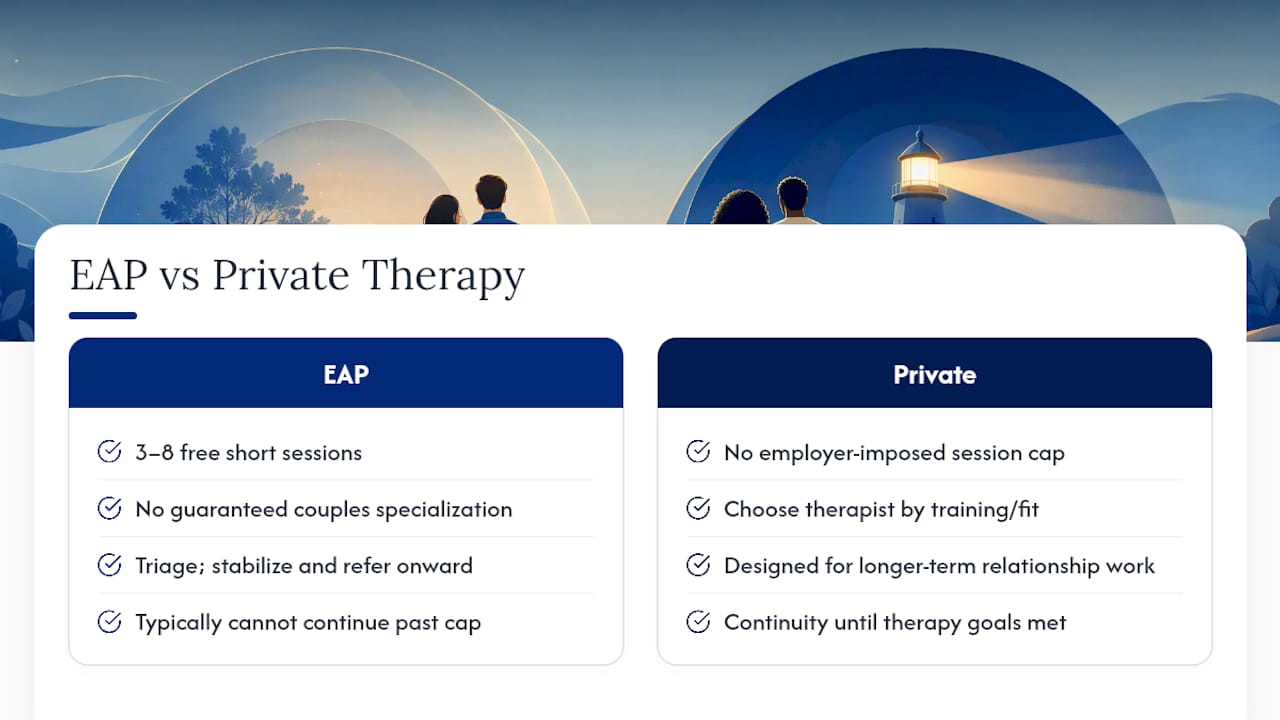
An Employee Assistance Program, or EAP, is a benefit some employers offer that includes a limited number of free, short-term counseling sessions, often three to eight, through a third-party provider network. When people search for “EAP marriage counseling,” they’re usually asking about this employer-sponsored benefit specifically.
EAP counseling exists to stabilize an immediate problem and refer you onward, not to provide long-term relationship work. The counselor you’re matched with may or may not specialize in couples work, may not use EFT or Gottman training, and typically can’t see you past the session cap. It’s a triage service, closer to urgent care than to ongoing treatment.
Private couples therapy is different in structure and intent. You choose your therapist based on their training and fit for your specific issues, you’re not capped at a handful of sessions dictated by a benefits administrator, and the clinician’s only obligation is to you and your relationship, not to an employer’s contracted network. If your situation is complex, chronic, or involves something like infidelity or entrenched resentment, the short runway of an EAP benefit usually isn’t enough runway to do the deeper work outlined earlier in this article.
How EAP Counseling Access Actually Works
If your employer offers an EAP, it typically shows up buried in your benefits packet, HR portal, or a small card in new-hire paperwork with a phone number and a web login. Access almost always starts with a call or online request to the EAP administrator, who then matches you with a counselor from their contracted network based on availability, not necessarily fit.
Most programs cap sessions per issue, per year, commonly somewhere in the three-to-eight range depending on the employer’s contract. You’ll usually complete a brief intake over the phone before your first appointment, and scheduling is often faster than typical private practice waitlists because these networks are built for quick turnaround.
The catch is choice. You generally can’t request a specific therapist or specialty the way you can when booking private therapy, and if the assigned counselor isn’t a strong match for couples work, your options within the program are limited. Once the covered sessions run out, the EAP’s usual next step is a referral out to private practice, which is often where couples land anyway once they realize they want ongoing, chosen care rather than a capped benefit.
Cost and Insurance: EAP Versus Paying Privately
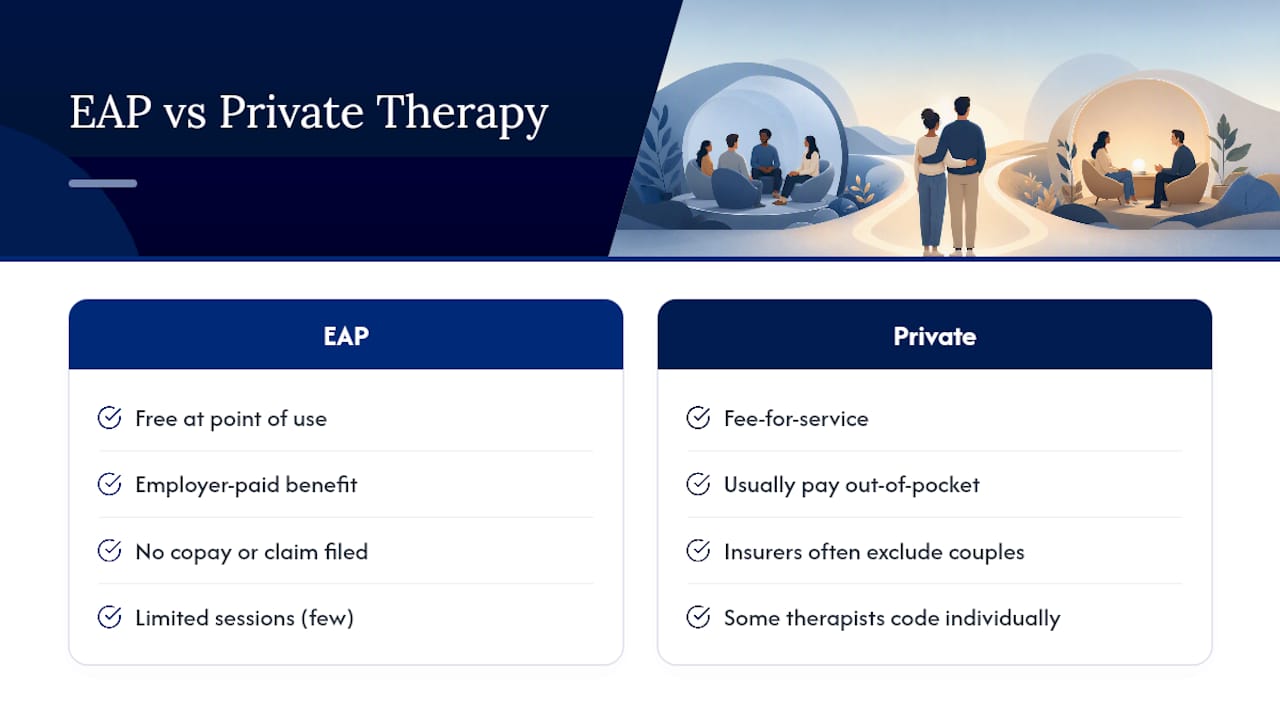
EAP sessions are free to the employee at the point of use. The employer has already paid for the benefit as part of a broader contract, so there’s no copay and no claim filed on your end. That’s the single biggest practical difference from private therapy.
Private couples therapy is fee-for-service, and here’s the detail many couples don’t realize going in: most health insurance plans don’t cover couples or marriage counseling the way they cover individual mental health treatment, because “relationship” isn’t a diagnosable condition insurers reimburse against. Some therapists code sessions under an individual diagnosis to allow partial reimbursement, but that’s inconsistent and worth asking about directly before you book. Many private practices, including therapists trained in the approaches covered earlier in this piece, offer sliding-scale rates or provide superbills so you can seek out-of-network reimbursement yourself.
The real cost comparison isn’t just dollars per session. It’s dollars per session multiplied by how many sessions you’ll actually get. An EAP’s few free sessions might be enough for a short-term communication tune-up. Deeper work, the kind EFT and Gottman protocols are built around, generally needs more room to run than most EAP caps allow, which usually means paying privately once the free sessions end anyway.
Where EAP Counseling Helps, and Where It Falls Short
The genuine strength of EAP marriage counseling is speed and cost. Zero out-of-pocket expense and fast scheduling make it a reasonable first stop for a couple in mild distress who just needs a few sessions to break a bad habit or navigate a specific, contained stressor like a recent move or job change.
The limitations show up quickly for anything more complex. Session caps mean you may just be building momentum when the benefit runs out. You typically can’t choose a therapist based on specialized training in EFT, Gottman, or IBCT, so the fit can be a coin flip. And because EAP counselors work within a referral network built for breadth rather than depth, couples dealing with infidelity, long-standing resentment, or a partner who’s ambivalent about the relationship itself often find the format too shallow and too short.
Think of an EAP benefit as a bridge, not a destination. It’s a reasonable way to test the waters of counseling at no cost, but couples with real structural problems usually need to graduate to a therapist they’ve chosen and can stay with for as long as the work requires.
Privacy Questions You Should Ask Before Using an EAP
Confidentiality is the concern that trips up more couples than any other EAP question, and it’s a fair one. Most EAPs are technically confidential between you and the counselor, meaning your employer doesn’t see session content. But the program itself sits inside an HR-adjacent system, and some employees worry, reasonably, about whether usage data (not content, but the fact that services were used) ever surfaces in aggregate reporting to the employer.
Ask directly, before your first session, exactly what the EAP administrator reports back to your employer, and get that answer in writing if you can. Policies vary by provider and by employer contract, and vague reassurance isn’t the same as a documented answer.
Private therapy sidesteps this concern almost entirely. There’s no employer in the loop, no third-party network administering your care, and confidentiality runs under standard clinician-patient privilege with no corporate intermediary. For couples working through something sensitive, infidelity, a health diagnosis, immigration stress, that separation from workplace systems is often worth the added cost on its own.
Mastering Conflict’s Take on Doing This Work Right
Couples therapy is not a script you run once and check off. It’s ongoing clinical work, and some practices approach it that way, offering couples therapy alongside anger management and family counseling under one clinical roof.
What sets thoughtful practices apart isn’t just credentials on a wall. It’s whether the clinician can meet couples where they actually live, culturally, logistically, and emotionally. Some providers offer culturally responsive services alongside standard couples work, plus online and in-person formats, because insisting on one format for every couple ignores how differently people actually access care.
One thing worth doing before any first session, regardless of who you book with: write down one or two shared goals with your partner beforehand. Walking in with “we want to stop the Sunday-night fight about money” gives a therapist something concrete to build a plan around instead of an hour of general venting.
— Carlos
Ready to Book Your First Session?
If the patterns described above sound familiar, the fastest way out of them is working with someone trained specifically in couples work, not a general therapist and not a capped benefit program. Licensed couples therapy is available online and in person, using evidence-based approaches like EFT, Gottman, and CBT-based methods matched to what your relationship needs.
An initial assessment typically covers your relationship history, the specific patterns bringing you in, and a first pass at shared goals, the same intake structure described earlier, so you leave that first session with an actual plan rather than just a scheduled follow-up. Mastering Conflict also supports clinicians seeking supervision and offers guidance if you’re weighing coaching versus therapy for your situation. If cost is a concern, ask directly about sliding-scale availability when you reach out to providers.
The next step is simple: visit Mastering Conflict’s clinical services page and schedule your assessment.
Sources
- Could couples therapy be right for you? – Harvard Health
- Couples Therapy: How It Works, What to Expect, and When to Go (2026) | Simply Psychology
- How Marriage Counseling Can Save Your Relationship, According to Therapists – Verywell Mind
- What to Expect in Couples Therapy: A Session-by-Session Guide From a Therapist Who’s Been in the Room for 16 Years – Empathi
- What Actually Happens in Couples Therapy? – The Relationship Therapy Center
FAQ
Does Insurance Cover Private Couples Therapy?
Most health plans don’t cover couples counseling directly since relationship distress isn’t a billable individual diagnosis, though some therapists provide superbills for partial out-of-network reimbursement.
What if Only One Partner Wants to Go to Therapy?
Individual sessions can build skills and sometimes create a bridge to joint work later, so a reluctant partner isn’t necessarily a dead end.
How Long Does Counseling Take After Infidelity?
There’s no fixed number, but rebuilding trust after infidelity generally takes longer than a standard 8 to 20 session EFT protocol built for other issues, often stretching into many months of consistent work.
Can Therapy Guarantee We’ll Stay Together?
No credible therapist promises a specific outcome; clinical summaries put general success rates around 50 to 60 percent, and results depend heavily on both partners’ engagement.
Is EAP Marriage Counseling the Same as Private Therapy?
No. EAP counseling is a capped, employer-sponsored benefit meant for short-term stabilization, while private therapy like the services Mastering Conflict offers gives you a chosen therapist and no session limit dictated by a benefits network.