
Emotional Control: Practical Strategies That Actually Work

TL;DR:
- Emotional control involves managing responses rather than suppressing feelings, which often worsens internal distress. Developing skills like reappraisal, acceptance, and labeling emotions improves emotional regulation and relationship satisfaction over time. Consistent practice during calm moments strengthens these habits for better responses under stress.
Most people think emotional control means keeping a straight face when you’re furious, or pushing feelings down until they disappear. That instinct feels logical. But research tells a different story. Emotional control, done right, isn’t about suppressing what you feel. It’s about managing how you respond. Emotion dysregulation is linked with mental illness and strained relationships, which means getting this right matters more than most people realize. This guide breaks down what emotional regulation actually is, why suppression backfires, and which techniques work when anger, conflict, or parenting pressure hit hardest.
Table of Contents
- Key takeaways
- What emotional control really means
- Why suppression makes things worse
- Emotional regulation techniques that work
- Common pitfalls in emotional control
- Building sustainable emotional regulation habits
- My perspective on emotional control
- Ready to go deeper with real support?
- FAQ
Key takeaways
| Point | Details |
|---|---|
| Suppression backfires | Hiding emotions worsens your internal experience, even when you appear calm on the outside. |
| Regulation, not elimination | The goal is to change how you respond to emotions, not to erase them entirely. |
| Skill timing matters | Practice regulation techniques during calm moments so they’re available when stress peaks. |
| Naming emotions helps | Labeling what you feel precisely reduces brain reactivity and supports better decisions. |
| Support accelerates growth | Therapy, coaching, and structured programs can fast-track emotional regulation skill-building. |
What emotional control really means
Here’s a distinction most people never get clearly explained: emotional control and emotion suppression are not the same thing. Not even close.
Emotion regulation involves influencing which emotions arise, their timing, and how you experience and express them. It focuses on reducing intensity or shifting direction, not erasing the emotion altogether. Emotional control, in the truest sense, is the capacity to manage your emotional responses so your behavior stays aligned with your goals and values.
Suppression, by contrast, is the attempt to push down or hide what you’re feeling. You can usually pull it off for a few minutes. The problem is what happens underneath.
The table below shows the key differences:
| Approach | What it does | Long-term outcome |
|---|---|---|
| Suppression | Masks the emotion externally | Increased internal distress, worse relationships |
| Regulation | Shifts how you process the emotion | Reduced intensity, better decision-making |
| Acceptance | Acknowledges without judgment | Lower reactivity, greater emotional flexibility |
| Reappraisal | Reframes the meaning of a situation | More positive affect, improved resilience |
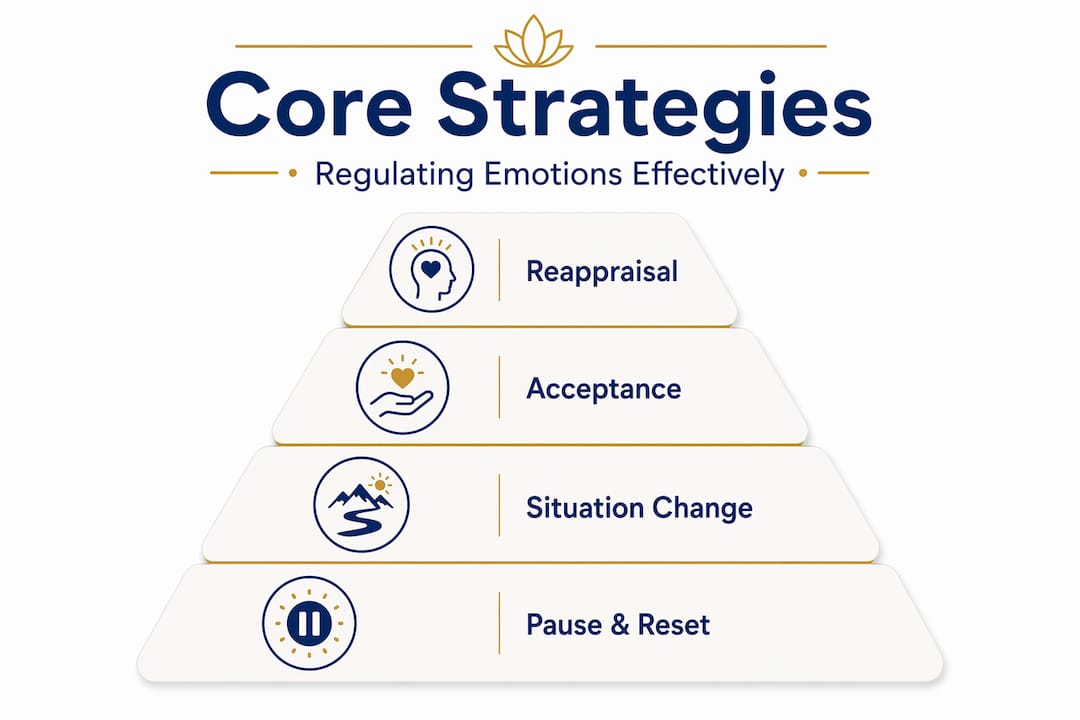
Four core strategies sit at the heart of emotion regulation science: reappraisal, acceptance, situation modification, and attentional deployment. Reappraisal means changing your interpretation of what’s happening. Acceptance means allowing an emotion to exist without fighting it. Situation modification means changing the circumstances that trigger you when possible. Attentional deployment means choosing where to direct your focus.
Pro Tip: Emotional self regulation is a skill, not a personality trait. You can get better at it with deliberate practice, regardless of how reactive you’ve been in the past.
Why suppression makes things worse
The science on suppression is clear, and it’s not encouraging for anyone who relies on “just keeping it together.”
Gross and John’s landmark 2003 research on suppression found that suppressing emotional expression is linked to experiencing more negative emotions internally, not fewer. You may look composed to everyone around you. Inside, the emotional intensity is climbing.
The neurological picture makes this even clearer. Stress already impairs prefrontal cortex function, the part of your brain responsible for rational thinking and decision-making. When you layer suppression on top of that, you double the cognitive load. You’re now managing the stressful situation and actively working to hide your reaction to it. That’s a recipe for poor judgment at the exact moment you need it most.
“The goal isn’t to prevent emotions but to change how you respond. Suppression worsens internal experience despite outward calm.”
Habitual suppression carries relationship costs too. People who regularly suppress emotions report lower satisfaction in their closest relationships. They’re harder to read, harder to connect with, and often feel misunderstood. Over time, repeated suppression becomes automatic, especially in high-pressure roles like parenting or leadership, making it progressively harder to change without conscious effort and often without outside support.
The takeaway: outward composure purchased through suppression is expensive. You’re paying for it with your mental health, your relationships, and your ability to think clearly when it counts.
Emotional regulation techniques that work
The good news is that effective emotional regulation techniques are learnable, practical, and adaptable to real-life situations including anger, conflict, and parenting challenges.
Pause and reset
Before you can regulate, you need a gap between the trigger and your response. Building in a pause, whether through deep breathing, drinking a glass of water, or simply stepping away for two minutes, gives your nervous system a chance to settle. This is especially critical for parents dealing with adolescent conflict, where automatic escalation can damage the relationship quickly.

The pause isn’t weakness. It’s precision.
Reappraisal and reframing
Reappraisal is one of the most studied and effective emotional regulation techniques in psychology. Instead of reacting to the surface-level trigger, you deliberately examine the situation from a different angle. Your teenager ignores your question. The automatic read is disrespect. The reappraised read might be that they’re overwhelmed and shutting down.
Neither interpretation is automatically true. But the second one opens up more useful responses.
Emotion acceptance
Shifting from controlling emotions to regulating them means adapting your responses rather than trying to erase what you feel. Acceptance is central to this. When you welcome an emotion without judgment, you reduce its intensity. You’re no longer fighting on two fronts.
This is especially counterintuitive for people dealing with anger. Accepting that you’re angry doesn’t mean acting on it. It means saying internally, “I’m angry right now, and that’s information.” Then deciding what to do with that information deliberately.
Emotion coaching for parents
Parents can act as emotion coaches, helping children label, respond to, and express emotions appropriately. This means narrating what you see (“It looks like you’re really frustrated right now”), validating the feeling without endorsing the behavior, and modeling regulation in real time. Children who grow up with emotion-coached parenting show better emotional regulation as they age. You can explore more about applying these principles in parenting conflict situations.
- Name the emotion you observe in your child without judgment
- Validate the feeling before addressing the behavior
- Model your own regulation process out loud when appropriate
- Use calm moments to practice coping language and breathing techniques
- Revisit difficult moments after the heat passes to build shared understanding
Pro Tip: Healthy emotional regulation sometimes means amplifying emotions appropriately, not always calming down. Using excitement to motivate yourself before a hard conversation is a form of up-regulation that works.
Common pitfalls in emotional control
Even people who understand regulation theory run into walls. Knowing the pitfalls ahead of time changes how you handle them.
Emotional flooding
When emotions hit a certain intensity, your capacity for rational thought drops sharply. This is called emotional flooding, and it’s not a character flaw. It’s biology. Once you’re flooded, trying to regulate in the moment is like trying to fix a leaking pipe while it’s still running full pressure. The better strategy is to recognize flooding early and create distance before you reach that point.
- Learn your personal early warning signs: tight chest, clenched jaw, raised voice, racing thoughts
- Set a personal threshold signal so you know when to call a time-out in a conflict
- Communicate the pause to your partner or child without blame: “I need ten minutes and then I want to come back to this”
- Use the time to regulate, not to rehearse your argument
- Return to the conversation with a specific intention for how you want to show up
Focusing only on behavior
A major trap in emotional self regulation is treating outward behavior as the whole goal. If you look calm, you’re winning. But focusing only on external behavior control neglects internal emotional labeling and appraisal, which are actually what drive genuine regulation. If you skip the internal work, you’re just performing composure. And that performance eventually cracks.
Naming emotions precisely is one of the most underused tools available. Research shows that affect labeling reduces amygdala activation, helping the brain regulate its own emotional responses. Saying “I feel humiliated” to yourself is more effective than telling yourself to calm down.
Pro Tip: Emotion regulation skills are best practiced during calm moments, not in the middle of a conflict. Drill the breathing, the reframing, the naming, when you don’t need them. They’ll be there when you do.
Building sustainable emotional regulation habits
The difference between people who grow in their emotional regulation and those who stay stuck usually comes down to one thing: consistency over intensity.
Mindfulness, acceptance, and reappraisal practiced regularly, even briefly, build the neural pathways your brain needs to regulate more automatically over time. Ten minutes of journaling after a difficult interaction is more valuable than a once-a-year emotional breakthrough. If you want to go deeper on managing anger specifically, the evidence-based anger management strategies at Masteringconflict offer a strong clinical framework.
Self-compassion matters here too. You will lose your temper. You will suppress when you meant to regulate. That’s part of learning, not proof that you can’t change. The skill is in recognizing what happened, understanding why, and adjusting the next attempt. Emotional control isn’t a destination you arrive at. It’s a practice you maintain, and it directly improves your relationships, your parenting, and your ability to pursue the things that matter to you.
My perspective on emotional control
I’ve worked with individuals, couples, and families for years, and one thing I see consistently is how much pain comes from the belief that feeling something intensely means failing at emotional control. That belief does serious damage.
For a long time, I saw clients who wore their composure like armor. They looked regulated. But underneath, they were exhausted, disconnected, and confused about why their relationships kept breaking down. The armor wasn’t protection. It was isolation.
What I’ve found is that the shift happens when people stop trying to control emotions and start getting curious about them. What is this feeling telling me? What do I need right now? That small pivot changes everything. It moves you from a battle you can’t win to information you can actually use.
For parents especially, I want to say this clearly: your kids don’t need you to be emotionally perfect. They need you to be emotionally honest and regulated enough to stay in the conversation. Practice the pause. Learn your triggers before you’re in the middle of them. And give yourself the same patience you’d give your child.
Mastery in this area is real, but it’s measured in months and years, not days. Be patient with the process. It’s worth it.
— Carlos
Ready to go deeper with real support?
Understanding emotional regulation is one thing. Applying it under real pressure, in real relationships, is where most people need a guide.

At Masteringconflict, the clinical services are built specifically for people dealing with anger, conflict, and the emotional weight of difficult relationships. Whether you’re working through personal reactivity, navigating a high-conflict partnership, or looking for tools to show up better as a parent, there’s a structured path forward here. For couples, the specialized couples packages address emotional regulation within relationship dynamics directly. If in-person isn’t accessible, teletherapy options make it easy to connect from anywhere. The next step toward genuine emotional mastery is one conversation away.
FAQ
What is emotional control?
Emotional control is the ability to manage your emotional responses so your behavior stays aligned with your goals and values. It involves regulating intensity and expression, not eliminating feelings.
How is emotional regulation different from suppression?
Suppression hides emotions externally but increases internal distress. Emotional regulation changes how you process and respond to emotions, leading to better outcomes for both mental health and relationships.
What are the most effective emotional regulation techniques?
Reappraisal, acceptance, emotion labeling, and building in a pause before reacting are among the most evidence-backed emotional regulation techniques available for anger, conflict, and parenting situations.
Can emotional control therapy actually help?
Yes. Therapists trained in emotion-focused approaches help clients develop skills like mindfulness, reappraisal, and acceptance that improve emotional control over time, particularly in high-stress or interpersonal contexts.
How do I start practicing emotional resilience at home?
Start by journaling your emotional triggers after difficult moments, practicing deep breathing during calm times, and naming your emotions precisely when they arise. Consistency in low-stakes practice builds the capacity you need when the pressure is high.
Recommended
- Anger management classes: Build emotional control that lasts – Mastering Conflict
- Emotional Regulation: Building Resilience in Relationships – Mastering Conflict
- Dealing with Difficult Emotions: Mastering Your Reactions – Mastering Conflict
- Learning Emotional Regulation: Tools for Parenting Teens – Mastering Conflict