
Family meetings for conflict resolution: 4 key steps

TL;DR:
- Family meetings foster better communication, shared decision-making, and conflict prevention.
- Proper preparation, clear structure, and consistent follow-up are essential for effective meetings.
- Some conflicts require professional support beyond family meetings for resolution and healing.
Family conflict is normal. But when a simple disagreement about chores or finances spirals into days of silence and resentment, the real problem is usually not the issue itself. It is the absence of a structured space where everyone can speak and be heard. Family meetings offer exactly that. Research consistently shows they improve communication, restore a sense of belonging, and build the problem-solving skills families need to handle future conflict. This guide walks you through how to set up, run, and follow through on family meetings that actually produce change.
Table of Contents
- Understanding the role of family meetings in conflict resolution
- Preparing for a successful family meeting
- Running the family meeting: structure and best practices
- Troubleshooting common challenges and ensuring follow-through
- Why most family meetings fail — and how yours can succeed
- Get professional support for your family’s unique challenges
- Frequently asked questions
Key Takeaways
| Point | Details |
|---|---|
| Structure matters | A clear agenda and ground rules help keep family meetings constructive and effective. |
| Preparation is key | Thoughtful setup—codes of conduct, facilitator, agenda—prevents common pitfalls. |
| Engagement builds trust | Regular, inclusive meetings foster communication skills and emotional safety. |
| Professional help available | When challenges persist, trained mediators and therapists can guide your family. |
Understanding the role of family meetings in conflict resolution
Most families handle conflict reactively. Someone gets upset, voices rise, and the conversation either explodes or shuts down completely. Family meetings flip that pattern. They create a predictable, structured space where conflict is addressed before it festers, and where every person at the table has a role.
The importance of family meetings goes well beyond just airing grievances. These gatherings serve three core functions: improving communication, supporting shared decision-making, and preventing future conflict from building up unaddressed. When families meet regularly, they develop a shared language for talking about hard things.
Research backs this up. A scoping review on Family Group Conferencing found consistent positive outcomes in sense of ownership, restoring belongingness, and reducing coercion. In other words, when families have a structured forum, members feel less forced and more invested in the outcomes.
It is also worth distinguishing between two types of family meetings:
| Type | Primary focus | Common topics |
|---|---|---|
| Everyday family meeting | Communication and harmony | Chores, schedules, feelings, rules |
| Family business meeting | Governance and roles | Finances, succession, business decisions |
For families running a business together, family business conflicts research shows that separating family forums from business forums is essential. Mixing the two creates confusion about roles and makes emotional issues harder to resolve.
For most families, the everyday meeting format is what matters most. Here is what a well-run meeting typically accomplishes:
- Gives every member a voice, including children and teens
- Reduces the buildup of unspoken resentment
- Models healthy conflict behavior for younger family members
- Builds trust through consistent, respectful dialogue
- Strengthens positive family relationships over time
Pro Tip: Start meetings with one positive comment from each person before diving into problems. It shifts the emotional tone and makes hard conversations easier to approach.
Family meetings are not a magic fix. But they are one of the most accessible tools families have for turning reactive conflict into proactive problem-solving.
Preparing for a successful family meeting
A family meeting without preparation is just another argument with chairs. The groundwork you lay before the meeting determines whether it produces real change or just more frustration.

One of the most overlooked elements is establishing a code of conduct. Family councils benefit from clear behavioral expectations: show up, pay attention, and tell the truth without blame. These three principles sound simple, but they address the most common reasons meetings fall apart.
Here is a practical preparation checklist:
- Set a clear purpose. Is this meeting about a specific conflict, a recurring issue, or general family check-in?
- Create an agenda. List topics in advance and share them with everyone so no one feels ambushed.
- Choose a time that works. Avoid scheduling when anyone is hungry, tired, or rushing to leave.
- Designate a facilitator. This person keeps the conversation on track and ensures everyone gets a turn.
- Agree on ground rules. No interrupting, no name-calling, phones away, and one person speaks at a time.
- Prepare younger members. Let children and teens know what to expect and encourage them to think about what they want to share.
The facilitator role deserves special attention. In most families, a neutral facilitator is not a professional. It might be a grandparent, an older sibling, or a trusted family friend. What matters is that they are not deeply invested in the outcome of any specific issue. If no one fits that description, rotating the role among adults can work.
| Preparation step | Why it matters |
|---|---|
| Written agenda | Prevents topic drift and ambushes |
| Code of conduct | Reduces emotional escalation |
| Neutral facilitator | Balances power and keeps focus |
| Pre-meeting notice | Gives everyone time to reflect |
Applying family counseling strategies to your preparation process, such as active listening and non-blaming language, sets the tone before the meeting even begins.
Pro Tip: Send a short message to each family member 24 hours before the meeting. Ask them to think about one thing they appreciate about the family and one thing they would like to improve. It primes everyone for constructive conversation.
Good preparation is not about controlling the outcome. It is about creating the conditions where honest, respectful dialogue is possible. Once that foundation is in place, the meeting itself can do its work.
Running the family meeting: structure and best practices
Structure is what separates a productive family meeting from a free-for-all. When everyone knows what to expect and how the conversation will flow, it is much easier to stay calm and focused.
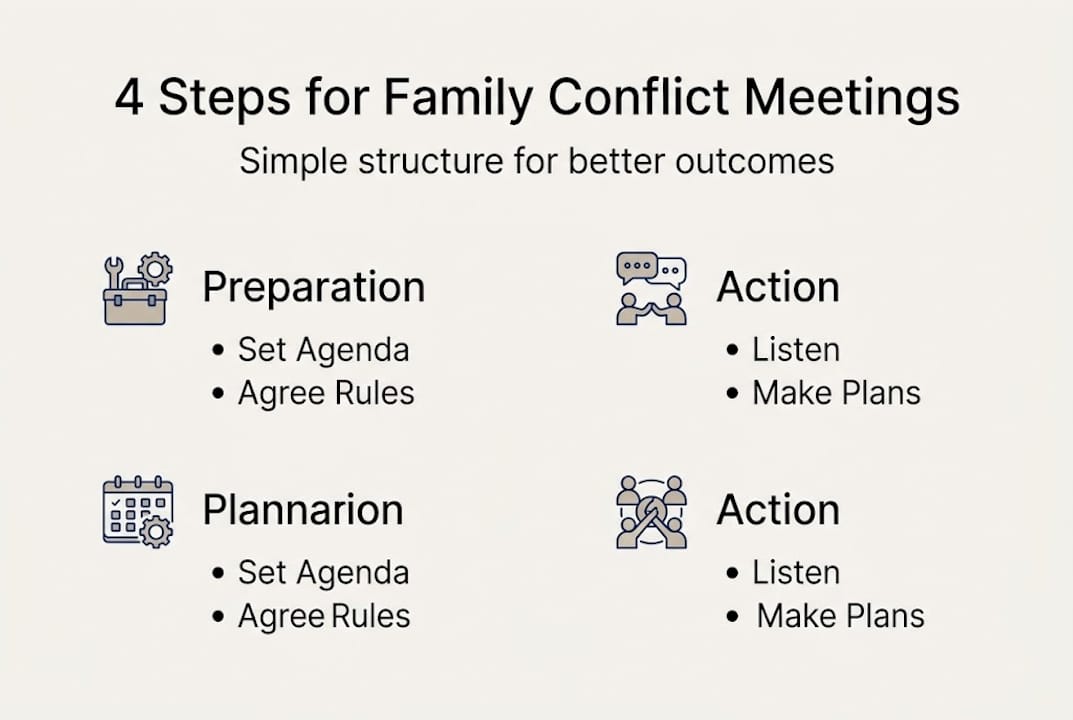
Here is a step-by-step format that works for most families:
- Open with appreciation. Each person shares one positive thing about the family or a specific member.
- Review the agenda. The facilitator reads through the topics and confirms everyone agrees on the order.
- Address each item. One topic at a time. Each person shares their perspective before discussion begins.
- Use process comments. These are brief facilitator statements that redirect the conversation without attacking anyone. Examples: “Let’s hear from everyone before we respond” or “We agreed to stay on this topic.”
- Problem-solve together. Once feelings are expressed, shift to solutions. Ask: “What would help?” rather than “Who is to blame?”
- Summarize agreements. Before closing, review what was decided and who is responsible for what.
- Close with a positive. End on a note of connection, not just resolution.
Clear structure and process comments are essential for enforcing rules without creating more conflict. The facilitator’s job is not to judge but to guide.
“The goal of a family meeting is not to win. It is to be understood and to understand.”
For families with children, adapt the format. Keep meetings shorter, use simple language, and give kids specific roles like timekeeper or note-taker. Group interventions in structured settings reduce conflict and improve adjustment in children, which means even young kids benefit from being included.
When emotions run high, pause the agenda. Acknowledge the feeling without letting it take over. A facilitator might say, “I can see this is really important to you. Let’s give you a moment and then continue.”
Using conflict resolution tools like active listening, “I” statements, and reflective questioning during the meeting keeps things from spiraling. These are not just therapy techniques. They are practical communication skills any family can learn.
Pro Tip: Set a timer for each agenda item. Knowing there is a limit reduces anxiety and keeps the meeting from dragging on past the point where anyone can think clearly.
Troubleshooting common challenges and ensuring follow-through
Even the best-prepared family meetings hit walls. Someone shuts down. Someone else takes over. A topic triggers an old wound and suddenly the meeting is about something that happened three years ago. These are not signs of failure. They are signs that your family is dealing with real issues.
Here are the most common challenges and how to handle them:
- Emotional flooding. When someone becomes overwhelmed, they cannot process information clearly. Call a short break, five to ten minutes, and resume when everyone is calmer.
- Power imbalance. If one person dominates, the facilitator should explicitly invite quieter members to speak. “We haven’t heard from everyone yet. What do you think?”
- Silence or withdrawal. Some members shut down under pressure. Offer written input as an alternative. Let them share thoughts on paper before or during the meeting.
- Topic hijacking. When conversations drift to unrelated grievances, use a “parking lot” list. Write the new topic down and agree to address it at the next meeting.
- Escalation. If voices rise or the conversation becomes disrespectful, pause immediately. Restate the ground rules and ask if everyone is willing to continue.
A scoping review on Family Group Conferencing notes that challenges are especially significant in severe cases, and that follow-up is crucial for long-term effectiveness. The meeting itself is only part of the process.
Follow-through is where most families drop the ball. After the meeting, document what was agreed. A simple shared note or whiteboard works fine. Schedule the next check-in before everyone leaves the room. Revisit agreements at the start of the next meeting.
Pro Tip: Assign a “keeper of agreements” role, someone who tracks what was decided and gently reminds the family of commitments made. Rotate this role so it does not feel like a burden.
Know when to get help. If meetings consistently escalate, if there is a history of trauma or abuse, or if one member refuses to engage despite repeated attempts, family counseling benefits include professional guidance that can make the difference between stagnation and real progress. Some conflicts need more than a structured meeting. They need a trained professional in the room.
For ongoing support with parenting conflict tips and co-parenting challenges, additional resources can help you apply these strategies in specific, high-stakes situations.
Why most family meetings fail — and how yours can succeed
Here is the uncomfortable truth most guides will not tell you: families abandon meetings not because they do not work, but because they expect the wrong thing from them.
Families walk in hoping to solve the problem. When the problem is not fully resolved after one or two meetings, they conclude that the process failed. But that is the wrong measure. The real value of a family meeting is not the resolution. It is the practice of showing up, listening, and staying in the room when things get hard.
Consistent positive outcomes in skills and belonging are documented even when empirical evidence is mostly anecdotal. That matters. It means the process builds something real, even when it feels messy.
We have seen families at Mastering Conflict who could not get through a single agenda item without conflict in their first meeting. Six months later, they were navigating serious disagreements with calm and structure. The meetings did not fix them. The meetings trained them.
Exploring family counseling approaches alongside regular family meetings gives you both the structure and the support to build that kind of resilience. The goal is not a perfect meeting. It is a family that keeps trying.
Get professional support for your family’s unique challenges
Family meetings are a powerful starting point, but some conflicts run deeper than any agenda can reach on its own. If your family is dealing with long-standing patterns, trauma, or communication breakdowns that keep repeating, professional support can help you move forward faster and more safely.
At Mastering Conflict, our professional clinical services are designed to meet families where they are, whether that means individual therapy, family counseling, or structured conflict coaching. For families who need flexibility, our online teletherapy options make it easy to get support without leaving home. Couples dealing with conflict can also explore our couples counseling packages for targeted, evidence-based help. Reach out today and take the next step toward a healthier family dynamic.
Frequently asked questions
What is the ideal frequency for family meetings to address conflict?
Regular family meetings support communication and prevent escalation, with many families benefiting from monthly sessions. Adjust the frequency based on your family’s current level of tension and need.
How do you keep family meetings from turning into arguments?
Clear ground rules, a set agenda, and a neutral facilitator are the three most effective tools for keeping discussions respectful. Codes of conduct and a structured process give everyone a framework to return to when emotions spike.
What if a family member refuses to participate?
Focus on open invitations and express the benefits without pressure or ultimatums. If refusal continues, a professional coordinator or counselor can help with structured outreach, as noted in Family Group Conferencing research on reluctant participants.
Are family meetings appropriate for serious conflicts or trauma?
In severe situations, meetings alone are not enough. Mental health professionals can use structured meetings as one tool within a broader treatment plan, and professional coordination is strongly recommended when trauma is involved.
Recommended
- Navigating Family Conflict for Positive Relationships – Mastering Conflict
- Effective Conflict Resolution Steps for Couples, Families, and Professionals 2025 – Mastering Conflict
- Parenting Conflict Resolution: Steps for Healthier Family Bonds – Mastering Conflict
- Master Conflict Resolution Skills for Real-Life Success – Mastering Conflict
- Conflict mediation – Nu Life Digital