
Anger and Alcohol: Why Drinking Makes Some People Angry

Alcohol does not create anger from nothing. It lowers the brakes on feelings that were already there, narrows what you notice, and makes a small slight feel like a threat. If you get angry when you drink, the problem usually has two parts: how you drink and how you handle anger. Both can be changed, and anger skills are the part you can start building before you change anything else. At Mastering Conflict, our anger management classes and counseling are built for exactly this kind of pattern.
TL;DR
- Alcohol impairs self-control and attention, so irritation turns into outbursts faster, even in people who are calm when sober.
- Research describes a two-way loop: aggression-prone traits make heavy drinking more likely, and heavy drinking makes aggression more likely.
- Anger while drinking hits partners and children hardest. Intimate partner violence is more likely and more severe when both partners have been drinking.
- Pacing, planning for triggers and learning anger skills lower the risk. People who have been violent while drinking are advised to avoid alcohol entirely.
- If drinking feels out of control or anyone is unsafe, call the SAMHSA helpline or 911 first, then add anger work.
Table of Contents
- What alcohol does to your anger
- Why you and not the person next to you
- Is it an anger problem or a drinking problem?
- What it does to partners and children
- How to stop alcohol from turning into anger
- When to get help, and what kind
- Where Mastering Conflict fits
- Our perspective
- FAQ
- Sources
What alcohol does to your anger
Most people picture alcohol as a relaxant. In the first drinks it often is. But alcohol also affects the parts of the brain that plan, weigh consequences and hold back a reaction. A review of the research describes intoxication as altering executive functioning and impeding self-regulation, which tips the balance toward aggression when someone is provoked (Parrott & Eckhardt, PMC).
Three things tend to happen at once.
Your attention narrows. The UK charity Drinkaware explains that alcohol makes it harder to take in social and environmental cues, so drinkers can misread other people’s behavior and “rise to the bait” (Drinkaware). A joke sounds like an insult. A late text sounds like contempt.
Your inhibitions drop. The same source notes that alcohol suppresses inhibition, and that heavy drinking can deplete GABA, a calming brain chemical, which raises tension and panic. Anger is often the first emotion to show.
You assume the worst. Researchers describe a “hostile attribution bias”: ambiguous situations start to look hostile. They also point to impaired attention and information processing in all drinkers, not only those who are dependent on alcohol (Beck & Heinz, 2013).
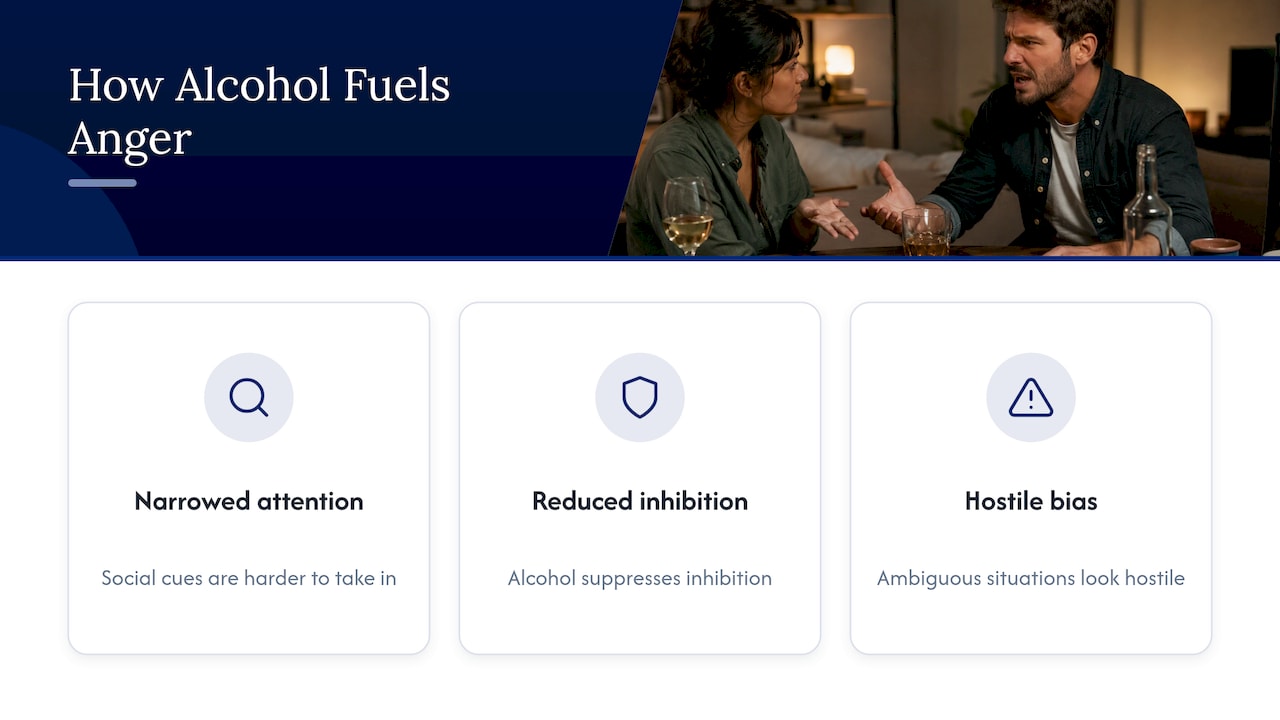
The link is real but not absolute. A review of 32 meta-analyses found alcohol’s effect on aggression to be medium in size (d = 0.39) (Parrott & Eckhardt, PMC). That is why two people can drink the same amount and only one becomes hostile.
The same mechanism shows up outside the home. A French article on how alcohol changes impulsivity and risk assessment shows how emotional state and drinking combine to push people toward riskier choices.
Why you and not the person next to you
If you ask why you get angry when you drink, the research points to a handful of personal factors. Reviews list sensation-seeking, high underlying irritability, lack of empathy, and expectations such as “alcohol makes me aggressive”. Social learning also matters: people who grew up around relatives or friends who turned aggressive when drinking often absorb that script (Beck & Heinz, 2013).
The most useful finding is about anger control. In one line of research, high trait anger predicted aggression after provocation only among intoxicated men who also had low anger control (Parrott & Eckhardt, PMC). Anger itself was not the whole story. The missing skill was control, and control can be trained.
A 2025 review adds that the connection runs both ways. Aggressive traits, emotional dysregulation and externalizing problems often come before problem drinking. Chronic heavy drinking then changes the brain in ways that can raise aggression, including during abstinence. The authors describe a vicious spiral driven by shared prefrontal and limbic circuit problems (Russell et al., 2025).
In practice, this means:
- If you were quick to anger before you drank much, drinking is likely amplifying a pattern, not starting it.
- If your temper got worse as your drinking increased, the loop may now be feeding itself.
- In both cases, working only on the drinking or only on the anger leaves half of the loop running.
Is it an anger problem or a drinking problem?
Neither label is automatic. Getting angry after a few drinks does not by itself mean you have an alcohol use disorder, and it does not by itself mean you have an anger disorder. Clinicians think of alcohol problems as a range. The ICD-11 diagnostic system, for example, separates a harmful pattern of alcohol use from alcohol dependence, with dependence being the more severe (Hazardous drinking and alcohol use disorders, 2022).
Screening is how professionals tell where someone sits on that range. The Alcohol Use Disorders Identification Test (AUDIT) is the most widely used screening questionnaire for problem drinking worldwide (Dagne et al., 2024).
Some questions worth asking yourself honestly:
- Do my angry episodes mostly happen after drinking?
- Do I remember what I said or did, and do I regret it the next day?
- Has a partner, child or friend told me they feel afraid or walk on eggshells when I drink?
- Have I tried to cut back and found I couldn’t?
- Do I feel irritable or tense when I go without drinking?
Yes to the first three points to an anger pattern worth working on. Yes to the last two suggests you should talk to a doctor or a treatment provider about your drinking as well. Heavy, long-term drinkers should not stop suddenly without medical advice, because withdrawal can be dangerous.
What it does to partners and children
Alcohol-related anger rarely stays with the person who drinks. A 2025 evidence review summarizes women’s accounts of physical, verbal and emotional aggression and intimidation by men affected by alcohol. It also reports that a father’s heavy drinking may be associated with aggressive behavior in children, adolescent drinking, school behavior problems and lower educational attainment (Laslett et al., RTI Press, 2025).
The scale is large. In a 19-country European study, the share of children exposed to a parent’s problematic drinking ranged from 6.2% in Italy to 35.2% in Lithuania (same review).
For couples, the pattern matters in a specific way. A 2024 review reports that intimate partner violence is both more likely and more severe when both partners have been drinking. It also notes that self-regulation skills and empathy may lower the risk of acting violently when drinking (Prevention Collaborative, 2024).
Two points for people on the receiving end:
- Being drinking yourself never makes you responsible for violence someone else does to you. Canadian guidance on alcohol and violence is explicit that blaming a victim’s drinking reinforces blame, and that the focus belongs on reducing use by those who perpetrate harm (CCSA, 2022).
- If you are in danger now, call 911. The National Domestic Violence Hotline and your local crisis services can help you plan for safety.
How to stop alcohol from turning into anger
These steps work best together. The first group is about the drinking, the second about the anger.
Before and while you drink
Drinkaware’s guidance suggests setting limits and anticipating triggers before you start, pacing drinks and alternating them with water or soft drinks. It also advises watching for triggers such as tiredness and stress (Drinkaware).
A few concrete habits follow from that:
- Decide your limit before the first drink, not after the third.
- Skip drinking when you are already angry. Alcohol amplifies the mood you bring with you.
- Plan an exit. Know in advance that you will walk outside, leave the room or end the call when you feel your jaw tighten.
- Avoid drinking in situations that usually end in an argument, such as a tense family gathering or a late-night talk about money.
If alcohol has led to violence
The Canadian Centre on Substance Use and Addiction concluded that people with a history of perpetrating alcohol-related violence should avoid drinking altogether. The same overview reports that roughly half of violent incidents involve alcohol (CCSA, 2022). If that describes you, not drinking is the safest step, and anger work is how you rebuild what drinking was covering over.
When irritation rises
Drinkaware recommends breathing or grounding techniques when you feel irritation building, and non-alcohol coping habits such as talking to someone you trust or going for a walk. Learn these while sober so you can reach for them when your judgment is slower. Our guides on recognizing anger warning signs early and healthy ways to deal with anger walk through the physical cues and responses in detail.
Build the skill that alcohol removes
The research above points to self-control and empathy as the protective factors. Those are the skills evidence-based anger programs teach: spotting early signals, slowing the response, and communicating the need underneath the anger. You can read how that works in our overview of evidence-based anger management strategies and our anger management exercises for adults.
This matters because evidence-based programs aimed at alcohol-facilitated aggression are still limited, and researchers call for interventions that address both drinking and aggression together (Parrott & Eckhardt, PMC). For parents, a US meta-analysis found that combining parenting-skills and stress-reduction content with alcohol treatment worked better than alcohol-focused treatment alone (Prevention Collaborative, 2024).
When to get help, and what kind
Match the help to what is happening.
| Situation | First step |
|---|---|
| Someone is in immediate danger or has been hurt | Call 911 |
| You are in emotional crisis or thinking of self-harm | Call or text 988, the 988 Suicide & Crisis Lifeline, free and open 24/7 |
| You cannot cut down, or you get shaky or ill when you stop | Call the SAMHSA National Helpline at 1-800-662-HELP (4357), a free, confidential referral line open every day, and talk to a doctor |
| You get angry or aggressive after drinking but can control your intake | Anger management plus the limits above |
| Anger is hurting your marriage or your kids | Anger work, couples or family counseling |
One caution from the Prevention Collaborative: people with severe alcohol use disorders or dependency may need additional support before standard violence-prevention programming is appropriate, and programs should assess family violence risk (Prevention Collaborative, 2024). If dependence is part of your picture, treat it with a medical or addiction provider alongside anger work.
The WHO’s 2024 global report finds that effective treatments exist but coverage is very low worldwide, with gaps in psychosocial services and peer support (WHO, 2024). Reaching out early is worth the effort, and online options make it easier to start.
Where Mastering Conflict fits
We work on the anger side of this loop: the triggers, the warning signs, the skills and the relationships it damages. Which option suits you depends on where you are.
Start with a class. Our online anger management classes are priced as published on our site: a 1-hour class at $24.99, a 6-hour class at $79 and an 8-hour class at $85. We also offer 4-hour and 8-hour programs at $149 and $249.
Work one on one. Anger management counseling, counseling for men, counseling for women and teen counseling are available, with online therapy for readers outside the Carolinas and Florida. Our founder, Dr. Carlos Todd, is a licensed clinical mental health counselor and psychologist.
Bring your partner. Couples sessions are $175 per hour, and our couples packages include a 6-hour intensive for $1,995. If drinking and anger have strained trust, these sessions give both of you a structured place to talk.
If you are not sure which fit is right, start at Mastering Conflict and look at the options for your situation.
Our perspective
We meet many people who say, “I’m not an angry person until I drink.” Often that is partly true and partly a way of keeping the anger at a distance. Alcohol removes the brakes, but the feelings behind the outburst, usually hurt, fear, shame or feeling disrespected, were already there.
That is why we put the focus on skills. When you can notice your body heating up, name what you need and slow your response, you have something to lean on in the moments when alcohol makes judgment harder. We build that through evidence-based frameworks, practical tools and the clinical experience behind our counseling.
We also see how much this touches families. A partner or a teenager is often the one who first names the pattern. Counseling for the person who is angry, for the couple, or for a teen who has grown up around it gives each of them a voice and a plan. And if drinking is beyond what you can manage alone, we want you to get medical or addiction care alongside anger work, not instead of it.
Change is possible, and the first step does not have to be large.
Carlos
FAQ
Why do I get angry when I drink?
Alcohol impairs self-control, narrows attention and makes it easier to read neutral behavior as hostile. If you already have a short fuse, a history of stress or learned habits from people who drank aggressively, those effects hit harder. Building anger control skills reduces how far that goes.
Does getting angry when I drink mean I’m an alcoholic?
Not necessarily. Alcohol problems range from a harmful pattern of use to dependence. A validated screening such as the AUDIT, discussed with a doctor or counselor, is the way to see where you fall. If you cannot cut down or feel unwell when you stop, get medical advice.
Can I fix this by just drinking less?
Drinking less lowers the risk, and for anyone who has been violent when drinking, avoiding alcohol is the safest course. But research suggests aggression and drinking feed each other, so learning anger skills helps keep the pattern from returning. Doing both gives the best footing.
How does alcohol-fueled anger affect my family?
It can bring verbal and physical aggression, fear, and lasting effects on children’s behavior and schooling. Partners are at higher risk of severe violence when both have been drinking. Couples or family counseling can help everyone feel safe and heard again.
Can I get help online?
Yes. We offer online anger management classes and online therapy, so you can begin from home. If you or someone else is in danger, call 911 instead.
Sources
- Parrott & Eckhardt, Effects of Alcohol on Human Aggression (PMC, 2018)
- Drinkaware, alcohol and aggression
- Beck & Heinz, Alcohol-Related Aggression (PMC, 2013)
- Russell et al., bidirectional links between alcohol misuse and aggression (PMC, 2025)
- Hazardous drinking and alcohol use disorders (PMC, 2022)
- Dagne et al., scoping review of assessment tools (PMC, 2024)
- Laslett et al., Harms to Women and Children From Men’s Alcohol Use (RTI Press, 2025)
- Prevention Collaborative, Addressing Harmful Alcohol Use to Reduce Intimate Partner Violence (2024)
- CCSA, Alcohol and violence rapid overview (2022)
- WHO, Global status report on alcohol and treatment of substance use disorders (2024)
- SAMHSA National Helpline
- 988 Suicide & Crisis Lifeline
- Alcool et impulsivité : quand l’état émotionnel modifie l’évaluation du risque