
Local Classes $24.99–$249: Clinician Tips on Teen Anger for Parents

Yes, local teen anger management classes are commonly available, offered in group, short-intensive, and individual formats, and parent participation is often part of the process. If your teen is struggling, the most useful next step is to call a licensed provider such as Mastering Conflict or a community clinic and book an intake assessment.
TL;DR:
- Group classes are best for teens with mild to moderate anger issues and typically involve weekly sessions over several weeks.
- Intensive programs, lasting a single day or weekend, suit families needing quick results or with busy schedules.
- Individual CBT is recommended for teens with severe or frequent outbursts, especially when other formats have limited effects.
- Prices vary but generally include flat fees per session or program, with additional assessment costs and options for insurance or sliding scales.
- Parents should confirm provider credentials, curriculum evidence base, and how progress is measured before enrollment.
Table of Contents
- What kinds of programs will you actually find?
- What pricing and scheduling should you expect locally?
- How do you choose the right class or program?
- What does the research say about what actually works?
- What if your teen has special needs or another diagnosis?
- How is your teen’s privacy protected during treatment?
- A clinician’s note on working with teens and families
- Mastering Conflict’s options for teen anger
- Sources
- FAQ
What kinds of programs will you actually find?
Local search results for anger management usually turn up three formats, and each fits a different level of need.
Group classes, often structured as weekly sessions over several weeks, work well for teens with mild to moderate frustration issues who benefit from peer feedback and structured practice. Multi-hour intensives, condensed into a single day or a weekend, suit families who need results fast or teens whose schedules make weekly attendance hard. Ongoing individual therapy, usually built around cognitive behavioral therapy (CBT), fits teens with more severe, frequent, or aggressive outbursts that need one-on-one attention and a longer treatment arc.
- Group format: typically several sessions across weeks, focused on skill-building alongside peers.
- Intensive format: a single 4-8 hour block, useful when a fast, concentrated intervention is needed.
- Individual CBT: open-ended sessions tailored to the teen’s specific triggers and history.
- Online delivery: convenient and often more affordable, but less useful for teens who need in-person behavioral cues and supervision.
Most programs, regardless of format, expect some parent involvement: attendance at intro or closing sessions, homework review, or periodic check-ins. In-person delivery tends to work better for teens with attention difficulties or those who need a controlled environment, while online options remove transportation barriers for busy families. A complete guide to emotional regulation for teens breaks down what the skill-building itself typically looks like.
Pro Tip: If you’re unsure which format fits, start with an intake assessment rather than guessing. Most licensed providers can recommend group, intensive, or individual formats based on a short evaluation.
What pricing and scheduling should you expect locally?
Pricing models vary by provider, but three patterns are common: a flat fee per single class, a flat fee for a multi-hour program, and a separate intake or assessment fee. Ask about all three before assuming you know the total cost.
- Confirm the exact session length and whether the fee covers one class or a full program.
- Ask about the weekly cadence: is it once a week, twice, or a single weekend block?
- Find out the makeup policy for a missed session and whether refunds are available if the teen doesn’t continue.
- Ask whether the provider accepts insurance, offers a sliding scale, or partners with a community mental health clinic.
- Confirm parental consent requirements and whether the school needs to be notified.
- Ask what the safety or crisis plan looks like if your teen has a serious incident mid-program.
A short, structured emotional-regulation program with clear safety planning and prioritized access tends to reduce stigma and improve outcomes for teens with behavioral health concerns, according to SAMHSA’s guidance for families. That’s a useful benchmark when you’re comparing what a local provider offers against a bare-bones class with no follow-up plan.
How do you choose the right class or program?
A short checklist keeps you from picking based on price alone.
- Confirm the facilitator’s license or clinical credential, not just a certificate in “anger management.”
- Ask whether the curriculum uses CBT or DBT elements, since these have the strongest evidence base.
- Ask if family or parent sessions are built in, and how often.
- Ask how the program measures progress, whether through checklists, parent reports, or formal assessments.
- Ask what happens if your teen’s behavior escalates during the program.
When you call, ask directly: What’s the facilitator’s license type? What’s the typical group size? Are parent sessions included, and how many? Is there homework between sessions, and how is it reviewed? What does the initial assessment involve?
If a program can’t answer these clearly, or if your teen shows signs of violence, self-harm, or substance use alongside the anger, treat that as a signal to escalate to individual clinical therapy rather than a short class. A step-by-step guide for parents covers more of this ground.
Pro Tip: Write down each provider’s answers side by side. A simple comparison sheet makes it much easier to spot which program actually has a plan versus which one is just running a script.
What does the research say about what actually works?
The evidence points in a consistent direction: cognitive behavioral therapy and multimodal programs, meaning ones that combine skill training, problem-solving, and communication practice, show the strongest results for reducing adolescent anger and aggression, according to a systematic review published in the Indian Journal of Psychiatric Nursing.
A meta-analysis found a large effect size (d = 1.139) for individually oriented CBT in treating severe adolescent aggression, which means individually tailored treatment can matter a great deal when a group class isn’t enough.
- Family-involved and parent-training components tend to improve short-term outcomes for externalizing behaviors.
- Long-term maintenance of those gains often depends on continued supports at home and school.
- Group formats are common and useful, but effects can fade at follow-up without that ongoing reinforcement.
Severe or frequent aggression usually calls for individual clinical treatment rather than a standalone short class.
What if your teen has special needs or another diagnosis?
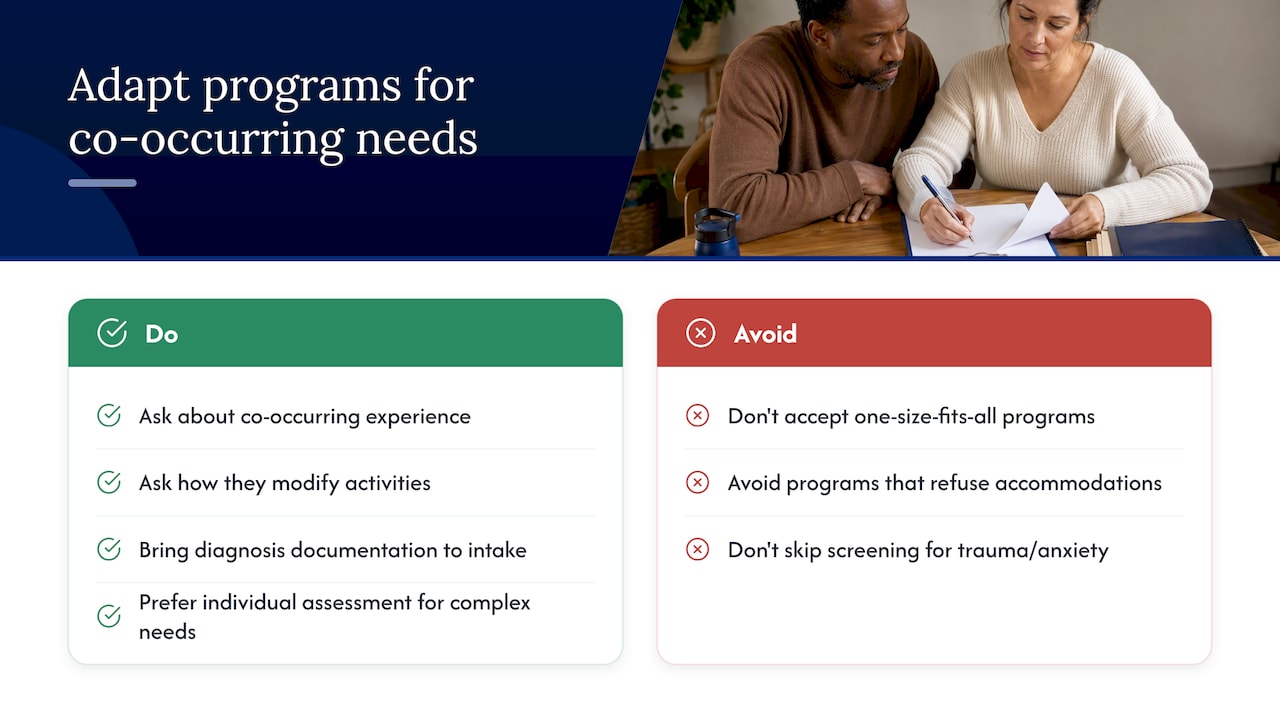
Anger rarely shows up in isolation. Teens with ADHD, autism spectrum conditions, anxiety, or learning differences often need a program that adapts its pacing and communication style rather than a one-size-fits-all curriculum. Ask providers directly whether they’ve worked with co-occurring conditions and how they modify group activities, sensory environments, or homework expectations.
For teens with significant behavioral or emotional complexity, an individual assessment is usually more useful than a group class, since a clinician can screen for anxiety, trauma history, or attention difficulties that are fueling the anger rather than causing it directly. SAMHSA’s 2026 guidance on youth crisis systems recommends individualized stabilization plans and connecting families to community-based supports rather than defaulting to rigid, standardized programs.
If your teen has a diagnosed condition, bring documentation to the intake so the provider can adjust format, pacing, and communication accordingly. A program that refuses to discuss accommodations at all is worth reconsidering.
How is your teen’s privacy protected during treatment?
Confidentiality rules for minors vary somewhat by provider and jurisdiction, but reputable clinical programs will explain, before you enroll, what gets shared with parents, what stays between the teen and the clinician, and what triggers a mandatory disclosure, such as a safety risk. Ask this question directly during intake rather than assuming.
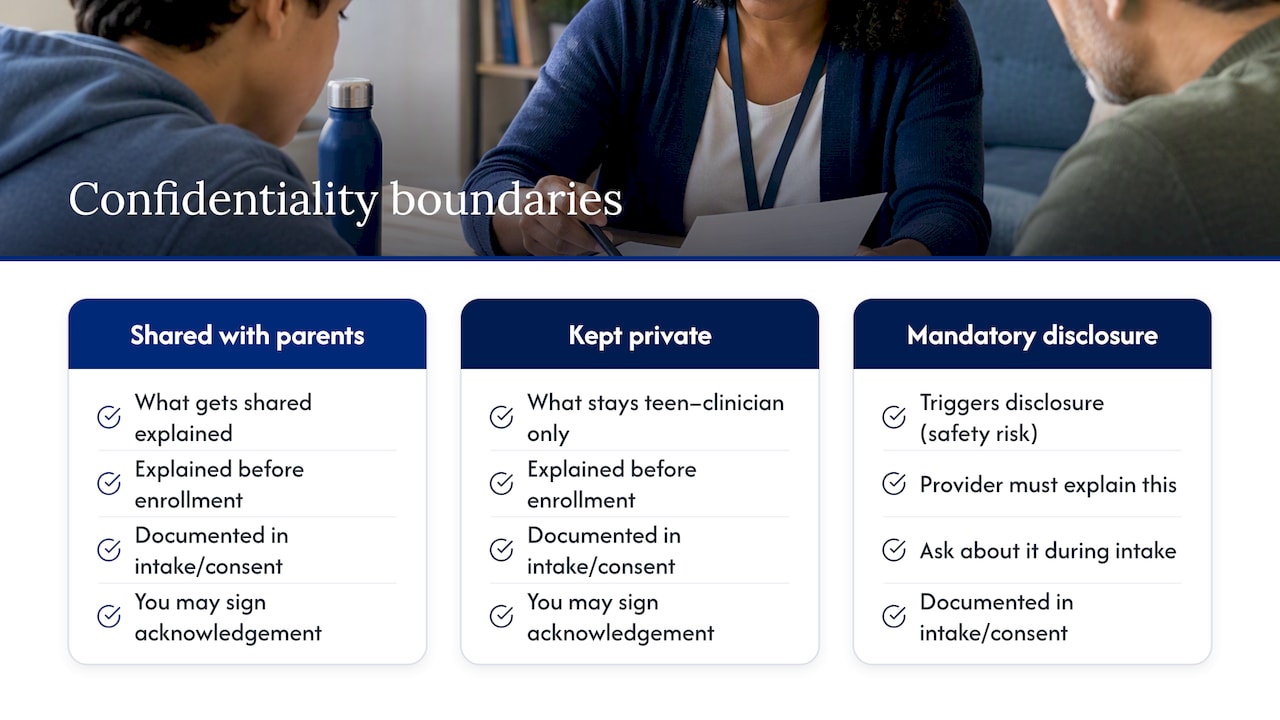
Most licensed providers document their confidentiality policy in an intake packet or consent form, and you should expect to sign something acknowledging it. If a program can’t explain its privacy practices clearly, or gives a vague answer about “keeping things confidential” without specifics, treat that as a gap worth asking more about before committing.
A clinician’s note on working with teens and families
I’m Dr. Carlos Todd, a licensed clinical mental health counselor, and most of the teens I’ve worked with make faster progress when their parents are part of the process, not just informed about it afterward. We build our work around CBT and structured family involvement rather than a one-size-fits-all curriculum. If you’re weighing your options, reach out and we’ll help you figure out the right starting point.
— Carlos
Mastering Conflict’s options for teen anger
We offer several ways into this work depending on how much structure your teen needs. Our course catalog includes a 1 Hour Anger Management Class, a 6 Hour Anger Management Class, and an 8 Hour Anger Management Class, and our group program page lists a 4-Hour Program and an 8-Hour Program for teens who need a more intensive block.
- Teen counseling and family sessions are available through our teen counseling page, which also covers local scheduling.
- Every path starts with an intake to match your teen to the right format.
- Sessions are available both online and in person, depending on what fits your family.
Booking starts with a short intake call. Visit our course catalog to see current class times and get your teen scheduled.
Sources
- Mental Health, Drug, or Alcohol Issues: Helping your Child | SAMHSA
- The Work After the Work: Embedding Long-Term Recovery in CYF Crisis Systems (March 2026)
- Anger management in adolescents: a systematic review (Indian Journal of Psychiatric Nursing / IOPN)
- A meta-analysis of the effectiveness of individually oriented CBT for severe aggressive behavior in adolescents
FAQ
What age group do teen anger management classes typically serve?
Most programs are designed for adolescents in the typical teenage years, though intake ages vary by provider. Ask the specific provider, since age ranges vary by program.
Do insurance plans cover teen anger management classes?
Coverage depends on your specific plan and whether the provider is in-network, so it’s worth calling both your insurer and the clinic directly. Some community mental health centers also offer sliding-scale fees for families without coverage.
How long does it take to see improvement?
Short intensives can produce initial skill gains within a single session, but research on family-involved programs suggests that lasting change usually depends on continued practice and support at home. Severe aggression often needs the longer arc of individual CBT rather than a one-time class.
Should you choose a group class or individual therapy?
Group classes tend to fit mild to moderate anger issues where peer feedback helps, while individual therapy suits teens with more severe, frequent, or aggressive behavior. A meta-analysis on individually oriented CBT found strong effects for tailored individual treatment in severe cases.
What does an anger management class with Mastering Conflict cost?
Mastering Conflict’s course options include a 1 Hour Anger Management Class at 24.99 dollars, a 6 Hour Anger Management Class at 79 dollars, and an 8 Hour Anger Management Class at 85 dollars. The group program page also lists a 4-Hour Program at 149 dollars and an 8-Hour Program at 249 dollars.