
Build Self Compassion in 5–10 Minutes a Day: Clinician Backed Practice

Practicing self-compassion means treating yourself with the same kindness you’d offer a friend in pain, grounded in three components: self-kindness, common humanity, and mindfulness. The fastest way to start is the Self-Compassion Break: name what hurts, remind yourself that struggle is part of being human, then place a hand on your heart and offer yourself a kind phrase. This article walks through more exercises, a short starter plan, and what to do when the practice stirs up more than you expected.
TL;DR:
- Short, daily self-compassion exercises, especially the Self-Compassion Break and supportive touch, can activate calming physiological responses within minutes.
- Consistent practice over several weeks, starting with brief sessions of five to ten minutes, builds emotional resilience and reduces self-criticism effectively.
- Initial emotional surfacing or backdraft is normal; slowing down practices and grounding yourself helps prevent overwhelm and maintains progress.
- External support from therapists can tailor exercises to individual triggers, pacing, and deeper emotional work, boosting long-term adherence.
- Research links higher self-compassion to lower anxiety and depression, with physical gestures contributing to hormone release that enhances emotional regulation.
Table of Contents
- What Self-Compassion Actually Means (And What It Isn’t)
- Self-Compassion Exercises You Can Use Today
- How to Build a Self-Compassion Habit That Actually Sticks
- Why Self-Compassion Sometimes Backfires at First
- What the Research Says About Self-Compassion’s Benefits
- How Clinical Support Deepens a Self-Compassion Practice
- A Clinician’s View on Why This Work Sticks (Or Doesn’t)
- Guided Support From Mastering Conflict for Building This Skill
- Where to Learn More About Self-Compassion
- Sources
- FAQ
What Self-Compassion Actually Means (And What It Isn’t)
Self-compassion breaks down into three parts, according to the model most clinicians and researchers use: self-kindness, common humanity, and mindfulness. Self-kindness means speaking to yourself the way you’d speak to someone you love, instead of the way a harsh coach might. Common humanity means recognizing that failure, embarrassment, and pain are not personal defects. They’re part of being a person. Mindfulness means noticing your suffering without either exaggerating it into a crisis or shoving it down where it festers.
That last part matters because self-compassion gets confused with self-pity constantly. Self-pity isolates you (“this only happens to me”) and often exaggerates the drama. Self-compassion does the opposite: it connects your pain to the shared experience of being human and holds it steady, without amplifying it.
People also worry self-compassion is a permission slip for laziness. The opposite tends to be true. Research summarized in a review on self-compassion and motivation found that self-compassionate people often show more sustained motivation and better performance, not less, because they recover faster from setbacks instead of spiraling into avoidance.
Here’s how self-compassion differs from the self-esteem model many people grew up with:
- Self-esteem is often built on comparison and performance; self-compassion is stable whether you win or lose.
- Self-esteem can crater after failure; self-compassion is specifically designed to hold you steady during failure.
- Self-esteem sometimes requires being better than others; self-compassion connects you to others through shared struggle.
The evidence is substantial. A body of peer-reviewed research summarized by the National Center for Biotechnology Information links higher self-compassion to measurably lower anxiety and depression, along with improved emotional resilience across different populations and age groups.
Self-Compassion Exercises You Can Use Today
These exercises come from clinical practice and established self-compassion research. Pick one and try it before finishing this article. Do not wait for the “right” moment. There isn’t one.
The Self-Compassion Break. This is the core exercise, built on three steps. First, acknowledge the pain out loud or silently: “This is a moment of suffering.” Second, name the common humanity: “Suffering is part of life; I’m not alone in this.” Third, offer yourself kindness, often paired with a hand over the heart: “May I be kind to myself right now.” The physical gesture of touch helps trigger a calming response in the body, which is part of why this exercise works faster than just thinking kind thoughts.
The compassionate friend letter. Write a letter to yourself about a struggle, but write it as if a wise, unconditionally loving friend were writing to you. Give yourself some time for this, such as around 10 to 15 minutes. Don’t edit for grammar. Read it back the next day, out loud if you can stand it. Most people report it feels strange the first time and less strange by the third.
Soothing touch. Placing a hand on your chest, cradling your own face, or giving yourself a gentle self-hug sounds almost too simple to matter, but supportive touch activates the parasympathetic nervous system, the branch responsible for calming you down after stress. It’s not symbolic. It’s a physiological lever.
A short mindful self-compassion meditation. Sit for five to ten minutes. Breathe normally. When a difficult thought or sensation arises, silently note it (“this is anxiety,” “this is tightness in my chest”), then say, “It’s okay to feel this. Let me be gentle with myself.” Repeat as needed. You don’t need incense or an app subscription. You need five uninterrupted minutes.
The “what would you say to a friend” reframe. When your inner critic gets loud, pause and ask: if my best friend told me this exact thing about themselves, what would I say back? Write the answer down. Then say it to yourself, even if it feels awkward at first.
Journaling prompts for self-kindness. Three prompts that work well in rotation: “What did I do well today, even in a small way?” “Where was I harder on myself than I’d be on someone else?” “What do I need right now that I haven’t given myself?”
The Pause Ritual. Before reacting to a stressful email, an argument, or a mistake, take one full breath and silently say, “Pause. What do I need right now?” This interrupts the automatic self-attack response before it gains momentum.
Micro-restorations for a packed day. These are 60 to 90 second interventions: three slow breaths with a hand on your heart before a meeting, a single kind sentence to yourself in the bathroom mirror, or stepping outside for thirty seconds of fresh air between tasks.
The boundary-check exercise. Ask yourself, “Am I saying yes to this because I want to, or because I’m afraid of disappointing someone?” Self-compassion includes protecting your own limits, not just softening your self-talk.
Pro Tip: Start with the Self-Compassion Break and soothing touch before adding journaling or letters. The physical, in-the-moment tools build trust with your nervous system faster than written exercises, and that trust makes the deeper work easier later.
How to Build a Self-Compassion Habit That Actually Sticks
Consistency beats intensity here. A protocol described in guided-practice research recommends short, repeatable sessions of about five to ten minutes daily sustained over several weeks, not one long retreat-style session.
A simple starter plan looks like this:
- Week 1: Do the Self-Compassion Break once a day, ideally at a moment of mild frustration rather than your worst crisis. Five minutes is enough.
- Week 2: Add either the compassionate letter (once, midweek) or a five-minute mindful self-compassion meditation most mornings.
- Week 3: Layer in the three-question journal check-in a few evenings a week, alongside whatever practice from weeks 1 and 2 is sticking.
- Weeks 4 through 8: Keep whatever combination is working, and let the rest fall away. You do not need all seven exercises running at once.
For busy schedules, micro-practices matter more than long sessions. A hand on your heart during a red light, one kind sentence before a hard phone call, or a slow breath before opening your inbox counts as real practice, not a lesser version of it.
Track progress with behavior, not just mood. Ask yourself three things at the end of each week: Did I catch my inner critic and respond differently at least once? Did I take a pause before reacting at least once? Do I feel slightly less dread about starting the practice than I did last week? If two of three are “yes,” the habit is taking hold.
If a session leaves you shakier than before, that’s a signal to shorten the practice, not push through it. Slow down before you stop entirely.
Why Self-Compassion Sometimes Backfires at First
Opening up kindness toward yourself can unearth pain you’ve been managing by staying busy or self-critical. Clinicians call this “backdraft,” a term borrowed from firefighting: when you open a door on a fire that’s been starved of oxygen, it can flare rather than calm down. Old grief, shame, or fear surfaces precisely because compassion finally makes it safe enough to feel.
This is normal, not a sign you’re doing it wrong. But it needs a plan.
- If a wave of emotion feels too strong, stop the formal practice and ground yourself first: feel your feet on the floor, name five things you can see, or make a cup of tea slowly and deliberately.
- Shorten the exercise. Thirty seconds of hand-on-heart is still self-compassion. You don’t need the full script every time.
- Some clinicians recommend swapping meditation for a physical, sensory action during a hard stretch: a short walk, cold water on your hands, or simply stepping outside.
Pro Tip: If backdraft shows up more than once or lasts more than a day or two after practicing, that’s a cue to bring in outside support rather than push through alone. A licensed therapist can pace the work so old pain surfaces in a manageable way instead of overwhelming you.
If practice consistently triggers flashbacks, panic, or thoughts of self-harm, stop self-guided exercises and reach out to a mental health professional or crisis line right away.
What the Research Says About Self-Compassion’s Benefits
The psychological case for this practice isn’t speculative. Multiple peer-reviewed studies summarized in a comprehensive research overview tie higher self-compassion scores to lower anxiety, lower depression, and stronger emotional resilience under stress.
The mechanisms behind those outcomes are becoming clearer too:
- Soothing touch and calming self-talk activate the parasympathetic nervous system, lowering heart rate and cortisol after a stressful event.
- Physical gestures like a hand over the heart are associated with oxytocin release, the same hormone involved in bonding and feeling safe with another person.
- Repeated practice appears to reshape automatic thought patterns over time, so the compassionate response starts to compete with, and eventually outpace, the critical one.
What this means day to day is simple: a bad meeting, a mistake at home, or a hard conversation doesn’t have to spiral into hours of self-attack. A two-minute Self-Compassion Break can shift your physiology, not just your mindset, within minutes.
How Clinical Support Deepens a Self-Compassion Practice
Self-guided exercises work well for a lot of people, but a licensed therapist adds something books and apps can’t: pacing tailored to your history. A clinician trained in trauma-sensitive approaches can scaffold self-compassion work so backdraft stays manageable instead of destabilizing, adjusting the intensity of exercises session by session based on what’s actually surfacing for you.
In practice, that support usually includes:
- An initial assessment to understand what’s driving your self-criticism (perfectionism, past trauma, anger patterns, relationship conflict).
- Personalized exercises instead of generic scripts, matched to your specific triggers and history.
- Accountability between sessions, so the practice doesn’t quietly disappear after a busy week.
Consider reaching out to a therapist if backdraft repeats, if self-criticism is tied to anger you struggle to control, or if relationship conflict keeps undoing the progress you make on your own. Mastering Conflict’s clinical services are built around exactly this kind of trauma-sensitive, individualized pacing.
A Clinician’s View on Why This Work Sticks (Or Doesn’t)
The clients who make lasting progress with self-compassion rarely start out believing in it. Most begin skeptical, half expecting to be told to “just think positive.” What tends to shift them is smaller than that: one moment where they catch themselves mid-criticism and choose a different sentence instead.
Self-compassion isn’t the enemy of ambition. The people who pair it with clear goals recover faster from setbacks and quit less often, because a bad week doesn’t get read as proof they should give up. Building steadier emotional footing, whether through self-guided practice or structured emotional regulation work, is what makes both self-compassion and goal pursuit sustainable at the same time.
— Carlos
Guided Support From Mastering Conflict for Building This Skill
Reading about self-compassion gets you started. Working through it with structured guidance, feedback, and accountability is what turns a good intention into a lasting habit, especially if anger, grief, or relationship conflict keeps pulling you back into old patterns.

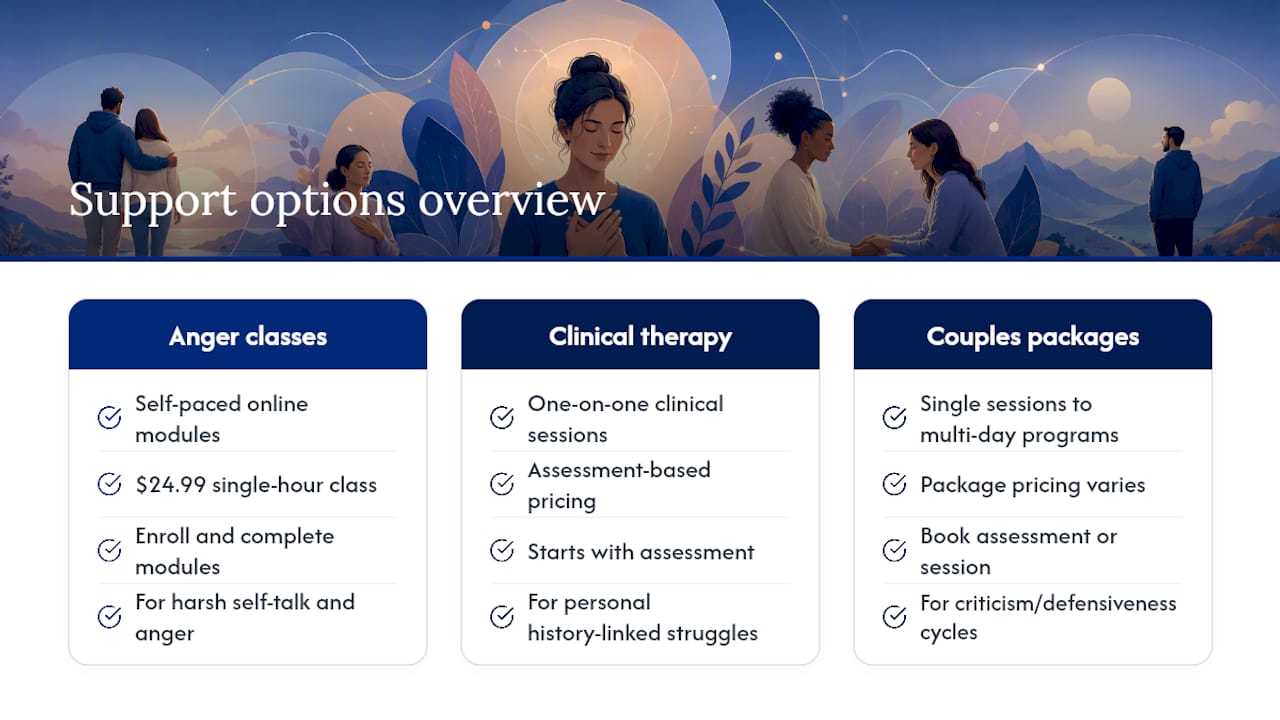
Several services are available depending on what’s driving your struggle. If harsh self-talk shows up alongside anger you can’t quite control, the online anger management classes give you structured, self-paced modules starting at $24.99 for a single-hour class. If the pattern is more personal or tangled up in relationship conflict, one-on-one clinical services start with an assessment so your therapist builds a plan around your actual history instead of a generic template. Couples working through cycles of criticism and defensiveness together can look at the couples packages, which range from single sessions to intensive multi-day programs.
A first booking typically starts with an assessment, then a personalized plan built around the issues you face. Book a session or browse the course catalog to see which format fits your schedule and budget.
Where to Learn More About Self-Compassion
For readers who want to go deeper than a single article allows, a few sources stand out for quality and clinical grounding.
- Self-compassion hosts free guided audio practices, meditation scripts, and printable exercises developed for ongoing home use.
- Cleveland Clinic offers clear, medically reviewed explanations of self-compassion and its role in emotional health.
- Harvard Health covers practical strategies and troubleshooting for people just starting out.
This article is general information, not a substitute for advice from a qualified doctor. Consult a qualified healthcare professional about your own circumstances before acting on anything here.
Sources
- Self love: what it is and how to practice it | Cleveland Clinic
- Self-compassion
- Self-compassion research overview (PMC4128472)
- Self-compassion exercises | Simply Psychology
- 4 ways to boost your self-compassion | Harvard Health
FAQ
What Is the Self-Compassion Break?
It’s a three-step exercise: acknowledge that you’re struggling, remind yourself that struggle is part of being human, then offer yourself kindness, often with a hand over the heart. The physical gesture is thought to help calm the nervous system, which is part of why it works faster than reasoning alone.
How Long Does It Take to See Results From Practicing Self-Compassion?
Guided-practice research points to measurable improvements from short daily sessions of five to ten minutes sustained over several weeks rather than one intense effort. Most people notice small shifts in self-talk within two to three weeks of consistent practice.
Does Self-Compassion Make You Less Motivated?
No. Evidence summarized in a review on self-compassion and motivation found the opposite tends to happen: self-compassionate people recover faster from setbacks and often sustain motivation and performance better than harsh self-critics.
What Should I Do if Practicing Self-Compassion Brings Up Strong Emotions?
This is called backdraft, and it’s a normal response when old pain surfaces because compassion finally makes it feel safe to notice. Shorten the practice, ground yourself with something physical like feeling your feet on the floor, and consider reaching out to a therapist if it happens repeatedly.
How Much Do Mastering Conflict’s Anger Management Classes Cost?
The 1 Hour Anger Management Class costs $24.99 one time, while the 6 Hour and 8 Hour versions cost $79 and $85 respectively. Group-based options like the 4-Hour and 8-Hour Programs run $149 and $249.