Clinicians: Ready to Run 12–16 Slide Workplace Conflict Resolution PPT Toolkit

A clinical conflict-resolution PowerPoint built for workplace and relational disputes needs three non-negotiable pieces: emotional-regulation practice, CBT-based cognitive and communication skill training, and a structured resolution model with a safety-planning component. Everything else, slide templates, session plans, timing, is a scaffold around those three. The approach draws on randomized trials of therapist-supported treatment, the SAMHSA anger management manual, and Integrative Behavioral Couple Therapy, and some organizations build clinical training around the same core.
TL;DR:
- Emotional regulation, cognitive restructuring, and a safety-focused resolution model are essential components of an effective conflict-resolution workshop.
- Evidence supports the use of CBT and IBCT models for managing workplace and relational disputes, with remote adaptations like internet-delivered formats increasing accessibility.
- Short programs can focus on skill exposure with minimal exercises, while extended modules follow structured sequences and include ongoing monitoring for sustained change.
- Clinical evidence shows high retention and effectiveness for emotion regulation and conflict resolution skills, especially when integrated into structured, time-limited interventions.
- Situations involving active abuse, suicidality, or severe substance use require direct clinical intervention rather than slide-based training.
Table of Contents
- Evidence-Based Models for Clinical Conflict Resolution
- A Slide-by-Slide Outline You Can Build From Today
- Turning Slides Into Session Plans
- The Research Behind Each Slide
- Facilitating the Session Without Losing Control of the Room
- When Slide-Based Training Isn’t the Right Tool
- What Mastering Conflict Sees Trainers Get Wrong
- How Mastering Conflict Supports Clinicians and Organizations
- Sources
- FAQ
Evidence-Based Models for Clinical Conflict Resolution
Most workplace and relational disputes trace back to a handful of underlying patterns, and the clinical literature offers four models worth building slides around.
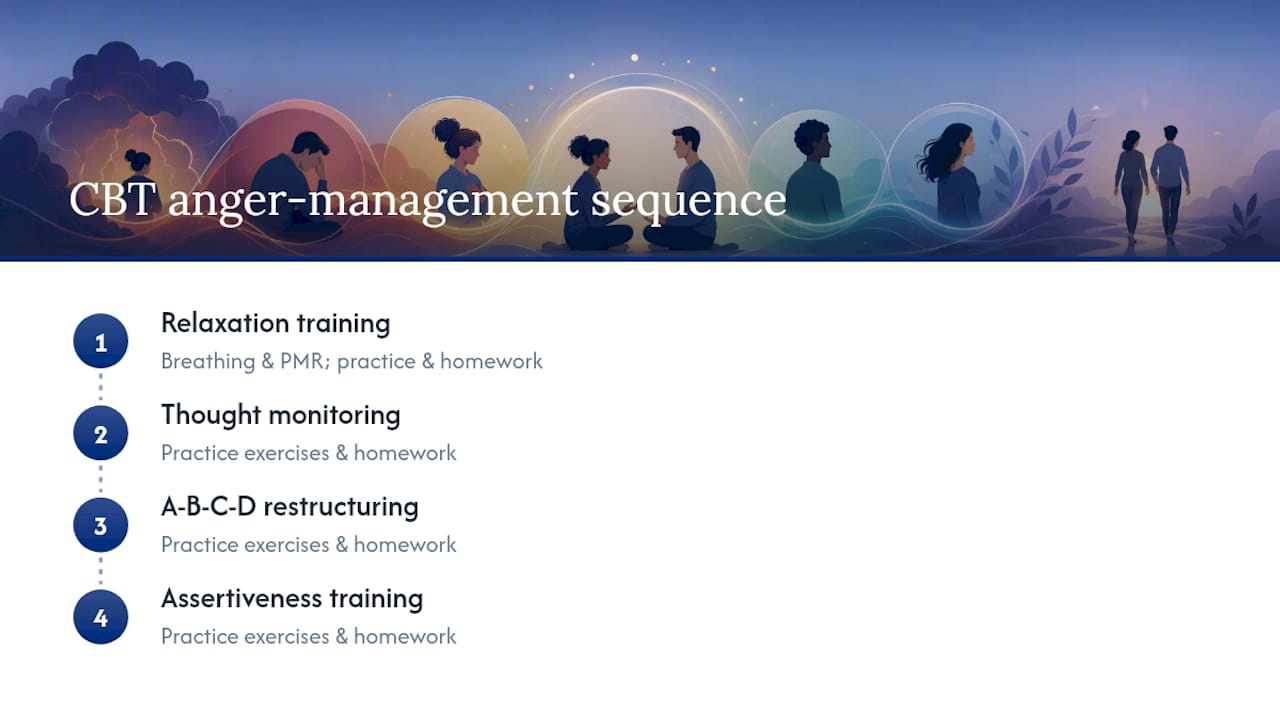
CBT-based anger management breaks down into four teachable components: relaxation training (breathing, progressive muscle relaxation), thought monitoring, cognitive restructuring using the A-B-C-D method (activating event, belief, consequence, dispute), and assertiveness training. The SAMHSA manual sequences these across a 12-week group format, pairing each skill with a practice exercise and homework.
Integrative Behavioral Couple Therapy (IBCT) works differently. Instead of eliminating conflict patterns, it teaches emotional acceptance and helps partners shift the vulnerable feelings underneath defensive behavior. Three clinical trials, including a five-year follow-up, back its use for entrenched relational conflict, and clinicians often frame these recurring patterns using DEEP or CCRT concepts (core conflictual relationship themes) to help clients see the cycle rather than just the latest fight, according to a review of IBCT trials.
Internet-delivered, clinician-guided CBT extends both models into remote formats, which matters for organizations spread across locations or clinicians building hybrid programs.
The WCM strategy (want, can, must) gives clients a simple decision framework for stuck negotiations: what each party wants, what they can realistically do, and what they must do regardless of preference. It works especially well for decision-focused disputes where emotion has crowded out logistics.
A Slide-by-Slide Outline You Can Build From Today
A workshop deck runs cleanest at 12 to 16 slides, organized into seven modules. Here’s a sequence that holds up across formats, from a lunch-and-learn to a full clinical training day.
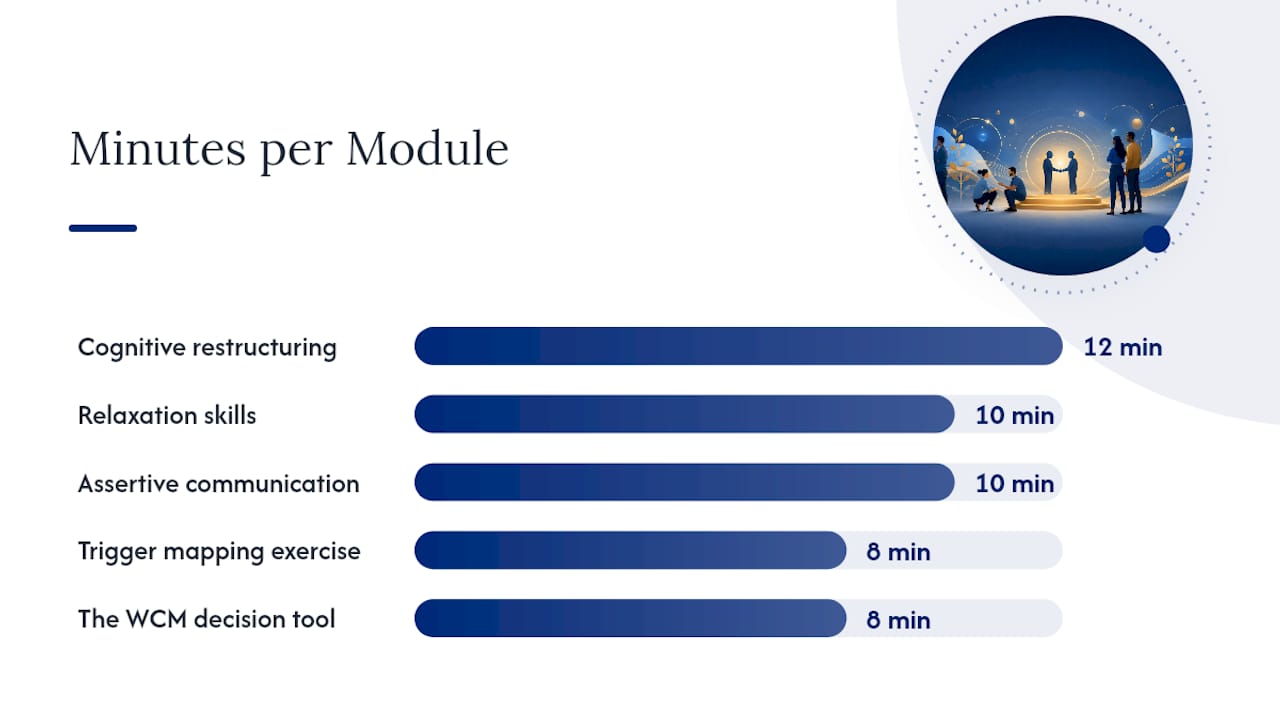
- Title and framing (1 slide, 3 minutes): State the workshop’s goal and ground rules. Speaker note: name confidentiality limits before anything else.
- Quick self-assessment (1 slide, 5 minutes): A short anger or conflict-style checklist participants score themselves on privately.
- Why conflict escalates (1 slide, 5 minutes): Cover the physiological arousal curve; note that skills work only below a certain arousal threshold.
- Trigger mapping exercise (1 slide, 8 minutes): Participants identify one recent trigger and the early body signal that preceded it.
- Relaxation skills (2 slides, 10 minutes): Demonstrate paced breathing live, then practice as a group.
- Timeouts and anger meters (1 slide, 5 minutes): Give the specific phrasing for calling a timeout without escalating further.
- Cognitive restructuring (A-B-C-D) (2 slides, 12 minutes): Walk through one worked example before asking participants to try their own.
- Assertive communication vs. aggression (2 slides, 10 minutes): Contrast “I” statements against blame language using two short scripts.
- The WCM decision tool (1 slide, 8 minutes): Apply want/can/must to a sample workplace scenario.
- Structured problem-solving practice (2 slides, 15 minutes): Role-play in pairs with a facilitator circulating.
- Safety, referrals, and resources (1 slide, 5 minutes): Close with escalation language and referral contacts.
Pro Tip: Build one slide per activity, not per talking point. A slide crowded with bullet text kills momentum right before a role-play, when energy matters most.
Keep visuals sparse: worksheets and role-play prompts belong on their own slides, not squeezed under a paragraph of text. Reserve one slide per measurement tool (a brief anger scale, a satisfaction check) so participants can screenshot or photograph it for later.
Turning Slides Into Session Plans
A deck only works once it’s mapped onto real session time. Three formats cover most needs:
- Single 90-minute workshop: Objective is skill exposure, not mastery. Core exercises: trigger mapping, one relaxation technique, one A-B-C-D worked example. Homework: a one-week anger or conflict log. Measure: brief pre/post self-rating.
- 6-session short group: Objectives build weekly, regulation first, then cognitive skills, then communication and negotiation, closing with a review session. Homework escalates from logging to scripted practice with a partner or colleague. Measure: session-by-session symptom or satisfaction tracking, flagged if a participant plateaus by session 4.
- 12-session extended module: Follows the SAMHSA sequence closely, adding IBCT-style acceptance work for participants in ongoing relational conflict. Homework includes rehearsed role-plays and timeout plans. Measure: monitoring every 3 to 7 sessions to catch clients going off track, a benchmark supported by couples-intervention research.
For couples or high-reactivity employees, shorten each exercise window and add a cooling-off buffer between role-play and debrief. Reactive clients need more transition time than the slide timing above allows.
The Research Behind Each Slide
The evidence base here is stronger than most workshop decks bother to cite. A 2022 randomized trial of therapist-supported, internet-delivered treatment combining emotion regulation and cognitive reappraisal found 88% retention at three-month follow-up, with meaningful reductions in anger expression and aggression, across participants averaging 41 years old, according to the trial published on PubMed.
A separate randomized trial of internet-delivered, clinician-guided CBT teaching emotion-regulation and conflict-resolution skills reduced intimate partner violence in a sample of 65 participants, with gains holding at one-year follow-up. Mediation analysis pointed to improved emotion regulation as the actual mechanism of change, not just skill recall, per the study in the Journal of Clinical Psychology.
On the couples side, meta-analytic reviews show distressed couples in structured, time-limited programs improve more than most untreated controls, a substantial average effect. IBCT specifically carries support from multiple trials, including long-term follow-ups, which is longer than most therapy research bothers to track.
Facilitating the Session Without Losing Control of the Room
Open every session with three ground rules: confidentiality limits, the right to pass on any exercise, and a clear plan for what happens if someone becomes distressed.
- Model role-plays yourself before asking participants to try them; a clinician demonstrating a de-escalation script normalizes the awkwardness of practicing out loud.
- Debrief every role-play with one question: “What did you notice in your body?” before asking what they’d change.
- For remote delivery, run breakout rooms in pairs of two, confirm tech and audio before starting the exercise, and get verbal consent before any disclosure-heavy discussion.
- Use a one-line pre and post measure (a 0 to 10 anger or stress rating) to track shift within the session itself.
Pro Tip: If a participant discloses active abuse or crisis-level distress mid-exercise, pause the group activity entirely rather than trying to fold it into the lesson. Address it privately, then return to the group with a brief, calm transition.
When Slide-Based Training Isn’t the Right Tool
Some situations call for direct clinical intervention, not a workshop slide. Ongoing intimate partner violence, active suicidality, or severe substance intoxication are immediate contraindications; a facilitator should pause the session and refer to crisis services rather than proceed with skill-building.
Before any group work, run a short screening: recent safety concerns, current substance use, and willingness to participate voluntarily. State confidentiality limits plainly on an early slide, and phrase them in plain language: “What’s said here stays here, except if I have concerns about safety.”
What Mastering Conflict Sees Trainers Get Wrong
Slides teach concepts. They don’t build skills. The most common mistake we see is a facilitator swapping experiential practice for a script, handing participants a phrase to memorize instead of letting them rehearse it under mild stress. Emotional-regulation practice gets cut first when time runs short, and it’s the piece that makes everything after it stick. Pair any slide deck with real supervision or coaching follow-up. Fidelity to a model matters more than fidelity to a template.
— Carlos
How Mastering Conflict Supports Clinicians and Organizations
Building a clinically sound workshop from scratch takes real time, and most organizations don’t have a spare month to pilot-test session sequencing. Mastering Conflict works directly with clinicians and teams to shortcut that process: custom workshop design grounded in the same evidence base covered above, group formats through the anger management groups program, and relational conflict support through couples packages for organizations dealing with partner or family-adjacent workplace strain.
For clinicians building their own practice around this material, clinical supervision and clinical mentoring provide the fidelity check that slide decks alone can’t. If you’re ready to move from outline to delivery, start with Mastering Conflict’s clinical services page and request a consultation to scope a workshop or supervision plan suited to your setting.
Sources
For handouts and slide citations, five sources carry real weight: the SAMHSA anger management manual for session structure, the PubMed iCBT trial for retention and effect-size data, the IBCT review for couple-conflict evidence, the UCLA couples intervention review for monitoring benchmarks, and the WCM mediation strategy for decision-focused disputes.
This article is general information, not a substitute for advice from a qualified doctor. Consult a qualified healthcare professional about your own circumstances before acting on anything here.
- Internet-delivered treatments for maladaptive anger (PubMed)
- Anger Management Manual (SAMHSA)
- Integrative Behavioral Couple Therapy (PMC review)
- iCBT for aggression and IPV (Wiley)
- Interventions for couples (UCLA review)
FAQ
What should a clinical conflict-resolution PPT include at minimum?
Emotional-regulation skills, CBT-based cognitive restructuring and communication training, and a structured resolution model with a safety-planning slide are the three essentials.
How long should a workplace conflict-resolution workshop run?
Formats range from a single 90-minute session for skill exposure to a 12-session extended module following the SAMHSA manual sequence for lasting change.
Is IBCT appropriate for workplace conflict, or only couples?
IBCT was built for couples, but its core mechanism, shifting vulnerable responses instead of just changing behavior, applies to any relational conflict with a recurring pattern, including coworker or supervisory disputes.
What’s the WCM strategy and when should I use it?
WCM (want, can, must) is a mediation framework that separates what each party wants from what they can do and must do; it works best for decision-stuck negotiations rather than emotionally raw disputes.
When is slide-based conflict training not appropriate?
Skip group slide training when there’s active suicidality, ongoing intimate partner violence, or severe substance intoxication involved, refer to direct clinical care instead, such as Mastering Conflict’s clinical services.