
Conflict Resolution for Elementary Students: A Parent’s Guide

When elementary students fight, the fastest useful step is to pause, do a quick safety check, let both kids take a short breath, then ask one neutral question: “Can you each tell me what happened, one at a time?” That single prompt, drawn from the facilitation approach used by clinicians like Dr. Carlos Todd at Masteringconflict, shifts the adult out of judge mode and gives children a structure they can eventually use on their own. Programs like Responsive Classroom have used this same calm-down-first sequence in elementary classrooms for years, and the Child Mind Institute recommends visual calming tools as a necessary first step before any problem-solving begins. If conflicts involve repeated physical aggression, a child who refuses to attend school, or signs of persistent anxiety around peers, those are signals to seek professional support rather than handle it at home alone.
Table of Contents
- What does conflict resolution for elementary students actually look like?
- How do you adapt these steps for K–2 vs. grades 3–5?
- Which activities help kids practice these skills at home?
- How should adults facilitate without playing judge?
- What are the red flags, and how long does this take to learn?
- What does professional help actually look like?
- Key Takeaways
- Why scaffolded practice is the part most parents skip
- Professional support from Masteringconflict
- Useful sources and further reading
What does conflict resolution for elementary students actually look like?
Teaching kids to resolve disputes is less about rules and more about a repeatable script they can reach for when emotions spike. The five steps below are adapted from validated protocols used in elementary classrooms, including the Responsive Classroom conflict resolution sequence. Practice each step during calm moments, not mid-argument.
-
Stop and breathe. Child line: “I need a minute.” Adult prompt: “Let’s both take three slow breaths before we talk.” Cooling off restores the nervous system’s capacity for problem-solving; skipping this step usually makes the conversation worse.
-
Say what happened using “I” statements. Child line: “I felt left out when you took the last turn.” Adult prompt: “Start with ‘I felt…’ so your friend knows how it landed for you.” I-statements and active listening keep the focus on feelings rather than blame.
-
Listen and repeat back. Child line: “So you’re saying you didn’t know I was waiting?” Adult prompt: “Can you tell me what your friend just said, in your own words?” This step is harder than it sounds for kids under 8, so model it yourself first.
-
Find a solution together. Child line: “What if we take turns, and I go first this time?” Adult prompt: “What’s one idea that works for both of you?” The goal is not winning; it is moving forward with a shared plan.
-
Close with an acknowledgment. Child line: “Okay, we’re good.” Adult prompt: “You two figured that out. How does it feel now?” A ritualized acknowledgment signals closure without forcing an apology that neither child means.
How do you adapt these steps for K–2 vs. grades 3–5?
The script above works at both levels, but the scaffolding looks very different. Younger children need visuals and heavy adult coaching; older kids can start running the process with minimal prompting.
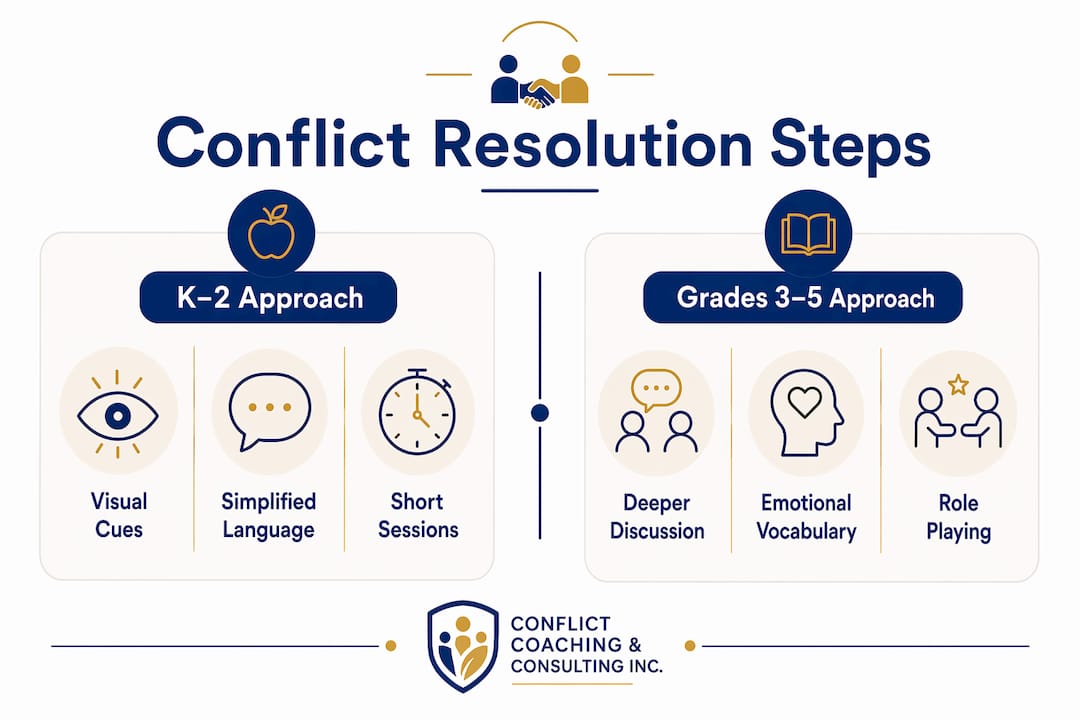
| Step | K–2 approach | Grades 3–5 approach |
|---|---|---|
| Stop and breathe | Stoplight poster: red = stop, yellow = breathe, green = talk | Emotion thermometer; child self-rates feelings before speaking |
| “I” statements | Picture prompt cards with feeling faces; adult models the sentence | Child writes or says the statement independently; adult listens |
| Listen and repeat | Adult paraphrases for the child, then asks “Did I get that right?” | Child repeats back; adult only corrects if the message was missed |
| Find a solution | Adult offers two choices; child picks one | Child brainstorms at least two options before adult weighs in |
| Acknowledgment | High-five or handshake ritual chosen by the class or family | Brief verbal check-in; no physical ritual required |
Building emotional vocabulary matters at both levels, but K–2 children typically work from a short list of five to eight feeling words, while grades 3–5 students can handle a richer set drawn from books they are reading. The Child Mind Institute recommends fading visual supports gradually as children demonstrate they can label feelings without them, rather than pulling the scaffolding all at once.
Which activities help kids practice these skills at home?
Practicing during calm times is the single most effective thing parents can do. Skills rehearsed at low emotional intensity are far more accessible when a real argument erupts. Here are four activities worth building into a weekly routine:
- Feelings chart check-in: Each morning or evening, the child points to or names a feeling on a chart. This builds the emotional vocabulary that makes Step 2 possible during conflict.
- Role-play scenario cards: Write three or four common conflicts on index cards (“Someone cut in line,” “A friend took your toy”). Take turns acting out each side and practicing the five steps. Scenario-based role-play builds the muscle memory children need to access these tools under stress.
- Problem-solving baseball: Assign bases to each step (first base = breathe, second = share feelings, third = listen, home = solution). Walk through a scenario and physically move to each base. Works especially well for kids who learn through movement.
- Peace Path walk-through: Tape or draw a simple path on the floor with five labeled stops. Two children walk it together after a disagreement, pausing at each stop to complete that step. Takes about five minutes once kids know the routine.
Step-by-step role-play template (15 minutes, no materials needed):
- Pick a low-stakes scenario from a card or make one up.
- Parent plays the “other kid” and models the wrong response first (interrupting, blaming).
- Redo the scene using the five-step script correctly.
- Child takes the lead; parent only prompts if the child gets stuck.
- Debrief: “Which step felt hardest? Why?”
For printable feelings charts and scenario cards, the Lenny Learning Peaceful Problem Solvers lesson and the Georgia DECAL peaceful problem-solving resource kit are both free and classroom-tested.
How should adults facilitate without playing judge?
The adult’s job is to hold the process, not decide who was right. Edutopia’s guidance on facilitation makes this concrete: steer toward shared values like safety and fairness rather than trying to establish whose version of events is accurate. Two kids can remember the same argument completely differently, and arguing about facts just prolongs the fight.
Dos:
- Ask open questions: “What were you hoping would happen?”
- Reflect feelings back: “It sounds like you both felt ignored.”
- Name the shared value: “We both want this to feel fair, right?”
Don’ts:
- Assign blame out loud, even when it seems obvious.
- Accept an apology on behalf of the other child.
- Resolve it for them when they are capable of reaching a solution themselves.
“When adults shift from ‘Who started it?’ to ‘Can we agree this needs to feel safe and fair for everyone?’ children stop defending their story and start solving the problem.” — Edutopia, Conflict Resolution in the Early Grades
Pro Tip: If a child is still crying or visibly dysregulated, the conversation will not go anywhere useful. Name it plainly: “You’re not ready yet, and that’s okay. We’ll try again in ten minutes.” Returning to the conversation after a genuine cool-down is more productive than pushing through when emotions are still high.
What are the red flags, and how long does this take to learn?
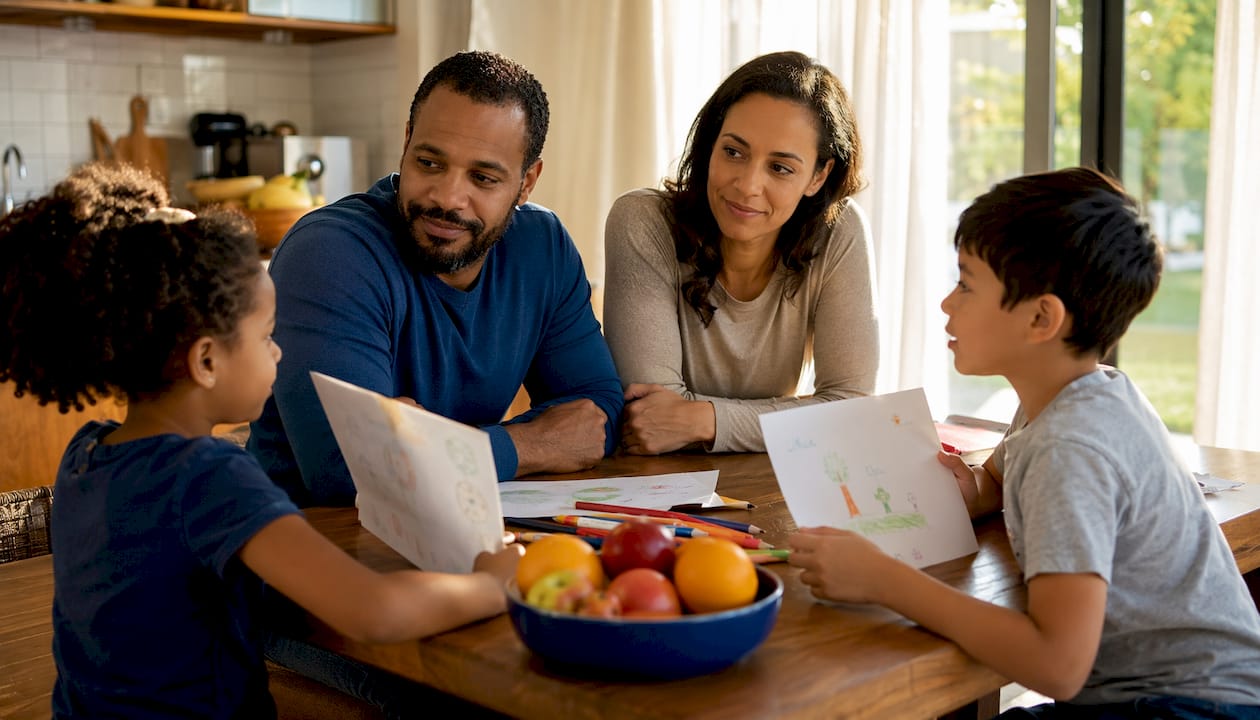
Most elementary students need several weeks of consistent practice before the steps feel natural, and months before they use them independently during real conflicts. Expect regression during stressful periods like the start of a new school year.
Red flags that warrant adult intervention or professional support:
- Repeated physical aggression (hitting, biting, pushing) that does not decrease with coaching
- A child who withdraws socially or refuses to attend school because of peer conflict
- Persistent anxiety, stomachaches, or sleep problems tied to peer relationships
- Threats of harm to self or others
- A pattern of targeting one specific child (bullying dynamic)
- No improvement after six to eight weeks of consistent practice at home and school
When these signs appear, brief family coaching or child therapy is a reasonable next step, not a last resort. Teletherapy options have made professional support more accessible for families who cannot easily get to an in-person office.
What does professional help actually look like?
Professional support for elementary conflict issues typically falls into three formats: individual child therapy focused on emotion regulation and social skills, brief family coaching sessions where parents learn to facilitate at home, and group social-skills classes where children practice with peers in a structured setting. Teletherapy works well for all three.
Questions worth asking any provider:
- Are you licensed, and do you have specific experience with elementary-aged children?
- What does a typical session look like for a child this age?
- How will we know if it’s working, and over what timeframe?
- Do you accept insurance, and what are the out-of-pocket costs if not?
Masteringconflict, founded by Dr. Carlos Todd, a licensed clinical mental health counselor and psychologist, offers child and family counseling, conflict coaching, and teletherapy. A first visit typically involves an intake conversation with the parent, a brief assessment of the child’s current social and emotional functioning, and a discussion of goals. Services are available in North Carolina, South Carolina, Florida, and remotely through online sessions. For families weighing whether coaching or therapy is the right fit, the coaching vs. therapy explainer on the Masteringconflict site walks through the practical differences.
Key Takeaways
Teaching elementary students conflict resolution works best when adults act as facilitators, children practice during calm moments, and visual scaffolds are faded gradually as skills develop.
| Point | Details |
|---|---|
| Pause before problem-solving | A short cool-down restores kids’ capacity to talk; skip it and the conversation usually escalates. |
| Use the five-step script | Stop, share feelings with “I” statements, listen back, find a solution, and close with acknowledgment. |
| Match scaffolding to age | K–2 needs stoplight posters and picture prompts; grades 3–5 can self-rate and brainstorm independently. |
| Watch for red flags | Repeated aggression, school refusal, or no progress after six to eight weeks signals time to get professional help. |
| Masteringconflict as next step | Dr. Carlos Todd’s team offers child counseling, family coaching, and teletherapy for families who need clinical support. |
Why scaffolded practice is the part most parents skip
Most parents understand the steps in theory. The gap is in the practice. Children do not internalize conflict-resolution skills by hearing about them once; they build them the same way they build any other skill, through repetition at low stakes. The clinical rationale is straightforward: when a child has rehearsed the five steps during a calm role-play, those steps become accessible even when the nervous system is activated during a real argument. Without that rehearsal, the script exists only on paper.
What I see consistently in clinical work is that parents who model the process openly, including saying “I’m going to take a breath before I respond,” give children permission to do the same. The adult’s behavior is the curriculum. Expecting a child to regulate emotions the adult has not modeled is asking for something the child has never seen.
Realistic expectations matter too. Six to eight weeks of consistent practice is a reasonable window to see early progress. Full independence, where a child navigates a peer conflict without adult prompting, typically takes several months. That timeline is not a failure; it is how skill development works.
Professional support from Masteringconflict
When home practice and school support are not enough, Masteringconflict offers child-focused counseling, family coaching sessions, and teletherapy for families across North Carolina, South Carolina, Florida, and beyond. Sessions are structured around the same evidence-based facilitation principles covered in this guide, adapted to your child’s age and specific situation.

On first contact, parents can expect a brief intake conversation, a discussion of what the child is experiencing, and a clear explanation of session format, length, and payment options, including insurance. To get started or ask a question, visit masteringconflict.com.
Useful sources and further reading
| Source | What it covers |
|---|---|
| Edutopia: Conflict Resolution for Elementary Students | I-statements, Peace Path steps, and classroom-tested scripts for building independence |
| Edutopia: Conflict Resolution in the Early Grades | Facilitation over judging; values-based reframing for classroom and home use |
| Child Mind Institute: Teaching Kids How to Deal With Conflict | Calming strategies, visual tools, and the case for practicing during low-stress moments |
| Responsive Classroom: Conflict Resolution Protocol | Step-by-step classroom protocol with cooling-off, acknowledgment rituals, and independence scaffolding |
| Lenny Learning: Peaceful Problem Solvers | Structured role-play and game-based activities with printable materials |
| Georgia DECAL: Peaceful Problem Solving Resource Kit | Free classroom solution kit with feeling posters and calming strategy cards |
| Masteringconflict: Conflict Resolution for Kids | Practical strategies and skill-building examples for child conflict resolution |
| Masteringconflict: Parenting Through Conflict | Parent-facing de-escalation strategies and modeling guidance |
Recommended
- Conflict Resolution for Kids: 5 Strategies Boosting Skills by 50% – Mastering Conflict
- Conflict Resolution for Teens: Building Communication Skills – Mastering Conflict
- Conflict Resolution for Adolescents: Parent Strategies That Work – Mastering Conflict
- Conflict Resolution Strategies for Teens: Building Stronger Family Bonds – Mastering Conflict