
Burnout Recovery Stages: What to Expect and How Long It Takes

Burnout recovery is not a straight line back to normal. Clinical guidance describes it as three phases: a short crisis phase of rest, a phase of working out what drained you, and a phase of changing how you work and live. For many people the whole path takes a few months, and it goes best with structured support rather than willpower alone. If you are a high achiever, a parent, a partner or a clinician, the stages below show you where you are and what to do next.
TL;DR
- Recovery has three phases: stop the damage and rest, understand the causes and build skills, then apply the changes in daily life.
- In one clinical framework these phases take about 2 to 3 weeks, 3 to 6 weeks and 3 to 6 weeks, with return to work typically within three months.
- Timelines vary. Remaining symptoms, sleep, stressors at home and support at work all shape how fast you recover.
- Perfectionism and the habits of high achievers can keep burnout going, so recovery works best when it changes those patterns and not only your schedule.
- If you are still unable to function after four to six weeks, or your symptoms are severe, get a professional assessment.
Table of Contents
- Burnout stages and recovery stages are not the same thing
- The three phases of burnout recovery
- How long does burnout recovery take?
- What helps at each stage
- Perfectionism, high achievers and burnout
- Burnout recovery for therapists and helping professionals
- Signs you need a professional assessment
- Getting structured support through recovery
- Our perspective
- FAQ
- Sources
Burnout stages and recovery stages are not the same thing
Search results for this topic are full of the “12 stages of burnout,” which describe how burnout builds: an urge to prove yourself, working harder, neglecting your own needs, withdrawing, and eventually collapse. That model describes the slide. Recovery is the climb back, and it has its own sequence.
Researchers also describe the slide in fewer steps. A 2024 peer-reviewed review of the temporal stages of burnout lays out four: engagement with a high ideal of the job, a weakening of that ideal, protective withdrawal, and confirmed burnout. The point for you is that burnout rarely arrives suddenly. By the time you feel flattened, you have usually passed several earlier stages without naming them.
That matters for recovery. The earlier stage you catch, the lighter the work of getting back. The later stage, the more you need rest first and structure second.
The three phases of burnout recovery
The same 2024 review describes a clinical follow-up in three steps, drawing on evidence-based practice guidance and a Dutch clinical guideline. The Dutch patient-information site Thuisarts, a professional health resource, describes a very similar order: understand and accept the burnout, find solutions to the problems that cause extra tension, then change what you do in your life.
| Phase | Typical length | Main goal | What it feels like |
|---|---|---|---|
| 1. Crisis and rest | About 2 to 3 weeks | Stop the drain, rest, regain energy | Flat, exhausted, easily overwhelmed. Small tasks feel large. |
| 2. Understanding and skills | About 3 to 6 weeks | Analyze the problems, build stress skills | Clearer thinking returns. You start to see the pattern behind the collapse. |
| 3. Applying changes | About 3 to 6 weeks | Put solutions into daily life and work | Energy is steadier. Old habits tempt you back. |
These ranges come from the clinical framework in the 2024 review. It also notes that patients typically return to work within about three months, and that someone still unable to work after four to six weeks needs more support and, often, other specialists. Treat the numbers as a map, not a deadline.
Phase 1: crisis and rest
The first job is to stop making it worse. You are depleted, and the goal is not to think your way out. It is to sleep, eat regularly, move gently and lower demands as far as your situation allows.
What goes wrong here: people try to “recover” by being productive about it. They schedule a perfect wellness routine, feel guilty when they miss it and add one more thing they are failing at. In this phase, a short list of basics is enough.
The American Psychiatric Association’s guide to protecting your well-being recommends 7 to 9 hours of sleep with consistent bedtimes, regular physical activity (even a 20-minute walk can reduce stress hormones) and keeping up social connections so you do not isolate. Those are good anchors for this phase.

Phase 2: understanding what drained you
Once the fog thins, you can ask what actually caused this. Was it workload, a lack of control, a conflict with a boss, caregiving at home, a relationship under strain, or your own standards? Usually it is a mix.
This is where many people stall, because it requires honest examination and a guide. You are looking for the specific pressures that exceeded your capacity, and the beliefs that made you carry them: “I can’t say no,” “if I rest, things fall apart,” “my worth is my output.”
A Swedish narrative review of rehabilitation for chronic stress-induced exhaustion concluded that cognitive behavioral and multimodal interventions seem to reduce symptoms, and that sleep matters for both symptom improvement and return to work. Skill-building in this phase is the work that therapy and coaching are designed to support.
Phase 3: applying the changes
The last phase is where recovery either holds or slips. You put new boundaries, a lighter load and new habits into real life, usually including a return to full work or caregiving duties.
The pattern to watch for is the relapse of old behavior at the first sign of feeling better. You feel 70 percent, so you say yes to everything again. Plan the return in steps, and decide in advance which commitments stay off your plate.
The Mental Health America burnout guide suggests small, practical moves: micro-boundaries, not checking email after hours, using paid time off, delegating tasks and building in short rest moments. These work best when they are decided in phase 2 and practiced in phase 3.
How long does burnout recovery take?
The honest answer is weeks for mild cases and months for severe ones, with real variation. Here is what the research shows.
- A 13-month follow-up. In a study of 71 patients on sickness leave for work-related stress, burnout complaints dropped to borderline clinical levels and 68% had resumed work by 13 months. The researchers also found that feeling better and returning to work were relatively independent processes. You can be back at your desk before you are recovered, or recovered before you are back.
- A 6-month follow-up. In a peer-reviewed study of 59 clinically burnt-out employees, all burnout symptoms had decreased significantly after six months, and 37% had fully returned to work. Those who fully returned had symptom levels similar to a healthy reference group. Sleep problems at the start predicted poorer return to work.
- Return-to-work quality. A 2021 study on returning to work after burnout found that supervisor support was the strongest determinant of quality of return, while remaining burnout severity, neuroticism and private stressors hampered it. It also noted that average sick leave for burnout can be only two to three months, which means some people go back while still symptomatic.
So what speeds recovery or slows it? The same research points to the same short list:
- How severe your symptoms are when you start.
- How well you sleep.
- Whether the sources of strain at work or home actually change.
- How much support you have, from managers, colleagues, family and professionals.
- How you cope: the 2015 study above found that less avoidant coping predicted stronger improvement.
A practical reading: do not measure yourself against a friend’s timeline. Measure by direction. Are you sleeping better than last month? Can you finish a task without dread? Is the day after effort less brutal than it used to be?
What helps at each stage
Support that is right in one phase can be wrong in another. Matching it to the phase saves effort.
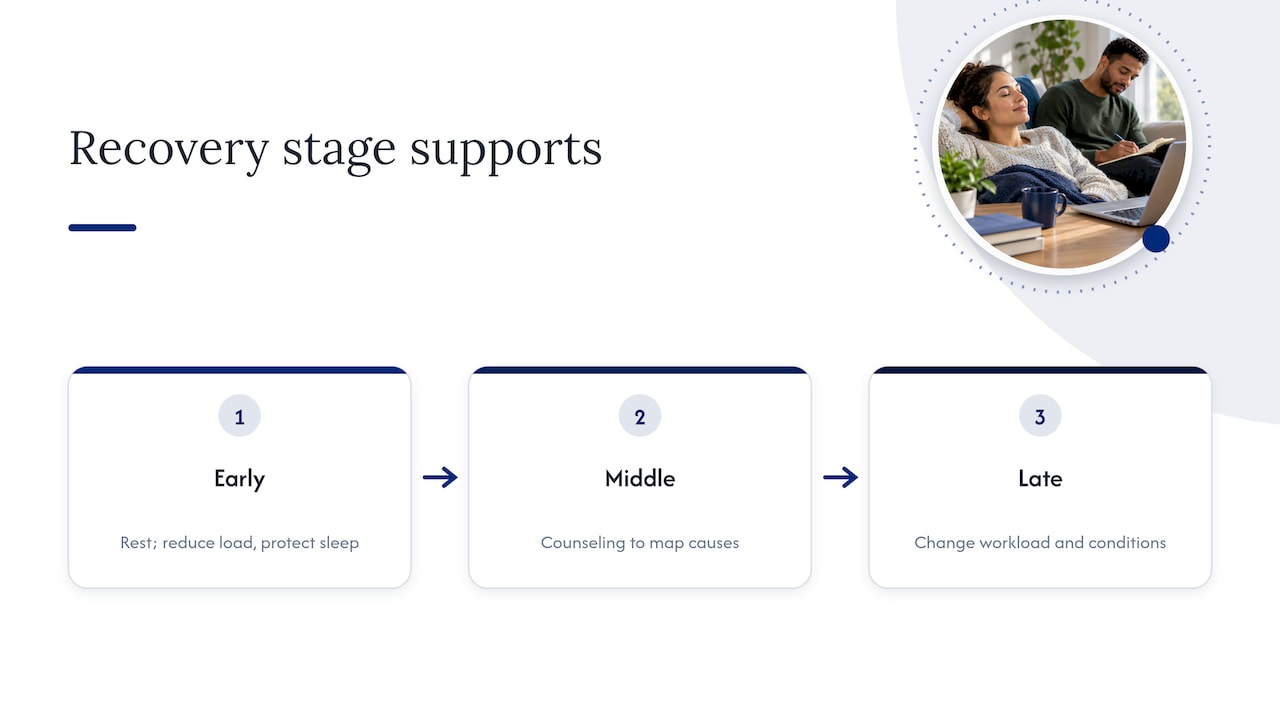
Early (rest). Reduce load, protect sleep, eat regularly, move gently, tell one trusted person what is happening. A 2025 review in PMC lists adequate social support, physical well-being, emotional flexibility and a sense of purpose among the individual factors that build resilience, and says people need to make time for rest, sleep, exercise, social contact and nutritious food.
Middle (understanding). Talk it through with someone trained to help. Individual counseling gives you a place to map what drained you. If strain is spilling into your marriage or family, couples or family sessions can ease the conflict that is feeding it. Our guides on stress management for professionals and resilience activities for adults cover practical skills for this stage.
Late (applying). Change the conditions, not just your coping. A 2019 systematic review of combined interventions found that all nine combined person-focused and organization-focused programs it covered helped rehabilitation. In a Dutch trial with self-employed owners on sick leave, the combined group returned fully about 200 days earlier than the comparison groups. Job control, social support, a voice in decisions and lower workload were the factors that seemed to help.
That is the lesson of the late stage: you recover fastest when you fix both the person and the setup. Wherever you can, change the workload, hours or expectations that caused the problem.
Workplace causes are real causes
Burnout is not a personal flaw. In healthcare support roles, for example, constant interruptions and unrealistic volume are common, as seen in the causes of an overworked medical receptionist. Naming the structural cause in your own job is part of phase 2, and it shapes what you ask for in phase 3.
Perfectionism, high achievers and burnout
High achievers often recover slowest, not because they are weaker, but because the traits that made them successful keep running during recovery: high standards, a strong sense of duty, difficulty delegating, and a habit of treating rest as a reward for finishing.
Research points to a useful distinction. A 2026 study of 598 students at Manipal Academy of Higher Education found that perfectionism was linked to lower mindfulness and, through that, to higher burnout, while excellencism, a drive to do well without the fear of any mistake, was linked to lower burnout. The authors suggest mindfulness-related training may help high-achieving students.
What that means in practice:
- Watch the recovery perfectionism. If you are grading your own rest, you are still in the loop that burned you out.
- Redefine “good enough.” Pick two or three priorities that truly matter and let the rest be adequate.
- Practice short daily mindfulness. The APA suggests 5 to 10 minutes a day.
- Separate worth from output. This is often the hardest belief change, and it is easier with a guide.
High achievers also tend to carry unspoken frustration: irritation at others who do not keep pace, or at themselves. When burnout shows up as short temper, snapping at your partner or resentment at home, that is a conflict problem as much as a stress problem, and it is worth addressing directly. Our article on evidence-based anger management strategies explains core techniques for this.
Burnout recovery for therapists and helping professionals
Clinicians are trained to hold other people’s distress, and often are the last to notice their own. The US Department of Veterans Affairs lists external causes of burnout among healthcare workers: larger patient panels, higher productivity demands, shrinking resources, little autonomy or control, heavy administrative work, a hostile workplace, work-life blend problems and malpractice suits.
If you are a therapist, recovery follows the same three phases, with two additions. First, you need a space where you are the one being supported, not the one holding space. Second, you need to look at caseload, documentation load and supervision, because those are the structural pieces that decide whether recovery lasts. Regular clinical supervision and mentoring give you a place to talk through hard cases and your own limits before they pile up.
Signs you need a professional assessment
Self-help has limits. Seek a professional evaluation if:
- you are still unable to function at work or home after four to six weeks of rest and changes;
- sleep has collapsed, or you feel constantly hopeless or numb;
- you are using alcohol, food or other substances to get through the day;
- you are withdrawing from the people you love;
- you have thoughts of harming yourself.
The four-to-six-week mark comes from the clinical framework in the 2024 review. Thuisarts also states that no medicines help you recover from burnout itself, which is why support centers on rest, understanding and change. A licensed clinician can also check whether depression or another condition is part of the picture. If you are in crisis or thinking about suicide, call or text 988, the Suicide & Crisis Lifeline in the US, or call 911 for an emergency.
Getting structured support through recovery
Our team works with individuals, couples, families and professionals, and burnout often touches all of these. Your options include:
- individual counseling for women and men, and teen and family counseling, including online sessions through teletherapy;
- the Women In Balance Coaching Program, a burnout recovery coaching program for women leaders;
- couples counseling when exhaustion and conflict are feeding each other;
- clinical mentoring and clinical supervision for practitioners.
Not sure whether you need a coach or a therapist? Our page on coaching vs therapy explains the difference.

If burnout is showing up as irritability or explosive conflict, our anger management options include online classes from $24.99 for a 1 Hour Anger Management Class, $79 for 6 hours and $85 for 8 hours. Start at Mastering Conflict to find the service that fits where you are in recovery.
Our perspective
We see burnout as a conflict problem as much as an energy problem. It is a conflict between what you are asked to carry and what you can sustain, and often between the person you want to be at work and the person who comes home.
That is why we do not treat recovery as rest alone. Rest is phase one, and it is essential. But lasting recovery needs a clinician who can help you understand the pattern, rebuild your boundaries and bring your relationships along. Our work is built on evidence-based frameworks developed by Dr. Carlos Todd, a licensed clinical mental health counselor and psychologist, and it combines practical tools with clinical rigor.
We serve individuals, couples, families and women leaders, and we support practitioners through mentoring and supervision. Whether you meet us in person in the Carolinas and Florida or online from anywhere, the aim is the same: a recovery that holds when your calendar fills up again.
Carlos
FAQ
What are the stages of burnout recovery?
Recovery usually moves through three phases: rest and regaining energy, understanding the causes and building stress skills, and applying the changes in daily life. In one clinical framework these take roughly 2 to 3 weeks, 3 to 6 weeks and 3 to 6 weeks. Individual timelines differ.
How long does it take to recover from burnout?
Mild burnout can ease within weeks, while more serious burnout often takes several months or longer. In a study following patients on sick leave, 68% had resumed work by 13 months. Sleep, severity, support and changes to the source of stress all affect the pace.
What does a burnout coach do?
A burnout coach helps you set goals, build routines and boundaries, and put changes into practice. Coaching focuses on personal development and action, while therapy addresses mental health conditions and deeper clinical concerns. Our page on coaching vs therapy lays out the difference, and our Women In Balance Coaching Program serves women leaders recovering from burnout.
Can therapists get burnout, and how do they recover?
Yes. Therapists face high caseloads, heavy paperwork and limited autonomy, all listed by the VA as causes of burnout among healthcare workers. Recovery follows the same phases, with added attention to workload and regular supervision or mentoring.
Is perfectionism a cause of burnout?
It can contribute. Research on students found perfectionism linked to higher burnout through lower mindfulness, while a healthier drive for excellence was linked to lower burnout. Recovery often includes loosening rigid standards and building daily habits such as short mindfulness practice.
Sources
- Temporal Stages of Burnout: How to Design Prevention? (PMC, 2024)
- Ik heb een burn-out (Thuisarts, 2025)
- Preventing Burnout: A Guide to Protecting Your Well-Being (American Psychiatric Association)
- Role of rehabilitation in chronic stress-induced exhaustion (Journal of Rehabilitation Medicine, 2019)
- Burnout: Signs, causes, and how to recover (Mental Health America)
- Recovery of Work-Related Stress: Complaint Reduction and Work Resumption (PMC, 2015)
- Clinically burnt-out employees on sick leave (Schaufeli, 2008)
- Successful return to work after burnout (PubMed, 2021)
- Burnout: its meaning and how to deal with it? (PMC, 2025)
- Combined Interventions to Reduce Burnout Complaints (PMC, 2019)
- The advantage of excellencism (Manipal Academy of Higher Education, 2026)
- Burnout and Resilience: Frequently Asked Questions (US Department of Veterans Affairs)