
Clinicians: 3 Printable Couples Communication Worksheets (PDF)

Printable PDF worksheets for couples communication exist, and you don’t need a therapist’s login portal to get them. Start with three exercises tonight: a 5-minute daily check-in, reflective listening (mirroring), and the Gottman Institute’s stress-reducing conversation. Scroll down for downloadable templates, exact scripts, and the four-part worksheet format therapists actually assign as homework.
TL;DR:
- Full couples workbooks like the Between Sessions PDF provide structured, multi-week exercises focused on communication, conflict reduction, and emotional connection.
- Single-page worksheets such as TherapistAid’s drawing drill or Kaiser Permanente’s listening handout are best suited for quick, targeted practice during or between sessions.
- Start with daily check-ins and gratitude exercises before progressing to listening drills, then advance to conflict management techniques, ensuring foundational skills are in place.
- Consistent practice over two to four weeks, rather than sporadic attempts, significantly improves relationship communication and reveals patterns needing professional attention.
- If conflicts escalate or safety feels compromised, it is time to seek therapy rather than rely solely on printed worksheets.
Table of Contents
- Where Can You Download Couples Therapy Exercises for Communication as a PDF?
- What Communication Exercises Do Couples Actually Practice?
- What’s in a Therapist-Style Worksheet Template?
- How Should You Use These Worksheets Between Therapy Sessions?
- Why Do Therapists Actually Assign These as Homework?
- A Clinician’s Note on What Realistic Progress Looks Like
- When Worksheets Aren’t Enough: Mastering Conflict’s Couples Programs
- Direct Downloads and Clinician Handouts Referenced Here
- Sources
- FAQ
Where Can You Download Couples Therapy Exercises for Communication as a PDF?
The best downloadable couples communication worksheets fall into two categories: full workbooks meant for weeks of homework, and single-page handouts meant for one conversation. Knowing which type you need saves you from printing 50 pages when you only wanted tonight’s exercise.
The Couples Communication Workbook from Between Sessions Resources is the closest thing to a therapist’s full toolkit available as a free PDF. It packs in dozens of worksheets covering relationship check-ins, conflict reduction, intimacy building, and mutual understanding. Every worksheet in the workbook follows the same four-part format: an objective, background information, the activity itself, and a reflection section. That consistency matters. Couples who bounce between random internet worksheets often quit because nothing feels connected. A structured workbook removes that friction. If you’re working through communication problems over a series of weeks, not just one rough night, this is the download to start with.
At the other end of the spectrum, Kaiser Permanente’s participant handout is built for a single session. It’s short, focused almost entirely on active listening mechanics, and reads more like a cheat sheet than a workbook. Therapists often print this one for clients who are already mid-session and just need a quick reference on what “listening to understand” actually looks like in practice, rather than listening to win the argument.
TherapistAid occupies the middle ground: single-exercise handouts built for practicing one skill at a time. Their back-to-back drawing exercise is a good example. One partner describes a shape or image using only verbal instructions while the other draws it without looking, which exposes exactly how much gets lost between what you say and what your partner hears. It’s a five-minute printable handout, not a 50-page commitment, which makes it ideal for a first session or a homecare assignment between appointments.
Sites like PositivePsychology and similar curated resource hubs aggregate links to dozens of these worksheets at once, which helps if you want variety but can also become a rabbit hole. If you find yourself with fifteen open tabs and no printed page, that’s a sign to pick one resource and commit to it for at least two weeks before shopping for another.
A few practical notes on choosing between them:
- Pick a full workbook (like the Between Sessions PDF) if you’re committing to structured, multi-week practice rather than a single fix.
- Pick a single-page handout (like TherapistAid’s) if you want to practice one specific skill, like listening or clarity, without a bigger commitment.
- Pick a concise clinical handout (like Kaiser Permanente’s) if you’re already in session and need a quick reference, not a full curriculum.
- Free PDF worksheets often run about three pages with 16 open-ended questions split across four sections: communication styles, conflict resolution, emotional connection, and relationship goals. That format works well as an intake tool before your first real conversation about what’s broken.
The core communication skills these worksheets teach are the same ones marriage counselors build sessions around, so a good PDF is a legitimate substitute for structured practice, not a watered down version of it.
What Communication Exercises Do Couples Actually Practice?
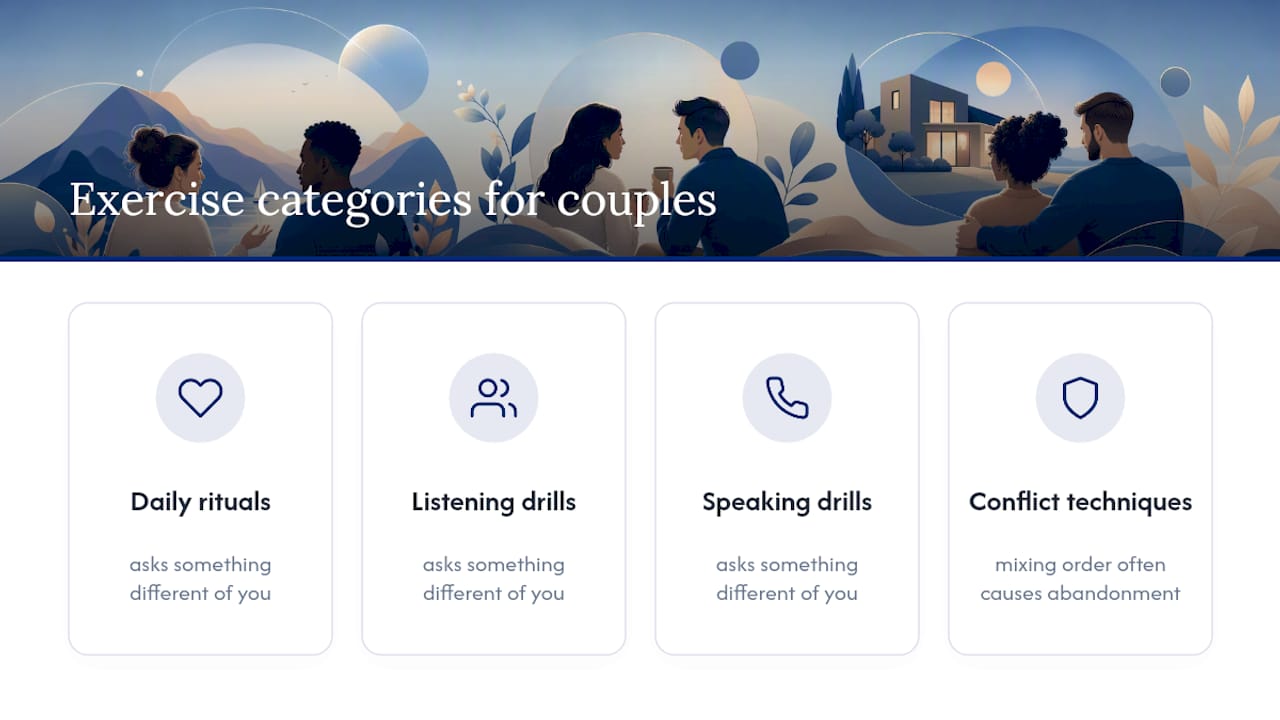
Communication exercises for couples split cleanly into four working categories: daily connection rituals, listening drills, speaking drills, and conflict-management techniques. Each category asks something different of you, and mixing them up in the wrong order is one of the most common reasons couples abandon worksheets after a week.
Daily connection rituals
These are short, low-stakes, and meant to run every single day, not just when things feel tense.
- The 5-minute check-in. Set a timer. Each partner gets 2.5 minutes to answer three questions out loud: What was the best part of your day? What was hard? What do you need from me right now, if anything? No advice-giving, no problem-solving. Just listening.
- Gratitude practice. Before bed, each partner names one specific thing the other did that day that they appreciated. Specificity matters. “Thanks for being you” doesn’t count. “Thanks for texting me back when I was anxious about the meeting” does.
- Love Maps. Once a week, ask your partner one question about their inner world you don’t already know the answer to. What’s stressing them at work right now? What’s a childhood memory they haven’t told you? The goal is staying curious about someone you already know well.
Print all three on one page with a checkbox grid for the week. Couples who track these visually stick with them longer than couples relying on memory alone.
Listening and understanding drills
This is where most communication breakdowns actually get repaired, because most fights aren’t about the topic, they’re about feeling unheard.
- Active listening, timed. One partner talks for two uninterrupted minutes about a feeling, not a complaint about the other person specifically. The listener says nothing until the timer ends, then paraphrases what they heard before responding.
- Mirroring. After the speaker finishes a sentence or two, the listener repeats back what they heard, starting with “What I heard you say is…” The speaker corrects anything that got twisted, then continues. Switch roles after five minutes.
- Reflective dialogue. Similar to mirroring but slower and more granular. Each exchange includes: reflect, validate (“that makes sense given…”), and empathize (“I imagine that felt…”). This one takes longer, but it’s the version therapists lean on when trust has eroded and partners no longer assume good intent.
Pro Tip: Set a visible timer during listening drills. Without one, the “listener” almost always jumps in early to defend themselves, which defeats the entire exercise.
Speaking and asking drills
Listening only works if the other person is also speaking clearly, which is harder than it sounds when you’re used to hinting instead of asking.
The “I” statement template structures a hard sentence as: “I feel [emotion] when [specific behavior] because [impact]. What I need is [specific request].” Compare “You never help with anything” to “I feel exhausted when I handle bedtime alone most nights because I don’t get a break. What I need is for you to take Tuesdays and Thursdays.” The second version is a request. The first is an accusation, and accusations trigger defense, not change.
Nonviolent Communication (NVC) breaks the same idea into four steps: observation (what actually happened, no interpretation), feeling, need, and request. It’s a close cousin to the “I” statement approach and both frameworks reduce defensiveness by separating facts from judgment.
For behavior change requests, the format is even more concrete: name the specific behavior, name the specific alternative, name why it matters to you, and ask if your partner is willing to try it for a set period, like two weeks, rather than forever. “Forever” requests feel like ultimatums. “Two weeks” requests feel like experiments.
Conflict-management techniques
These carry the highest emotional stakes and should come last, after the easier drills are already working.
- The stress-reducing conversation. Twenty minutes, one partner venting about something external to the relationship (work, family, a bad commute), while the other listens and shows they’re on the same team. Gottman’s research points to this as a genuine protective habit precisely because it’s low-risk. Nobody’s litigating the marriage. You’re just practicing being each other’s support system.
- The conflict post-mortem. After a fight has cooled, usually a day later, both partners answer: what triggered it, what each person actually needed in that moment, and what one thing each could do differently next time. Thirty minutes, done calmly, never in the heat of the moment.
- The exit and re-entry routine. When a conversation is escalating past a 7 out of 10 on the anger scale, either partner can call a time-out using an agreed-upon signal. The rule: whoever calls it also commits to a re-entry time, usually within an hour, not a vague “later” that never comes.
The most common mistake across all four categories is starting with conflict work before listening skills are solid. Couples skip straight to the hardest conversations, hit a wall, and conclude the exercises don’t work. They usually just started in the wrong order.
What’s in a Therapist-Style Worksheet Template?
Clinical worksheets almost universally follow a four-part structure: Objective, You Should Know, What to Do, and Reflections. This isn’t arbitrary formatting. Each section does a specific job, and skipping one weakens the whole exercise.
The Objective states, in one sentence, what the exercise is supposed to accomplish. Not “communicate better” (too vague to measure) but “practice listening without interrupting for a full two minutes.” The You Should Know section gives brief background, why the skill matters, what tends to go wrong, and what a “good” version of the exercise looks like. The What to Do section is the actual step-by-step activity, written specifically enough that two people could do it without a therapist in the room. The Reflections section closes the exercise with a few open prompts: How did that feel? What surprised you? Would you rate this helpful, somewhat helpful, or not helpful?
That reflections field isn’t filler. It’s where couples actually process what just happened, and where a therapist later spots patterns worth addressing directly.
Here are three worksheets you can recreate on a single printed page each:
Worksheet 1: The 5-Minute Check-In
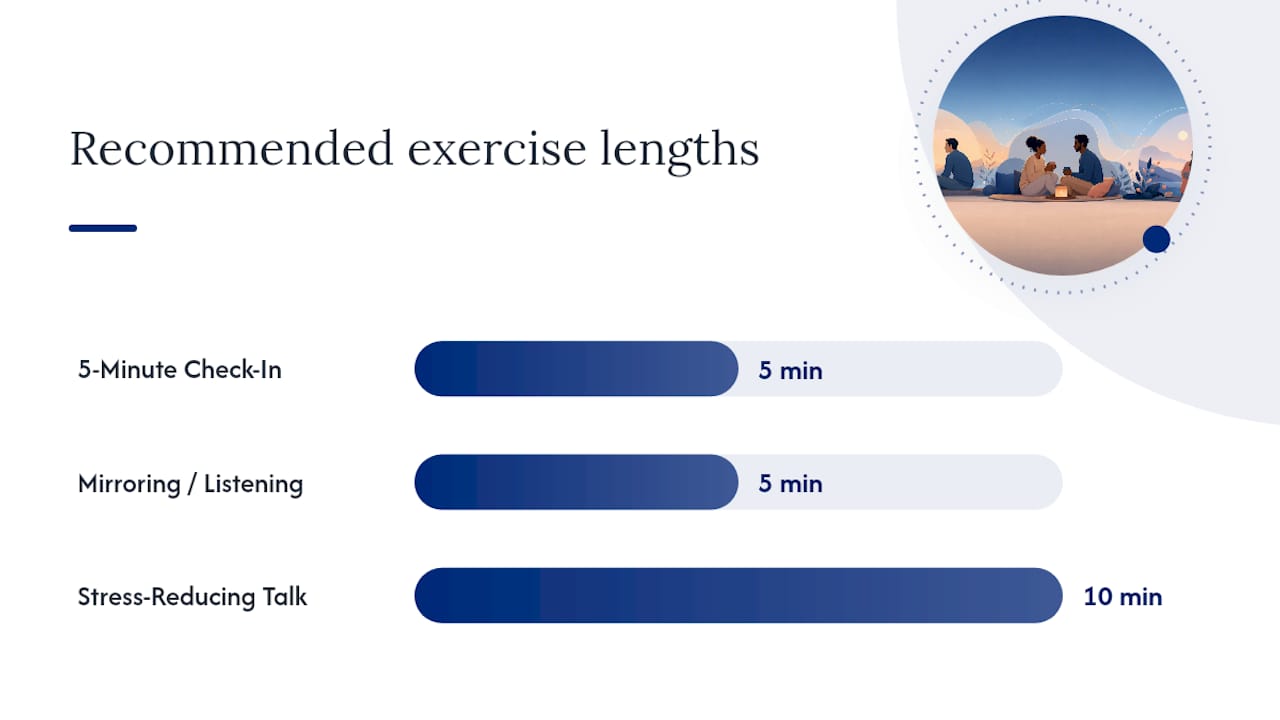
- Objective: Share one high point, one low point, and one need from today in under five minutes.
- You should know: This works best done at the same time every day, ideally not right before bed when both people are tired.
- What to do: Partner A speaks for 2.5 minutes uninterrupted. Partner B does the same. No problem-solving allowed during either turn.
- Reflections: What did you learn about your partner’s day that you didn’t know? Did anything feel hard to share?
Worksheet 2: Mirroring / Reflective Listening
- Objective: Practice repeating back what your partner said before responding.
- You should know: Most people listen to reply, not to understand. This exercise interrupts that habit on purpose.
- What to do: Speaker shares a feeling for one to two minutes. Listener repeats it back starting with “What I heard you say is…” Speaker confirms or corrects. Switch after five minutes.
- Reflections: Did your partner’s summary match what you meant? Where did the message get lost?
Worksheet 3: Stress-Reducing Conversation
- Objective: Practice supporting each other against outside stress, not relationship stress.
- You should know: The topic must be external, work, traffic, extended family, not each other.
- What to do: One partner vents for ten minutes while the other listens, validates, and shows they’re on the same side. Switch roles.
- Reflections: Did you feel supported? What did your partner do that helped most?
A structured worksheet like the Couples Communication Workbook contains dozens of exercises built on exactly this template, which is one reason therapists reach for it repeatedly instead of writing new handouts from scratch.
For printing, keep it simple: 12-point sans serif font, generous line spacing in the reflections section since people write more than they expect, and one worksheet per page rather than cramming two exercises together. Print two copies, one per partner, so nobody has to peer over a shoulder mid-exercise.
How Should You Use These Worksheets Between Therapy Sessions?
Homework works when it’s sequenced correctly and reviewed honestly, not when it’s assigned as a vague suggestion to “practice more.” Here’s a practical order of operations.
- Start with the simplest skill first. Daily check-ins and gratitude practice come before mirroring. Mirroring comes before conflict post-mortems. Jumping to conflict work before listening skills are solid is the single fastest way to make things worse, not better.
- Commit to a trial period, not a single attempt. Pick one exercise and run it daily, or several times a week, for two to four weeks before deciding whether it’s working. One awkward attempt tells you almost nothing. Consistent practice over 5 to 10 minutes a day builds the habit faster than occasional long sessions, according to Gottman Institute research on relationship practices.
- Use the Reflections section honestly, not politely. If one partner rates an exercise “not helpful” and the other rates it “very helpful,” that gap is worth flagging to a therapist directly. Disagreement in the reflections field often points to the exact pattern that needs attention next.
- Watch for red flags that worksheets can’t fix. If a listening exercise consistently escalates into a full argument, if either partner feels unsafe raising a topic, or if there’s a pattern of contempt, stonewalling, or controlling behavior, a printed handout isn’t the right tool anymore. That’s the point to move from self-guided practice into a professional setting.
Pro Tip: If you and your partner keep landing at opposite ends of the “how did that feel” scale on the same exercise, don’t just try harder next time. Bring that specific gap into a session. It’s usually more diagnostic than either of you realize.
Worksheets that touch conflict resolution directly, like the post-mortem exercise, deserve the same caution as any conflict work: if a disagreement repeatedly spirals rather than resolves, pause the exercise and address the pattern before continuing, rather than pushing through in hopes it improves on its own.
Why Do Therapists Actually Assign These as Homework?
Therapists don’t hand out worksheets because sessions run out of time. They assign them because a 50-minute weekly appointment can’t observe how a couple actually talks to each other on a Tuesday night after a bad day at work. Homework closes that gap.
The Reflections section is where the real clinical value sits. When a couple’s answers to “how did that feel” line up, that’s useful information. When they don’t line up, that’s often more useful. A therapist reading that a wife found an exercise clarifying while her husband found it pointless isn’t looking at a failed worksheet. They’re looking at a pattern worth exploring directly in the next session.
These exercises can be incorporated into couples work at varying levels of intensity depending on the couple’s situation. Some couples work through printable check-in and listening exercises alongside regular sessions, while others may need more compressed programs that condense weeks of skill building into a shorter, structured timeframe.
A few things worth knowing about how homework fits into that process:
- Worksheets teach skills in low-pressure moments so they’re already familiar when a real conflict shows up.
- The reflection fields give a therapist real data about what’s happening at home, not just what gets reported from memory a week later.
- Exercises get sequenced deliberately, from daily rituals to listening drills to conflict work, rather than handed out all at once.
- Homework works best paired with professional feedback on the parts that feel stuck, which is often the difference between practicing a skill and actually changing a pattern.
A Clinician’s Note on What Realistic Progress Looks Like
Couples chase intensity when they should chase consistency. A single two-hour worksheet marathon on a Sunday afternoon does less for a relationship than five minutes of daily check-ins done without fail for a month. The habit is the intervention, not the worksheet itself.
Expect the first few attempts to feel stiff and a little scripted. That’s normal, not a sign it’s not working. Progress usually shows up small: a fight that used to last two hours now de-escalates in twenty minutes, or a partner manages to ask for something directly instead of hinting and waiting to be disappointed. Those are real markers, even when they don’t feel dramatic.
If a conflict exercise repeatedly makes things worse instead of better, that’s information, not failure. It usually means the underlying issue needs a professional in the room, not a sharper worksheet.
— Carlos
When Worksheets Aren’t Enough: Mastering Conflict’s Couples Programs
Worksheets work when both partners are willing, safety isn’t a concern, and the problems are communication gaps rather than deeper ruptures like infidelity or chronic contempt. When practice at home keeps hitting the same wall, that’s the signal to bring in structured clinical support instead of printing yet another PDF.
Mastering Conflict builds couples work around the same skill progression covered in this article, just with a therapist actively steering the harder conversations. Standard couples sessions work well for ongoing weekly practice alongside your worksheets. Couples who need faster, more concentrated progress often choose the 6 Hour Couples Intensive, which compresses weeks of skill building into a focused block of time. For relationships at a real turning point, the Relationship Renewal Starter Program on the couples packages page offers a more structured, multi-session path back to solid ground.
If your two-week trial of check-ins and listening drills is holding steady, keep going. If it’s not, book a session and bring your printed worksheets with you. They give a therapist a real starting point instead of a blank slate.
Direct Downloads and Clinician Handouts Referenced Here
These are the specific resources cited throughout this article, organized by what each one is best for.
- The Couples Communication Workbook (Between Sessions Resources) — full multi-week workbook of therapeutic homework assignments, structured in the Objective/You Should Know/What to Do/Reflections format.
- Back-to-Back Drawing exercise (TherapistAid) — a single-exercise printable handout built for quick in-session practice.
- Couple Communication Worksheet (Pabau) — a free three-page download with 16 open-ended questions across four communication categories.
- 10 Communication Exercises for Couples (The Gottman Institute) — the source article behind the stress-reducing conversation and daily ritual exercises covered above.
Sources
- 10 Communication Exercises for Couples to Have Better Relationships — The Gottman Institute
- The Couples Communication Workbook — Between Sessions Resources (PDF)
- Back-to-Back Drawing communication exercise — TherapistAid
- Couple Communication Worksheet (Free PDF Download) — Pabau
FAQ
What Are Some Communication Exercises for Couples?
The most practical starting exercises are the 5-minute daily check-in, mirroring (reflective listening), and the stress-reducing conversation, where one partner vents about outside stress while the other listens and validates. From there, couples typically move into “I” statement practice and, once listening skills are solid, structured conflict post-mortems. Free downloadable PDFs, including the Couples Communication Workbook, organize dozens of these exercises into a ready-to-print format.
What Is the 40/20/40 Communication Exercise?
There’s no widely recognized clinical framework called the “40/20/40” communication exercise in couples therapy literature. If you encountered this term elsewhere, it may be a specific coach or program’s proprietary label rather than a standard technique, so treat any claim about it with caution rather than assuming it’s an established method.
How Often Should Couples Practice These Worksheets?
Short daily practice, around 5 to 10 minutes, produces faster results than occasional long sessions, based on Gottman Institute guidance on relationship habits. Give any single exercise two to four weeks of consistent practice before deciding whether it’s helping.
When Should Couples Move From Worksheets to Professional Therapy?
If a conflict exercise repeatedly escalates instead of resolving, or if either partner feels unsafe raising a topic, that’s a sign self-guided worksheets have reached their limit. Mastering Conflict’s couples sessions and intensives are built for exactly that point, when structured practice at home needs a therapist actively involved in the harder conversations.