
Conflict Resolution Strategies for Couples and Families

TL;DR:
- Effective conflict resolution relies on clinical skills and strategic flexibility to build lasting agreements. Using de-escalation scripts, mapping patterns, and involving professionals when necessary helps manage recurring issues safely and effectively. Emphasizing collaboration and understanding individual context leads to more durable and meaningful relationship changes.
Collaborative, flexible conflict work grounded in clinical skills produces the most durable outcomes. Start with a single de-escalation script today, and schedule a clinical assessment if safety concerns or repeated fight loops persist. The Thomas–Kilmann Conflict Model gives you a map of five styles; the Program on Negotiation (PON) at Harvard explains why collaboration wins when relationships matter. Masteringconflict, founded by Dr. Carlos Todd, a licensed clinical mental health counselor and psychologist, offers clinical support to move from insight to lasting change.
Immediate next steps:
- Say this now: “I feel [emotion] when [behavior] because [impact]. I need [specific request].” That three-line I-statement is your fastest de-escalation tool.
- Call a time-out: Agree in advance on a signal word (e.g., “pause”), step away for 60–90 seconds, and name a return time: “Let’s come back to this in 20 minutes.”
- Map the loop: If the same fight keeps cycling, write down who does what, what triggers it, and where the pattern locks in. That map is your first intervention point.
Pro Tip: Pre-agree on your time-out signal before the next argument starts. In the heat of the moment, a pre-planned word like “pause” works far better than trying to negotiate a break mid-fight.
Table of Contents
- What are the five conflict styles and why does flexibility matter?
- How do you resolve conflict step by step?
- When should you involve a clinician, mediator, or structured program?
- What does the research actually say about these methods?
- Safety first: when is conflict actually dangerous?
- Scripts and exercises you can practice at home
- What does clinical treatment for conflict actually look like?
- Key Takeaways
- Why conflict work changes when it’s clinically informed
- Masteringconflict offers real clinical support, not just information
- Useful sources and further reading
What are the five conflict styles and why does flexibility matter?
The Thomas–Kilmann model organizes every conflict response into five styles, each reflecting a different balance between asserting your own goals and preserving the relationship.
- Avoiding: Low assertiveness, low cooperation. Useful for trivial issues or when you need time to cool down, but it leaves core problems unaddressed.
- Competing: High assertiveness, low cooperation. Appropriate in genuine emergencies or when a non-negotiable boundary must hold, but corrosive in close relationships if overused.
- Accommodating: Low assertiveness, high cooperation. Keeps the peace short-term; clinically useful when the other person’s need is genuinely greater, but it breeds resentment when it becomes the default.
- Compromising: Moderate on both axes. Fast and fair, though both parties often walk away partially unsatisfied.
- Collaborating: High assertiveness, high cooperation. The most effective approach for durable agreements in relationships where both people share long-term goals.
The clinical principle here is strategic flexibility: no single style fits every situation. A therapist working with a couple might coach collaboration for recurring emotional patterns while recommending brief accommodation when one partner is overwhelmed. With a volatile supervisor or in an immediate safety situation, avoidance or accommodation is the smarter short-term move. The skill is reading the context, not defaulting to one style out of habit.
Clinical signals that collaboration is the right choice: both people are willing to practice new skills, the relationship matters to both, and the conflict is a repeating pattern rather than a one-time event. When safety concerns exist, or when one person is acutely dysregulated, de-escalation comes first.

How do you resolve conflict step by step?
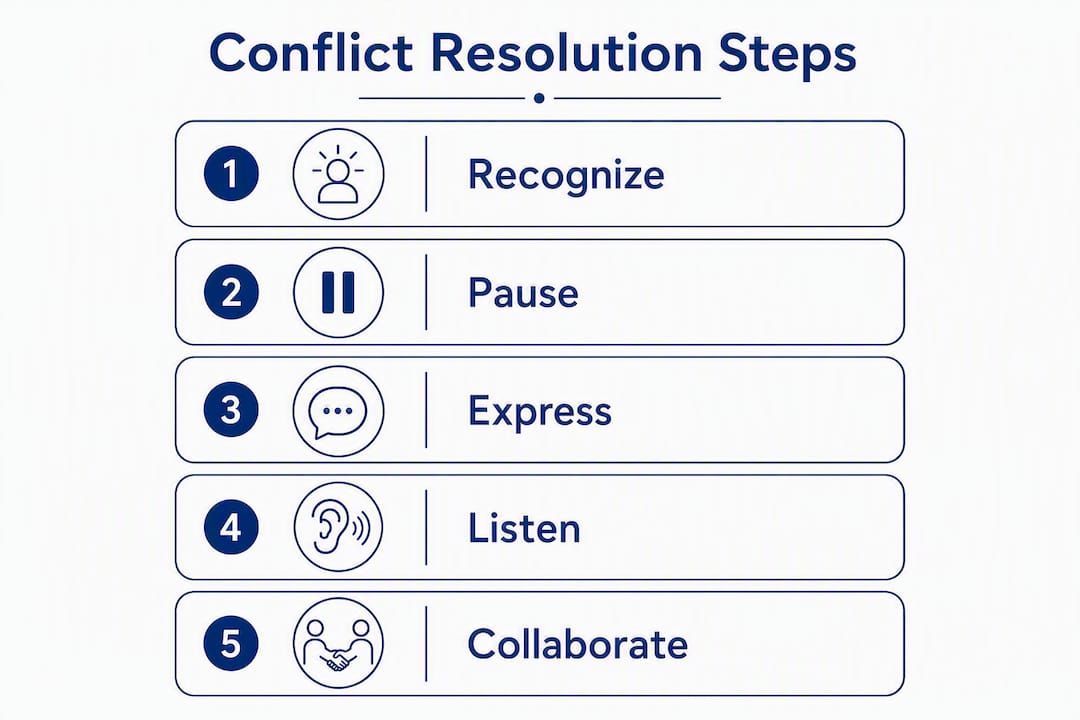
A sequenced playbook beats improvising mid-argument. Work through these six steps, in order.
-
Stabilize and de-escalate. Before any productive conversation can happen, both people need to be regulated. Take three slow breaths (4 counts in, 6 counts out). If arousal is still high, call the pre-agreed time-out: “I need a pause. I’ll be back in 20 minutes.” Return at the named time.
-
Map the conflict loop. Write down: What triggered it? What did each person do next? What kept it going? Mapping this sequence shifts the focus from blame to pattern, and one identified intervention point can break the whole cycle.
-
Clarify needs and values. Ask: “What do I actually need here, underneath my position?” Positions (“You always do this”) hide interests (“I need to feel respected”). Shifting to interests opens options.
-
Practice the speak/listen protocol. Speaker uses I-statements and owns their experience. Listener reflects back without defending: “What I hear you saying is…” Then validate: “That makes sense given what you’ve been through.” Validation is not agreement; it lowers defensiveness and opens the door to problem solving.
-
Turn complaints into requests. “You never help” becomes “I’d like you to handle dinner on Tuesdays and Thursdays.” Specific, behavioral, testable. Then brainstorm options together and pick one to try for two weeks.
-
Repair and prevent. After the conversation, use a brief repair script: “I’m sorry I [specific behavior]. Next time I will [specific alternative].” Then build one measurable prevention commitment, such as “I will tell you before making any purchase over $50.” Vague promises rebuild nothing; specific behavioral commitments do.
Checklist before you close any difficult conversation:
- Did both people feel heard?
- Is the request specific and behavioral?
- Do you have a named return time if the issue isn’t resolved?
- Is there one concrete prevention commitment written down?
When should you involve a clinician, mediator, or structured program?
Try negotiation and skills practice first. If the same pattern repeats after genuine effort, emotional regulation keeps failing, or safety concerns surface, it’s time to escalate.
Decision ladder:
- Self-guided skills practice (this article, books, online resources): best for mild, infrequent conflict with motivated parties.
- Clinical therapy (individual, couples, or family): indicated when patterns repeat, emotional regulation is a barrier, or one person’s history is driving the cycle. A therapist conducts a full assessment, screens for safety, sets goals, and structures conflict resolution steps across sessions.
- Mediation: A neutral facilitator helps parties reach a voluntary agreement. One to three sessions is common for family or workplace disputes. Less formal and less costly than arbitration or litigation.
- Arbitration/litigation: Last resorts. Experts consistently recommend starting with the least formal option and escalating only when lower-cost routes have failed.
What to expect at a first clinical appointment: intake interview, risk and safety screening, conflict history, and collaborative goal-setting. Therapy timelines vary by severity, typically weeks to several months. Costs vary widely; ask about sliding-scale fees, teletherapy options, and insurance coverage before booking.
Checklist for choosing a provider: licensed credentials (LCMHC, LCSW, psychologist), specialty in anger management or couples/family therapy, teletherapy availability, and transparent fee structure.
What does the research actually say about these methods?
The evidence base for collaborative, flexible conflict work is consistent across clinical and negotiation research.
The Thomas–Kilmann model remains the most widely used clinical taxonomy for conflict styles, giving therapists and clients a shared language for identifying default patterns and building flexibility. PON research highlights a trap most people fall into: egocentrism during conflict, where each person is so focused on defending their own fairness perception that they stop taking in the other’s perspective. Lecturing and arguing make this worse. Structured perspective-taking and facilitation break the cycle.
Constructive conflict approaches that teach emotional regulation, validation, and respectful dialogue consistently outperform strategies focused only on resolving the immediate dispute. The reason is straightforward: the same fight will return unless the underlying pattern changes.
Key research finding: Collaboration builds the most durable agreements when both parties are willing to engage, but strategic flexibility, adapting your style to the relationship stakes and context, is what separates skilled conflict managers from people who just know the theory.
Safety first: when is conflict actually dangerous?
Some situations require immediate action, not a communication protocol.
Call 911 immediately if:
- There are threats, weapons, or physical violence.
- Someone is severely intoxicated and escalating.
- You or anyone else is in imminent danger.
Contact a clinician urgently if:
- Active suicidal ideation or threats of harm to others are present.
- Violent behavior is uncontrolled and escalating across incidents.
Interim safety steps:
- Have a safe exit plan ready (a place to go, a bag packed if needed).
- Document incidents with dates, descriptions, and photos where safe to do so.
- Contact the National Domestic Violence Hotline: 1-800-799-7233 (available 24/7).
- Text “START” to 88788 (Crisis Text Line) for immediate text-based support.
Scripts and exercises you can practice at home
Core scripts
I-statement template:
“I feel [emotion] when [specific behavior] because [impact on me]. I need [specific, behavioral request].”
Time-out script:
“I need a pause. I’m not shutting down — I want to come back to this. Can we reconnect at [specific time]?”
One-minute repair script:
“I’m sorry I [specific behavior]. I can see that hurt you. Next time I will [specific alternative action].”
Two role-play exercises
-
Speaker/listener rotation. One person speaks for two minutes using only I-statements. The listener reflects back without defending, then validates. Switch. Debrief: What felt hard? What landed well?
-
Role reversal. Each person argues the other’s position for 90 seconds. This is uncomfortable by design. It builds the perspective-taking that reduces escalation cycles.
Feedback checklist after each role-play:
- Did the speaker stay in I-statements?
- Did the listener reflect before responding?
- Was validation offered before problem solving?
Daily 5-minute practice plan
- Days 1–3: Write one I-statement about a current frustration (don’t send it, just write it).
- Days 4–5: Practice the time-out script aloud with a partner or in a mirror.
- Days 6–7: Identify one conflict loop from the past week and name one intervention point.
Pro Tip: Track progress with a simple if-then plan: “If I feel my chest tighten during an argument, then I will say the time-out script.” Written if-then plans dramatically improve follow-through compared to general intentions.
What does clinical treatment for conflict actually look like?
Assessment phase
A thorough intake covers conflict history, relationship context, risk and safety screening, and goal-setting. An Anger Management Assessment at Masteringconflict, for example, evaluates triggers, intensity, frequency, and behavioral patterns before any intervention begins. This shapes the entire treatment plan.
Treatment structure
| Phase | Focus | Typical length |
|---|---|---|
| Assessment | Intake, safety screen, goal-setting | 1–2 sessions |
| Skills training | I-statements, time-outs, loop mapping, validation | 6 sessions |
| Consolidation | Repair conversations, prevention planning | 2–4 sessions |
| Review | Relapse prevention, measuring outcomes | 1–2 sessions |
Clinicians track measurable outcomes: frequency of escalated arguments, use of skills between sessions, and severity ratings. Treatment plans embed relapse prevention from the start, not as an afterthought.
What good treatment includes:
- Specific, measurable behavioral goals (not “fight less” but “use a time-out before escalating”)
- Regular review of skill use between sessions
- A written prevention plan with named commitments before discharge
Key Takeaways
Collaborative conflict work combined with strategic flexibility produces the most durable outcomes; start with an I-statement and a pre-agreed time-out, escalate to clinical support when patterns persist or safety is at risk.
| Point | Details |
|---|---|
| Start with collaboration | Collaborative approaches build the most durable agreements when both parties are willing to engage. |
| Use strategic flexibility | Adapt your conflict style to the relationship stakes and context, not just one default approach. |
| Safety overrides everything | Call 911 or the National Domestic Violence Hotline (1-800-799-7233) before attempting any resolution strategy. |
| Escalate when patterns repeat | Move from self-guided skills to mediation or clinical therapy when the same fight keeps cycling. |
| Masteringconflict offers clinical support | Dr. Carlos Todd’s practice provides anger management assessment, couples therapy, and family counseling for individuals ready to work with a licensed clinician. |
Why conflict work changes when it’s clinically informed
Most people approach conflict as a problem to win, not a pattern to understand. That framing is the single biggest obstacle I see. When someone walks in convinced the other person is the problem, the first clinical task isn’t teaching communication skills — it’s shifting that lens. Once a person can see their own role in the loop, everything else becomes learnable.
The tools in this article (I-statements, time-outs, loop mapping, prevention plans) are not soft skills. They are evidence-based techniques that require practice, feedback, and sometimes a trained clinician to apply correctly. Knowing the theory and being able to use it under stress are two very different things. That gap is exactly where therapy earns its value.
If you recognize your relationship in these pages, that recognition is worth acting on. Patterns that repeat without intervention tend to deepen, not resolve on their own. A clinical assessment is a low-stakes first step that gives you a clear picture of what’s driving the cycle and what it will take to change it.
Masteringconflict offers real clinical support, not just information
Reading about conflict resolution strategies is a start. Applying them under pressure, in your actual relationships, is where most people need support.
Masteringconflict, founded by Dr. Carlos Todd, provides licensed clinical services designed for exactly this: anger management assessment, couples counseling, family therapy, and individual therapy, all grounded in evidence-based methods. A first appointment covers a full intake, safety screening, and collaborative goal-setting, so you leave with a clear picture of what’s driving the conflict and a plan to address it. Teletherapy is available, making it accessible whether you’re in North Carolina, South Carolina, Florida, or elsewhere. Sliding-scale and insurance options are worth asking about when you book. All services are confidential and delivered by credentialed clinicians. Schedule your clinical assessment today and move from understanding the problem to actually solving it.
Useful sources and further reading
Research and clinical resources:
- Program on Negotiation — Conflict Resolution Strategies — PON’s evidence-based overview of why perspective-taking and structured facilitation outperform argument.
- PON — Conflict-Management Styles: Pitfalls and Best Practices — The foundational case for strategic flexibility and collaborative approaches.
- PON — What Is Conflict Resolution, and How Does It Work? — Explains the tiered escalation ladder from negotiation to litigation.
- Positive Psychology — Constructive Conflict: A Step-by-Step Communication Protocol — Detailed guidance on conflict loop mapping, validation, and repair scripts.
- HelpGuide — Conflict Resolution Skills — Accessible overview of communication and emotional regulation skills.
Masteringconflict clinical resources:
- Conflict resolution for couples — Couples-specific scripts and strategies.
- Conflict resolution for families — Family-focused tools and teletherapy guidance.
- Conflict resolution for kids — Age-appropriate strategies for children and teens.
- Clinical conflict management skills — How clinicians embed collaboration and skill training into therapy.
This article is general educational information, not professional mental health or legal advice. For guidance specific to your situation, consult a licensed clinician or qualified professional.
Recommended
- Conflict Resolution for Couples: Practical Strategies for 2025 – Mastering Conflict
- Conflict Resolution for Families: Tools, Tips, and Teletherapy 2025 – Mastering Conflict
- Effective Conflict Resolution Steps for Couples, Families, and Professionals 2025 – Mastering Conflict
- Conflict Resolution Strategies for Teens: Building Stronger Family Bonds – Mastering Conflict