
Dealing with Isolation: Practical Strategies That Work

What actually helps when you’re dealing with isolation
The most effective approach to dealing with isolation combines small, deliberate social steps with emotional self-compassion and consistent self-care. You don’t need a packed social calendar. You need a handful of meaningful connections, a realistic plan to rebuild them, and the patience to let that process take time.
Isolation is not simply being alone. The CDC defines it as lacking meaningful close relationships even when other people are physically nearby. That distinction matters because it changes what you actually do about it. The goal isn’t more social exposure. It’s deeper, more intentional connection.
Here’s where to start:
- Reach out to one dormant contact. A former colleague, an old friend, a cousin you haven’t spoken to in years. Shared history makes the first message far less intimidating than cold outreach.
- Try micro-interactions daily. Say hello to a neighbor. Chat briefly with a cashier. These low-stakes exchanges build social confidence without the pressure of deep engagement.
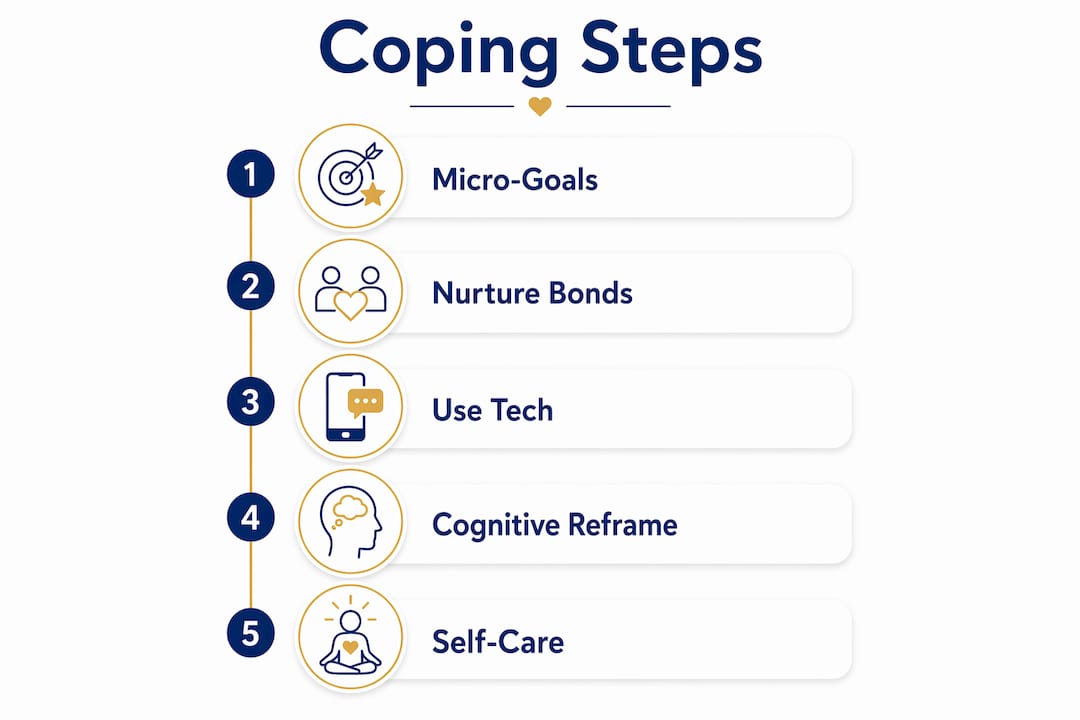
- Use technology with intention. Schedule a video call instead of scrolling through social media. Passive consumption tends to worsen loneliness, not ease it.
- Join one structured activity. A walking group, a book club, a faith organization. Structured settings reduce the pressure to perform socially.
- Tell your doctor. If isolation is affecting your sleep, appetite, or concentration, a healthcare provider can connect you with appropriate support.
Clinical advice consistently warns against trying to overhaul your social life overnight. Setting micro-goals — one small social step per day — builds momentum without triggering the burnout or anxiety that comes from pushing too hard too fast.
Pro Tip: Write down three people you’ve lost touch with. Pick one. Send a single message referencing a specific shared memory. You’re not asking for a deep reconnection. You’re opening a door.
How do you stay connected when loneliness keeps pulling you back?
Staying connected during a period of social isolation takes more than good intentions. It takes a system. The people who manage it best tend to do a few things consistently: they protect existing relationships, they use low-pressure settings to build new ones, and they treat technology as a tool rather than a substitute for real contact.
Nurture what you already have
Strengthening dormant relationships is often more effective than trying to build entirely new ones. You already have shared history, shared language, and a foundation of trust. That head start is worth using. Schedule a regular call with a family member. Send a letter. Suggest watching the same movie separately and then discussing it. These rituals don’t require proximity, and they compound over time.
For relationships that have drifted, the memory-draw approach works well: reference a specific shared experience in your first message. It signals genuine interest and gives the other person something easy to respond to.
Build new connections through shared activity
New connections form most naturally around a common purpose or interest. Volunteer work, community groups, faith organizations, and hobby classes all provide meaningful social interaction with built-in structure. You don’t have to be “on” socially. You just show up and participate.
- Join a local walking club or fitness class.
- Attend a community event or neighborhood meeting.
- Look for interest-based groups on platforms like Meetup.
- Volunteer with a local nonprofit or faith-based organization.
- Try an online community forum focused on a topic you care about.
Use technology wisely
Balanced technology use — video calls, emails, scheduled check-ins — helps maintain relationships across distance. What doesn’t help is passive scrolling. Research consistently shows that overusing social media for coping worsens feelings of isolation through social comparison and one-sided consumption. Use it to connect, not to observe.

Pro Tip: Schedule your social contact the way you’d schedule a meeting. A standing Sunday call with a friend is far more likely to happen than a vague “let’s catch up soon.”
The psychology behind isolation: why it’s so hard to break the cycle
Isolation rarely feels like a choice. For most people, it develops gradually as a self-protective response to anticipated rejection, social pain, or vulnerability. The logic is understandable: if you don’t reach out, you can’t be rejected. But the result is a reinforcing cycle. Withdrawal leads to more loneliness, which makes reaching out feel riskier, which leads to more withdrawal.
Understanding this pattern is the first step toward interrupting it.
Cognitive reframing: changing the story you tell yourself
One of the most clinically supported tools for breaking the isolation cycle is cognitive reframing. This means learning to recognize loneliness-related thoughts as symptoms rather than facts. “Nobody wants to hear from me” is a thought, not a truth. Labeling it as such creates enough distance to act differently.
Journaling is a practical entry point. Writing out a negative belief about your social life, then writing a more balanced alternative, gradually weakens the emotional grip of that belief. It’s a technique used in cognitive behavioral therapy (CBT) and one you can practice independently.
Emotional support strategies that complement this work:
- Journaling: Separate emotional weight from factual circumstances.
- Peer support groups: Normalize the experience and reduce shame.
- Talking therapies: CBT, in particular, addresses the thought patterns that sustain isolation.
- Self-compassion practices: Treat yourself with the same patience you’d offer a friend.
- Professional counseling: Especially when isolation is linked to grief, anxiety, or depression.
Facing loneliness honestly, rather than pushing it away, is what allows you to respond to it. And if you’re dealing with isolation that feels tied to relationship conflict or unresolved emotional pain, individual therapy techniques can offer a structured path through it.
Self-care habits that actually support your mental health during isolation
Self-care during isolation isn’t about bubble baths and candles. It’s about maintaining the physical and mental conditions that make social re-engagement possible. When your body is depleted, your motivation to connect drops. When your sleep is disrupted, your emotional regulation suffers. The basics matter more than they get credit for.
Regular physical activity, adequate sleep, and healthy eating form the foundation. Adults should aim for adequate sleep per night and at least 150 minutes of moderate physical activity per week. These aren’t arbitrary targets. They’re the conditions under which your brain manages stress and social motivation most effectively.
Daily habits that support mood and energy during isolation:
- Move your body. A 30-minute walk, a group fitness class, or a bike ride all count. Exercise outdoors combines physical activity with nature exposure, which reduces anxiety and depression symptoms.
- Eat consistently. Heart-healthy meals with fruits, vegetables, and whole grains support cognitive function and emotional stability.
- Protect your sleep. Keep a consistent sleep and wake time, even on weekends. Disrupted sleep amplifies emotional sensitivity.
- Practice mindfulness. Apps like Calm or Headspace offer guided meditation that takes under 10 minutes. Even brief mindfulness practice reduces the physiological stress response.
- Pursue a hobby. Creative activities, reading, gardening, and cooking all provide structure and a sense of accomplishment.
- Spend time in nature. Even a short walk in a park lowers cortisol and improves mood.
- Consider a pet. Animals provide companionship, routine, and physical comfort. Research from the National Institute on Aging notes that pets can lower blood pressure and reduce stress.
Routine is the underrated element here. When isolation disrupts your normal schedule, structure becomes the scaffold that holds everything else together. Build your day around consistent anchor points: a morning walk, a set mealtime, a scheduled call with someone you care about.
Coping with isolation also means knowing when self-care alone isn’t enough. If you’re struggling with loneliness in a marriage or close relationship, dealing with loneliness in marriage requires a different set of tools than general social isolation.
How do you recognize the signs and causes of isolation?
Isolation often develops quietly. By the time most people name it, it’s been building for months. Knowing what to look for, in yourself and in people you care about, makes early intervention possible.
Common signs of social isolation
Early recognition of isolation symptoms improves access to support and recovery. Watch for:
- Withdrawing from activities you previously enjoyed
- Declining invitations consistently, even when you want to go
- Low self-esteem or a persistent sense that you don’t belong
- Increased irritability or emotional flatness
- Difficulty concentrating or disrupted sleep
- Relying on alcohol, substances, or excessive screen time to cope
These signs don’t always mean clinical depression, but they do signal that something needs attention.
What causes isolation?
The causes are more varied than most people expect. The NHS identifies common triggers including living or working alone, retirement, illness or disability, bereavement, moving to a new city, and social anxiety. Life transitions that seem positive, like having a baby or starting a new job, can also produce unexpected loneliness.
Structural factors play a role too. Declining participation in community organizations, reduced access to transportation, financial stress, and language barriers all limit social opportunity. For older adults, hearing loss is a particularly underrecognized driver: difficulty following conversations leads to withdrawal, which others sometimes misread as disinterest or confusion.
The internet culture around loneliness has also shifted how people experience and express isolation, often making it harder to distinguish genuine connection from performative social activity online.
Understanding your specific cause matters because it shapes your solution. Someone isolated by social anxiety needs different support than someone isolated by geography or grief.
What are the long-term mental health effects of isolation?
Prolonged isolation is not just uncomfortable. It’s a physiological stressor with measurable consequences. The CDC links chronic isolation to weakened immune function and elevated risk for depression, anxiety, and suicide. Harvard Health research connects loneliness to increased risk of heart disease, stroke, high blood pressure, diabetes, dementia, and early death.
The mental health effects tend to compound over time. Isolation reduces the social feedback that normally regulates self-perception. Without regular interaction, negative self-beliefs go unchallenged. Cognitive distortions deepen. The longer the withdrawal, the harder re-engagement feels, and the more the brain interprets social situations as threatening.
For older adults, the consequences are particularly acute. Social isolation is associated with faster cognitive decline and higher rates of depression in this population. Adults who are lonely tend to have longer hospital stays, are readmitted more often, and are more likely to die earlier than those with strong social connections.
The mental health effects of long-term isolation include:
- Depression: Persistent low mood, loss of interest, and hopelessness are strongly linked to chronic loneliness.
- Anxiety: Social withdrawal often increases social anxiety over time, making re-engagement feel progressively harder.
- Cognitive decline: Reduced social stimulation accelerates memory loss and executive function decline, particularly in older adults.
- Increased suicide risk: Isolation is a recognized risk factor for suicidal ideation. If you or someone you know is in crisis, call or text 988 to reach the Suicide and Crisis Lifeline.
- Physical health deterioration: Chronic stress from isolation suppresses immune function and elevates inflammation markers.
Talking therapies like CBT offer effective intervention for the psychological effects of long-term isolation. They address the thought patterns that sustain withdrawal and build the coping skills needed for re-engagement. If you’re unsure whether therapy or coaching is the right fit, understanding the difference between coaching and therapy can help you choose.
Seeking professional help is not a last resort. It’s often the most direct route out.
Key Takeaways
Overcoming social isolation requires gradual, intentional reconnection, consistent self-care, and cognitive tools that challenge the thought patterns keeping you withdrawn.
| Point | Details |
|---|---|
| Start with micro-goals | Set one small daily social step to build confidence without triggering burnout or anxiety. |
| Prioritize dormant relationships | Reconnecting with past friends or family is less intimidating and more effective than building entirely new connections. |
| Reframe loneliness as a signal | Cognitive reframing treats loneliness-related thoughts as symptoms, not facts, reducing the paralysis they cause. |
| Self-care enables re-engagement | Regular exercise, adequate sleep, and healthy eating maintain the mental resilience needed to connect with others. |
| Seek professional support early | CBT and individual therapy address the thought patterns and social anxiety that sustain long-term isolation. |
Ready to stop managing isolation alone?

Dealing with isolation is hard enough without trying to figure it out by yourself. Masteringconflict offers clinical services designed for exactly this: individual therapy, conflict coaching, and evidence-based counseling that meet you where you are, whether that’s in person or online. Dr. Carlos Todd and the Masteringconflict team bring clinical depth and genuine warmth to every session, helping you rebuild connection on your own terms.
If you’re ready to take the next step, coping with isolation doesn’t have to look like a dramatic overhaul. It can start with a single conversation.