
How to Use Family Counseling Approaches for Better Relationships

TL;DR:
- Family conflict signals the need to address relational patterns, not individual issues.
- Choosing a therapy model depends on family dynamics, goals, and cultural values, with flexibility being key.
- Consistent effort and collaborative techniques are essential for effective family counseling progress.
Family conflict is not a sign of failure. It is a signal that something in the system needs attention. Whether you are dealing with a teenager who shuts down every conversation, a co-parenting relationship that feels impossible, or siblings who cannot be in the same room without arguing, these patterns rarely fix themselves. Structured family counseling approaches give you a proven framework for breaking cycles that feel permanent. This article walks you through the core models, how to choose one that fits your family, and how to handle the inevitable bumps along the way.
Table of Contents
- Understanding the foundations of family counseling
- Choosing the right family counseling approach
- Step-by-step: How to put family counseling into action
- Troubleshooting: Common challenges and how to handle them
- A fresh take: Why flexibility matters more than any single counseling model
- How Mastering Conflict supports your family’s journey
- Frequently asked questions
Key Takeaways
| Point | Details |
|---|---|
| Family as a system | Effective counseling looks at relationships and patterns, not just individual problems. |
| Model selection matters | Choose an approach that fits your family’s unique needs and challenges. |
| Step-by-step guidance | Preparation, open communication, and goal-setting lead to better results. |
| Flexibility is crucial | Adapting techniques and respecting family values increases the chances of lasting change. |
Understanding the foundations of family counseling
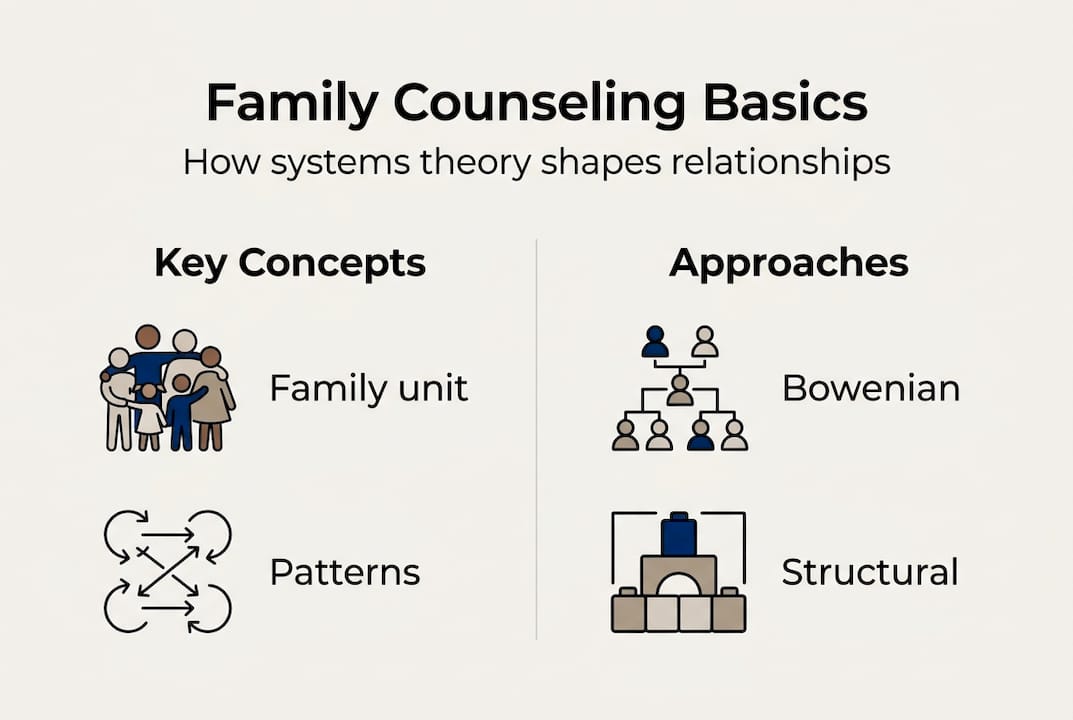
Most people assume that family problems come down to one difficult person. One parent who overreacts. One child who acts out. One partner who refuses to communicate. Family counseling challenges that assumption at its core. Family counseling approaches are rooted in systems theory, viewing the family as an interconnected unit where individual issues stem from relational dynamics. That shift in perspective changes everything.
Systems theory, in plain terms, means that no one person in a family operates in isolation. Every behavior, every reaction, every silence sends a ripple through the whole group. When a child becomes anxious, it is often because anxiety already exists in the relational space around them. When a parent withdraws, it shifts how every other family member behaves. The goal of family counseling is not to fix the “problem person” but to change the patterns everyone participates in.
This is why family conflict strategies that focus only on individual behavior often fall short. The real work happens at the relational level.
Common goals of family counseling include:
- Improving how family members communicate under stress
- Reducing recurring conflict cycles
- Strengthening emotional bonds between parents and children
- Rebuilding trust after a crisis or major transition
- Helping each person feel heard without someone else feeling blamed
Here is a quick look at how a systems approach compares to a traditional individual focus:
| Dimension | Individual focus | Systems focus |
|---|---|---|
| Problem location | Inside one person | In the relationships between people |
| Goal | Fix the individual | Change the pattern |
| Who attends | One person | Multiple family members |
| Blame | Often assigned | Replaced with curiosity |
| Progress measure | Symptom reduction | Relationship quality |
“The family is not a collection of individuals. It is a living system, and healing one part without addressing the whole rarely holds.” This is the core insight that separates family counseling from individual therapy.
Understanding this foundation makes every technique you encounter in counseling make more sense. You stop asking “why is this person like this” and start asking “what role does this pattern play for all of us.”
Choosing the right family counseling approach
Not every family needs the same model. Choosing the right approach depends on your family’s specific struggles, structure, and goals. Three of the most evidence-based models are worth knowing before you walk into a counselor’s office.
Bowenian Family Therapy focuses on how anxiety travels across generations. Bowenian therapy emphasizes differentiation of self, emotional triangles, and multigenerational patterns to reduce anxiety transmission. If your family keeps repeating the same arguments your parents had, this model may be a strong fit.
Structural Family Therapy focuses on the invisible rules and hierarchies inside your family. It looks at who has power, who is enmeshed (meaning too emotionally fused), and where boundaries need to be redrawn. It works especially well for families where roles have become confused, such as a child who has taken on a parenting role.
Multisystemic Therapy (MST) takes the widest view. MST addresses individual, family, peer, school, and community factors for youth antisocial behavior. If you have a teenager involved in risky behavior, this model is one of the most researched options available.
| Approach | Best for | Core technique | Limitation |
|---|---|---|---|
| Bowenian | Generational patterns, adult anxiety | Differentiation work | Slower pace, more abstract |
| Structural | Role confusion, boundary issues | Restructuring family hierarchy | Requires active therapist |
| MST | Teen behavior, community factors | Multi-setting intervention | Intensive time commitment |
How do you decide? Follow these steps:
- Write down your top three concerns as a family.
- Note whether the issue is primarily relational, behavioral, or generational.
- Ask any prospective counselor which model they use and why.
- Consider your family’s cultural values and comfort with directness.
- Start with one model and stay open to adjusting.
If communication strategies are your biggest gap, Structural or Bowenian approaches often address this directly. For parents navigating a struggling teen, teen-focused counseling grounded in MST principles can be especially effective.
Pro Tip: Before your first session, ask the counselor to explain their model in plain language. If they cannot do that clearly, it may be a sign they are not the right fit for your family.
Step-by-step: How to put family counseling into action
Knowing the models is one thing. Actually getting your family into a room and doing the work is another. Here is how to move from intention to action.
Step 1: Get everyone on board. Resistance is normal. Some family members may see counseling as an accusation. Frame it as a team effort, not a verdict. Use language like “we are all going to learn something” rather than “you need to change.”
Step 2: Find a qualified counselor. Look for a licensed clinical mental health counselor or licensed marriage and family therapist with documented experience in family systems work. Check credentials, ask about their approach, and make sure they have experience with your family’s specific challenges.

Step 3: Set clear goals before session one. Non-blaming collaboration, harm reduction, and adapting to family values are the practical mechanics that drive real progress. Go in knowing what you want to improve, not just what you want to stop.
Step 4: Prepare for the first session. Discuss confidentiality expectations as a family. Agree that what is said in the room stays there. This builds psychological safety fast.
Step 5: Commit to consistency. One session rarely changes anything. Most families need at least eight to twelve sessions before lasting patterns shift. Schedule sessions in advance and treat them like medical appointments.
Useful family tools and tips can also support the work you do between sessions. Practicing active listening, using “I” statements instead of “you” accusations, and setting clear boundaries at home reinforces what you learn in the counseling room. For families navigating family conflict in real time, having these tools ready makes a measurable difference.
Pro Tip: Write down two or three questions before each session. Families who come prepared move through the process faster and get more out of every hour.
Troubleshooting: Common challenges and how to handle them
Even families who are fully committed to counseling hit walls. Knowing what to expect makes those moments less discouraging.
Skeptical family members. Not everyone will be enthusiastic. One person’s reluctance can stall the whole process. The best move is not to force participation but to invite curiosity. Ask them what they would need to feel safe enough to try. Sometimes one session is all it takes to shift a skeptic.
Slow progress. Change in family systems is rarely linear. You may feel like things are getting worse before they get better. This is actually common, because surfacing old patterns feels uncomfortable before it feels freeing. Stay the course.
Sessions turning into blame games. This happens when family members use the counseling space to score points rather than solve problems. A skilled counselor will redirect this. If it keeps happening, name it directly: “I notice we keep assigning fault. Can we talk about what we each want instead?”
Troubleshooting strategies that work:
- Ask your counselor to introduce a structured turn-taking format for difficult conversations
- Request a brief check-in at the start of each session to reset expectations
- Use homework assignments between sessions to practice new skills in lower-stakes moments
- Revisit your original goals every four sessions to measure progress honestly
- If one model is not working after eight sessions, ask about integrating a different approach
“Counseling success depends on adapting to family values and using collaborative techniques.” Rigidity in method is often the real obstacle, not the family itself.
Exploring resolution services that are specifically designed for families in high-conflict situations can also provide additional support outside of weekly sessions.
A fresh take: Why flexibility matters more than any single counseling model
Here is something most counseling articles will not say plainly: the model matters less than the fit. We have seen families make remarkable progress using approaches that were adapted, blended, and adjusted along the way. We have also seen families stall when a counselor applied one framework too rigidly, even when that framework had strong research behind it.
Modern families are not textbook cases. A blended family with children from three different households, a family navigating a parent’s serious illness, or a family where cultural identity shapes every interaction, none of these fit neatly into a single model. What works is a counselor who listens, adjusts, and keeps the family’s values at the center of every decision.
This is especially true for families where cultural context shapes how conflict is expressed and resolved. Culturally centered counseling recognizes that effective therapy must speak to the lived experience of the family, not just the theory on the page. Flexibility is not a weakness in a counseling approach. It is the mark of a counselor who truly understands that the family in front of them is the real expert on their own life.
How Mastering Conflict supports your family’s journey
If this article has helped you see that your family’s struggles are workable, the next step is finding the right support to act on that insight.
At Mastering Conflict, we offer clinical services grounded in evidence-based family counseling approaches, including work with children, teens, couples, and individual adults. Whether your family needs structured conflict resolution, communication rebuilding, or culturally responsive support, we have the tools and the experience to help. Explore our couples packages for relationship-focused work, or browse our resources shop for books and tools you can use between sessions. We are here to walk alongside your family, not just through the hard moments, but toward the relationships you actually want.
Frequently asked questions
What is systems theory in family counseling?
Systems theory sees the family as a connected unit where each person’s behavior affects everyone else. Family counseling approaches rooted in this theory focus on relational patterns rather than individual blame.
How do I choose the right family counseling approach?
Consider your family’s core challenges and ask prospective counselors about their model and experience with similar situations. Bowenian therapy suits generational patterns, while structural or MST models fit other needs.
What if family counseling is not working for us?
If progress stalls, discuss adapting your approach or blending techniques with your counselor. Counseling success depends on flexibility and matching methods to your family’s values.
Are there family counseling approaches tailored for teens?
Yes. MST addresses individual, family, peer, school, and community factors specifically for youth antisocial behavior, making it one of the most targeted options for struggling teens.
Recommended
- Family counseling strategies: improve communication in 2026 – Mastering Conflict
- Family counseling basics: practical guide to improve communication – Mastering Conflict
- Family Counseling Benefits: Support, Healing, and Connection 2025 – Mastering Conflict
- Navigating Family Conflict for Positive Relationships – Mastering Conflict
- Complete Guide to the Role of Family Counselling – Interactive Counselling