
Family counseling basics: practical guide to improve communication

Many people believe family counseling is reserved for families in severe crisis, but this misconception prevents countless individuals and couples from accessing practical tools that can transform everyday interactions. Family counseling teaches foundational communication and conflict resolution skills that benefit families at any stage, whether you’re navigating minor disagreements or seeking to strengthen existing bonds. This guide explores the basics of family counseling, from core techniques and therapeutic models to actionable steps for getting started, empowering you to improve relationships and resolve conflicts with confidence and clarity.
Table of Contents
- Key takeaways
- What is family counseling and why it matters
- Core techniques and approaches in family counseling
- Comparing family counseling models: structural and Bowenian
- How to start family counseling: practical steps and what to expect
- Explore professional family counseling services
- Frequently asked questions
Key Takeaways
| Point | Details |
|---|---|
| Improved family communication | Family counseling teaches practical tools to improve everyday communication and resolve conflicts among family members. |
| Tailored approaches by stage | Therapists tailor techniques and models to fit the family structure and developmental stage. |
| I statements practice | I statements replace blame with expressions of feelings to reduce defensiveness and encourage honest dialogue. |
| Boundary setting essentials | Boundary work helps define roles and limits to support healthier interactions. |
| Generational pattern awareness | Therapists explore generational dynamics to understand recurring conflicts and improve family functioning. |
What is family counseling and why it matters
Family counseling is a specialized form of therapy designed to improve communication, resolve conflicts, and strengthen relationships within family systems. Unlike individual therapy, which focuses on one person’s internal experience, family counseling views the family as an interconnected unit where each member’s behavior affects the whole. Family therapy involves joining the family system, mapping structures, and active therapist interventions to identify and shift problematic patterns.
Therapists don’t simply observe families. They actively engage with the system, understanding roles, hierarchies, and communication patterns that may contribute to conflict. This hands-on approach helps families recognize how their interactions create cycles of misunderstanding or hurt, then provides concrete tools to break those cycles. Different therapeutic models exist to address various family needs, from structural therapy that reorganizes family roles to Bowenian approaches that explore generational patterns and emotional systems.
A common myth is that family counseling only addresses severe issues like addiction, abuse, or divorce. In reality, many families seek counseling to enhance already functional relationships or improve everyday communication. You don’t need to be in crisis to benefit from learning how to express needs clearly, set healthy boundaries, or navigate transitions like blending families or launching adult children. The family counseling benefits extend far beyond crisis intervention.
Key purposes of family counseling include:
- Healing past wounds and resolving ongoing conflicts
- Building support systems within the family unit
- Enhancing connection and emotional intimacy
- Teaching practical communication and problem solving skills
- Addressing life transitions and developmental challenges
Family counseling matters because it equips you with skills that ripple through every relationship in your life. When you learn to communicate clearly with your partner or children, you carry those abilities into friendships, work relationships, and future family dynamics. The investment in family counseling creates lasting change that benefits not just your immediate family but generations to come.
Core techniques and approaches in family counseling
Effective family counseling relies on specific techniques that facilitate healthier communication and conflict resolution. These methods aren’t abstract concepts but practical tools you can learn and apply immediately, even before formal therapy begins. Understanding these core techniques helps you recognize what to expect in sessions and how therapists guide families toward positive change.
I-statements form the foundation of non-defensive communication. Instead of saying “You never listen to me,” you might say “I feel unheard when conversations end abruptly.” This subtle shift removes blame and invites understanding rather than triggering defensiveness. I-statements help family members express emotions and needs without attacking others, creating space for genuine dialogue. Therapists teach families to practice this technique until it becomes natural, transforming how members interact during conflicts.

Boundary work addresses the invisible lines that define where one person ends and another begins. Healthy boundaries allow family members to maintain individual identities while staying connected to the family unit. Start with willing participants using communication techniques like I-statements and boundary work, assessing for safety first. Therapists help families identify where boundaries are too rigid, creating emotional distance, or too loose, leading to enmeshment and loss of self.
Active therapist interventions distinguish family counseling from simple group conversations. Therapists map family structures, identifying who holds power, who forms alliances, and how communication flows through the system. They may interrupt unhealthy patterns in real time, redirect conversations, or assign specific tasks to shift dynamics. This active involvement helps families see their patterns from an outside perspective and experiment with new ways of relating.
Pro Tip: Before starting family counseling, assess for contraindications like active domestic violence or severe substance abuse. These situations require specialized interventions and individual safety planning before family sessions can be productive or safe.
Different therapeutic approaches focus on specific aspects of family functioning:
- Structural therapy reorganizes family hierarchies and boundaries
- Bowenian therapy addresses multigenerational patterns and differentiation
- Strategic therapy uses specific interventions to interrupt problem patterns
- Narrative therapy helps families rewrite limiting stories about themselves
The couples therapy benefits often overlap with family counseling, especially when parenting conflicts or relationship issues affect the entire family system. Many families benefit from combining couples work with family sessions to address both partnership dynamics and broader family patterns. Therapists tailor their approach based on your family’s specific needs, developmental stage, and readiness for change.
Safety remains the paramount concern throughout family counseling. Therapists continuously assess whether all family members can participate safely and whether the therapeutic environment supports honest communication without fear of retaliation. This ongoing evaluation ensures that counseling promotes healing rather than inadvertently causing harm. Access to family conflict resolution tools between sessions helps families practice new skills in their daily lives.
Comparing family counseling models: structural and Bowenian
Understanding different family counseling models helps you choose the approach that best fits your family’s needs and conflict patterns. Two widely used models, structural and Bowenian therapy, offer distinct perspectives on family dynamics and employ different intervention strategies. Knowing how these approaches differ empowers you to have informed conversations with potential therapists about which methods might serve your family best.
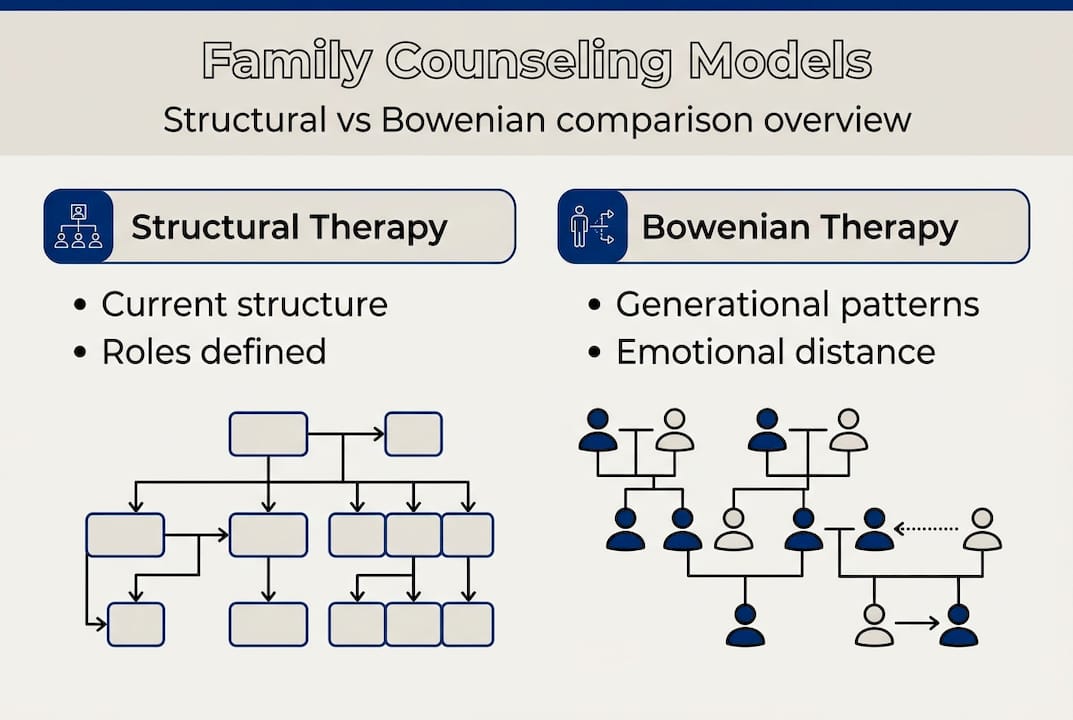
Structural family therapy, developed by Salvador Minuchin, focuses on the present organization of your family system. Therapists tailor counseling to family stage, using models like Bowenian for generational conflict and structural for active intervention. Structural therapists actively map your family’s boundaries, hierarchies, and subsystems, then work to reorganize problematic structures. If parents have lost authority or siblings are parentified, structural therapy addresses these imbalances directly through in-session exercises and homework assignments.
Bowenian family therapy, created by Murray Bowen, takes a multigenerational perspective. This approach examines how patterns, roles, and emotional dynamics transmit across generations, often outside conscious awareness. Bowenian therapists help you understand your level of differentiation, meaning how well you maintain your sense of self while staying emotionally connected to family. They explore triangulation patterns where two people pull in a third to reduce tension, and they trace how anxiety flows through family systems across time.
| Aspect | Structural Therapy | Bowenian Therapy |
|---|---|---|
| Primary Focus | Current family organization and boundaries | Multigenerational patterns and differentiation |
| Therapist Role | Active restructuring and direct intervention | Teaching and coaching toward self-awareness |
| Time Orientation | Present interactions and immediate change | Historical patterns and long-term growth |
| Best For | Families with hierarchy or boundary issues | Families with repeated generational conflicts |
| Key Techniques | Enactment, boundary making, unbalancing | Genogram work, detriangulation, process questions |
Structural therapy works exceptionally well when family roles have become confused or when boundaries are either too rigid or too diffuse. If your teenager is acting as a parent to younger siblings, or if in-laws are overly involved in your marriage decisions, structural interventions can quickly clarify appropriate roles and create healthier boundaries. The therapist actively participates in sessions, sometimes joining different family subsystems to understand their perspectives, then strategically unbalancing the system to promote change.
Bowenian therapy excels when families notice the same conflicts repeating across generations or when individuals struggle to maintain their identity within intense family relationships. If you find yourself reacting to your spouse the way your parents reacted to each other, or if family anxiety consistently pulls you into mediator roles, Bowenian work helps you recognize and interrupt these patterns. This approach emphasizes individual growth within the family context rather than direct system manipulation.
Pro Tip: Many skilled family therapists integrate multiple models based on your family’s evolving needs. You might begin with structural interventions to address immediate crises, then shift to Bowenian work to prevent pattern repetition. Ask potential therapists about their theoretical orientation and flexibility.
The family therapy services comparison shows how different therapeutic approaches address various family concerns. Some families benefit from combining family counseling with individual therapy, especially when one member needs additional support. Understanding the therapy versus coaching guide helps you determine whether clinical intervention or developmental coaching better fits your situation.
Both structural and Bowenian approaches require skilled therapist involvement and active family participation. Neither model works if family members attend sessions unwillingly or if safety concerns prevent honest communication. The right model depends on your family’s specific conflict type, developmental stage, and readiness for change. Most importantly, the therapeutic relationship and your family’s trust in the therapist matter more than the specific model employed.
How to start family counseling: practical steps and what to expect
Starting family counseling can feel overwhelming, but breaking the process into clear steps makes it manageable and less intimidating. Understanding what to expect helps you prepare your family for success and ensures everyone approaches therapy with realistic expectations. These practical steps guide you from initial consideration through your first sessions.
- Identify willing participants and assess readiness. Begin with willing participants, assess for safety and contraindications, and use communication techniques as a starting point. Not every family member needs to attend every session, but those who participate must be willing to engage honestly. If someone adamantly refuses, starting with available members often creates positive momentum that encourages others to join later.
- Define your goals and concerns clearly. Before contacting a therapist, discuss with your family what you hope to achieve. Are you addressing specific conflicts, improving general communication, navigating a transition, or healing from past hurt? Clear goals help therapists tailor their approach and give your family markers to measure progress. Write down your top three concerns so you can articulate them during initial consultations.
- Research and contact qualified family counselors. Look for licensed therapists with specific training in family systems work. Finding a family counselor requires considering factors like therapeutic approach, availability, insurance acceptance, and whether they offer teletherapy options. Many therapists offer brief phone consultations to determine fit before scheduling a full session.
- Complete intake assessments honestly. Therapists typically conduct individual or family intake sessions to understand your history, current concerns, and family structure. This assessment phase helps them identify any safety issues that would contraindicate family sessions and determine the most appropriate treatment approach. Be thorough and honest during this process, as accurate information leads to better treatment planning.
- Establish ground rules and expectations together. During early sessions, therapists help families create agreements about respectful communication, confidentiality, and participation. These ground rules create psychological safety and ensure everyone understands the therapeutic process. Discuss logistics like session frequency, duration of treatment, and how to handle conflicts that arise between sessions.
- Practice basic techniques before and between sessions. Start using I-statements and boundary awareness immediately, even before your first formal session. These foundational skills create positive momentum and demonstrate your family’s commitment to change. Parenting conflict resolution techniques can be practiced in everyday situations to build confidence.
What to expect during family counseling sessions:
- Initial sessions focus on understanding family dynamics and building therapeutic relationships
- Therapists may meet with different family subsystems separately before bringing everyone together
- Sessions typically last 50 to 90 minutes, with frequency ranging from weekly to biweekly
- Expect homework assignments that ask you to practice new skills or observe specific patterns
- Progress isn’t always linear; some sessions feel difficult or uncomfortable as patterns shift
- Therapists actively guide conversations, interrupt unhealthy patterns, and teach new skills in real time
Timelines for family counseling vary widely based on your goals and family complexity. Some families achieve significant improvement in 8 to 12 sessions, while others benefit from longer-term work spanning several months or even years. Discuss timeline expectations with your therapist early, understanding that flexibility is important as your family’s needs evolve. Many families transition from intensive weekly sessions to monthly maintenance sessions once they’ve established healthier patterns.
Preparing your family emotionally matters as much as logistical preparation. Acknowledge that counseling can feel vulnerable and uncomfortable at times. Frame therapy as an investment in your family’s future rather than a sign of failure. Celebrate small wins along the way, like successfully using an I-statement during a heated moment or respecting a newly established boundary. These incremental changes build toward lasting transformation in how your family communicates and resolves conflicts.
Explore professional family counseling services
Understanding family counseling basics provides a strong foundation, but applying these principles with professional guidance accelerates your progress and ensures you’re addressing underlying patterns effectively. Mastering Conflict offers specialized clinical services designed for individuals and couples seeking expert support in improving family communication and resolving conflicts. Our licensed therapists bring extensive training in family systems work, tailoring approaches to your unique dynamics and developmental stage.
Convenient teletherapy counseling options make professional support accessible regardless of your location or schedule constraints. Whether you’re navigating everyday communication challenges or addressing deeper generational patterns, our team provides the expertise and tools you need. Explore our coaching vs therapy resource to determine which approach best fits your current needs and goals for family growth.
Frequently asked questions
What is family counseling?
Family counseling is a therapeutic approach that treats the family as an interconnected system, focusing on improving communication, resolving conflicts, and strengthening relationships among family members. Therapists actively engage with families to identify problematic patterns and teach practical skills that transform how members interact. This approach addresses both current issues and underlying dynamics that perpetuate conflict.
How do I know if family counseling is right for my family?
Consider family counseling if you notice persistent conflicts, communication breakdowns, or relationship tensions that don’t improve despite your efforts. Evaluate whether family members are willing to participate and whether safety concerns exist that might require individual intervention first. Family counseling works best when at least some members are ready to engage honestly and work toward change, even if not everyone is initially enthusiastic.
What should I expect in a family counseling session?
Sessions involve open dialogue facilitated by a trained therapist who guides conversations, teaches communication techniques, and helps clarify family roles and patterns. Therapists may map your family structure, assign specific tasks or homework, and actively interrupt unhealthy interaction patterns in real time. Expect a mix of discussion, skill building, and sometimes uncomfortable moments as your family experiments with new ways of relating.
How can I prepare my family for counseling?
Discuss your goals and concerns openly with family members before starting therapy, emphasizing that counseling is an investment in your collective future rather than a sign of failure. Set ground rules for respectful participation and encourage all willing members to join, understanding that not everyone needs to attend every session. Practice basic techniques like I-statements before your first appointment to build confidence and demonstrate commitment to positive change.
Recommended
- Communication Skills for Couples: Guide to Connection and Conflict Resolution – Mastering Conflict
- Family Counseling Benefits: Support, Healing, and Connection 2025 – Mastering Conflict
- Navigating Family Conflict for Positive Relationships – Mastering Conflict
- Enhance Your Relationship: Couples Communication Exercises – Mastering Conflict
- Liegt Es An Der Beziehung Oder An Mir? – YourPowerFoods.com
- How to Encourage Teamwork for Kids: Build Lifelong Skills – The Zoofamily