
Family counseling strategies: improve communication in 2026

TL;DR:
- Effective family counseling relies on active listening, I-statements, and emotional needs identification.
- Building a strong therapist-family alliance and cultural responsiveness are key to success.
- Progress is measurable through reduced conflicts, better cooperation, and improved daily communication.
Family arguments can spiral fast. A disagreement over curfew becomes a screaming match. A blended family’s tension quietly poisons every dinner. Without clear tools, even well-meaning families in North Carolina, South Carolina, and Florida find themselves stuck in the same painful loops. The good news is that professional counseling strategies give families a structured, proven path out of those cycles. This guide walks you through the exact methods counselors use, from foundational principles to step-by-step techniques, so you can start building real change at home or in the therapy room.
Table of Contents
- Core principles of effective family counseling
- Preparing for a productive family counseling session
- Step-by-step counseling strategies for family communication and conflict
- Verifying success: Measuring change and overcoming setbacks
- Our perspective: What most guides miss about family counseling success
- Connect with expert family counselors in the Carolinas and Florida
- Frequently asked questions
Key Takeaways
| Point | Details |
|---|---|
| Proven strategies | Active listening, I-statements, and clear ground rules are at the heart of family counseling success. |
| Family-tailored approach | Adapting counseling strategies to each family’s unique structure and culture maximizes effectiveness. |
| Measure progress | Look for better cooperation, fewer arguments, and lasting behavior changes as signs of real improvement. |
| Therapist alliance matters | A warm, nonjudgmental therapist and strong alliance lead to better results for families. |
Core principles of effective family counseling
Every successful family counseling process starts with the same building blocks, regardless of the specific model a therapist uses. Understanding these principles helps you recognize what good therapy looks like and what to expect when you walk through the door.
The family counseling basics that counselors rely on most include active listening, I-statements, setting ground rules for discussions, timeouts, solution-focused problem-solving, and identifying the underlying emotional needs driving the conflict. These are not soft suggestions. They are the clinical backbone of most evidence-based family therapy approaches.
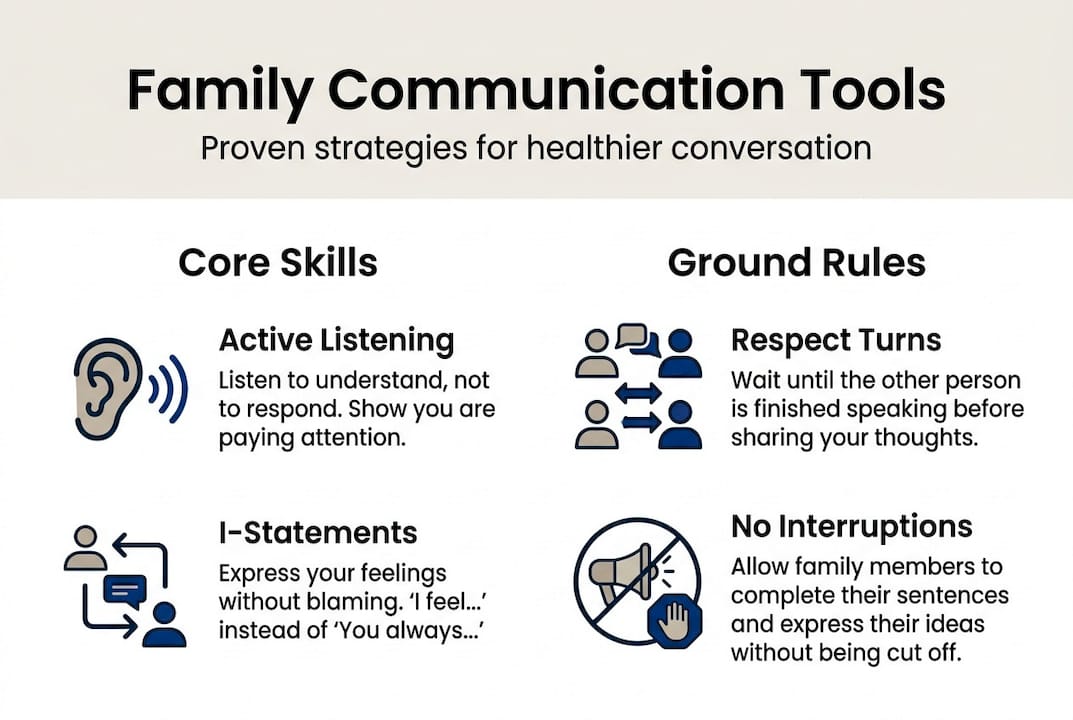
Therapists do not just sit back and nod. They actively guide the communication process, interrupt harmful patterns, and redirect conversations toward productive territory. Think of the therapist as a traffic controller: they do not drive the car, but they keep everyone moving safely.
Several therapy models shape how counselors approach family work. Family Systems therapy looks at the family as one interconnected unit. Structural therapy examines roles and boundaries. Strategic therapy focuses on changing specific behaviors quickly. Bowenian therapy explores multigenerational patterns. Emotionally Focused therapy targets attachment bonds. Gottman Method uses research-based tools for communication repair. The right model depends on your family’s unique makeup, history, and goals.
| Principle | Core tactic |
|---|---|
| Active listening | Reflect back what you hear before responding |
| I-statements | “I feel hurt” instead of “You always hurt me” |
| Ground rules | No interrupting, no name-calling, one speaker at a time |
| Timeouts | Pause when emotions spike above a productive level |
| Solution focus | Identify what works and build on it |
| Emotional needs | Ask what the conflict is really about beneath the surface |
Every productive session also needs these must-haves:
- A neutral, safe physical space
- Willingness from all participants to engage honestly
- Clear confidentiality agreements between family members and therapist
- A shared commitment to the process, not just a single session
- A therapist who understands your family’s cultural context
Exploring the benefits of family counseling before your first appointment can help every family member arrive with realistic expectations and genuine buy-in.
Preparing for a productive family counseling session
The work starts before you sit down in the therapist’s office. How a family prepares for counseling directly affects how quickly they see results.
Safety is the absolute first priority. This is not a formality. Families dealing with active domestic violence or physical threats need immediate safety planning before any joint counseling begins. Attempting family therapy in an unsafe environment can actually increase risk.
Critical note: Safety screening must happen before family counseling starts. Active violence, credible threats, or severe power imbalances are contraindications for joint sessions. A qualified therapist will assess this in the first contact.
Beyond safety, mutual willingness matters enormously. One person dragging reluctant family members into therapy rarely produces lasting change. A good therapist builds alliance with every person in the room, not just the one who made the appointment.
Families in the Carolinas and Florida come in every shape. Blended families, multigenerational households, and families from diverse cultural backgrounds all need a counselor who adapts rather than applies a one-size-fits-all approach. Culturally responsive counseling is especially important when cultural values around authority, communication, or family roles differ from mainstream therapeutic assumptions.

One of the most common preparation mistakes is entering therapy with one person already labeled as “the problem.” This framing almost always backfires. Effective counselors look at patterns and relationships, not individuals in isolation. Review cultural considerations that might shape how your family engages with the process.
Here is what to prepare before your first session:
- Agree on a shared goal, even a simple one like “talk without yelling”
- Arrange childcare for younger children not participating in sessions
- Choose a therapist together when possible, or at least discuss the choice openly
- Write down your main concerns privately so you feel heard from the start
- Discuss confidentiality expectations with the therapist upfront
Pro Tip: When selecting a therapist, ask directly about their experience with families in your specific situation, whether blended, multicultural, or dealing with a particular type of conflict. A strong therapist alliance is one of the biggest predictors of a good outcome.
Step-by-step counseling strategies for family communication and conflict
Now for the practical part. These are the steps counselors walk families through, and you can begin practicing several of them at home between sessions.
- Set ground rules first. Before any difficult conversation, establish clear agreements: one person speaks at a time, no interrupting, no personal attacks. Write them down and post them somewhere visible.
- Practice active listening. When someone speaks, your only job is to understand them, not to prepare your rebuttal. Reflect back what you heard: “So what I’m hearing is that you feel ignored when decisions are made without you.”
- Use I-statements consistently. I-statements reduce defensiveness by keeping the focus on your experience rather than the other person’s behavior. “I feel anxious when plans change last minute” lands very differently than “You never stick to plans.”
- Implement timeouts before escalation. Agree on a signal, like a raised hand, that means the conversation pauses for 20 minutes. This is not avoidance. It is a reset that prevents words said in anger from doing lasting damage.
- Shift to solution focus. Once emotions settle, move from “who is to blame” to “what would help.” Ask: “What would a good outcome look like for everyone here?”
Here is a comparison of the five most common conflict resolution approaches:
| Approach | Pros | Cons |
|---|---|---|
| Avoiding | Reduces immediate tension | Problems remain unresolved |
| Accommodating | Preserves harmony short-term | One person’s needs go unmet |
| Competing | Fast decisions | Damages trust and relationships |
| Compromising | Both sides give and get | Neither side fully satisfied |
| Collaborating | Best long-term outcomes | Requires time and effort |
Collaborating and compromising are the preferred approaches in most conflict resolution steps because they protect the relationship while solving the problem. Avoiding and competing tend to create more conflict over time.
Pro Tip: Defensiveness is the enemy of progress. If you notice someone shutting down or going on the attack, name it gently: “I think we’re both getting defensive right now. Can we slow down?” This simple move can break the cycle before it escalates.
For more practical problem-solving tools your family can use between sessions, explore resources built specifically for families navigating conflict.
Verifying success: Measuring change and overcoming setbacks
Implementing strategies is only half the work. Knowing whether they are actually helping, and what to do when they are not, is just as important.
Progress in family counseling shows up in several measurable ways. Families report fewer arguments per week. Individual members feel more heard and understood. Cooperation on daily decisions improves. Children show fewer behavioral problems at home and school. These are real, trackable changes, not just feelings.
The research backs this up. Family therapy improves cohesion and reduces conflict with effect sizes of 0.23 to 0.33, and 80% of children show measurable improvement within 12 sessions. That is a strong return on investment for families willing to do the work consistently.
But setbacks happen. Resistance from one family member, a therapist mismatch, or a major life stressor can stall progress. Knowing the warning signs helps you respond rather than give up.
Watch for these signals that adjustments may be needed:
- Conflict frequency or intensity is increasing after several sessions
- One or more family members consistently refuse to engage or attend
- The therapist seems to favor one person’s perspective over others
- Sessions feel repetitive without any new tools or insights
- Family members feel worse after sessions, not better
If you notice these signs, raise them directly with your therapist. A good clinician welcomes that feedback. If the mismatch persists, switching providers is not failure. It is smart advocacy for your family. Explore couples therapy benefits and family counseling outcomes to set realistic benchmarks before you start.
Our perspective: What most guides miss about family counseling success
Most step-by-step guides focus heavily on techniques and tools. They give you the I-statement formula and the timeout protocol. Those things matter. But in our experience working with families across North Carolina, South Carolina, and Florida, the biggest predictor of success is something most guides barely mention: the quality of the therapist-family alliance.
Warmth, genuine curiosity, and a nonjudgmental stance from the therapist create the safety that makes every other technique actually work. Without that foundation, even the best tools fall flat. Therapist alliance and family strengths are the real engines of change.
We also see families get stuck when therapy focuses too heavily on excavating past wounds instead of building present-day skills. Short-term, present-focused models often produce faster, more durable results for families who need practical change now.
Finally, matching the therapeutic style to your family’s actual culture and communication norms is not optional. It is essential. A therapist who respects how your family expresses emotion, handles authority, or defines loyalty will get further in three sessions than a mismatched approach will in thirty. When navigating family conflict, lean into what your family already does well.
Connect with expert family counselors in the Carolinas and Florida
Reading about strategies is a great start. Applying them with the guidance of a skilled professional is where real transformation happens.
At Mastering Conflict, we work with families across North Carolina, South Carolina, and Florida to build the communication skills and conflict resolution tools that actually stick. Whether you are navigating a blended family, parent-teen tension, or long-standing communication breakdowns, our family counseling services are designed to meet your family where you are. Explore our full range of clinical counseling services and take the first step toward a calmer, more connected home. Booking is simple and same-week appointments are often available.
Frequently asked questions
What are the top strategies used in family counseling?
Active listening, I-statements, ground rules, and solution-focused problem-solving are the core strategies counselors use to improve communication and reduce conflict.
How do you know if family counseling is working?
Signs of progress include fewer arguments, better cooperation, and improved daily communication. Therapy improves cohesion and reduces disruptive behavior in measurable ways.
Is family therapy effective for blended or multicultural families?
Yes, especially when the therapist adapts the approach to fit the household’s structure and values. Cultural responsiveness is a critical factor in whether therapy succeeds for diverse families.
When is family counseling not recommended?
Joint family counseling is not appropriate when there is active domestic violence or serious safety concerns. Family counseling is contraindicated in these situations, and safety planning must come first.
How quickly do families see results from counseling?
Most families notice meaningful change within 8 to 12 sessions. 80% of children show measurable improvement within that timeframe according to current research.
Recommended
- Improve communication for conflict resolution in 2026 – Mastering Conflict
- Top Couples Therapy Benefits for Families in 2025 – Mastering Conflict
- Family counseling basics: practical guide to improve communication – Mastering Conflict
- Family Counseling Benefits: Support, Healing, and Connection 2025 – Mastering Conflict
- Why Naming Your Feelings Helps — The Caia Journal