
Find Local and Virtual Single Parent Support Groups: Six Step Vetting

Call 211 or search 211.org with your ZIP code. It is the fastest way to get a real list of local single-parent support groups today, not next week. If that comes up short, check your library or community center bulletin board, or search Meetup and Parents Without Partners. Most groups meet weekly for about an hour to an hour and a half, many offer childcare, and many are free.
TL;DR:
- Calling 211 or visiting community hubs like libraries or community centers provides the most current and reliable local support group listings.
- Support groups typically meet weekly for 60 to 90 minutes, with many offering childcare and a structured focus on emotional support and education.
- Peer-led groups show evidence of reducing depression, trauma, and loneliness, but benefits diminish without access to additional resources or therapy.
- When symptoms of depression or trauma are severe or persistent, professional counseling or teletherapy should complement participation in support groups.
- Starting or joining a group requires verifying facilitator type, confidentiality, childcare, accessibility, and crisis procedures to ensure safety and alignment with your needs.
Table of Contents
- Where To Find Single Parent Support Groups Near Me
- What Types Of Single Parent Groups Exist?
- What Happens At A Support Group Meeting?
- Do Support Groups Actually Help Single Parents?
- How Do You Vet A Single Parent Support Group?
- How Do You Join Or Start A Group Yourself?
- Why Peer Support And Professional Care Work Better Together
- Professional Support When A Group Isn’t Enough
- Sources
- FAQ
Where To Find Single Parent Support Groups Near Me
211 works because a real person pulls current listings for your ZIP code instead of pointing you to a group that folded two years ago. Have your ZIP code, your kids’ ages, and your schedule handy, and ask the specialist for more than one option since local program availability changes frequently.
Beyond 211, several community hubs quietly run or know about groups that never show up in a general search:
- Public libraries, which often host free parenting groups in meeting rooms
- YMCAs, YWCAs, and hospital family resource centers
- School family liaisons and pediatricians, who hear about informal groups first
- Community Action agencies, WIC clinics, and HRSA health centers, which frequently handle referrals for childcare, food, and emergency aid alongside group referrals
Online, Meetup and Facebook groups list active single-parent meetups by city, and Parents Without Partners maintains chapters in many regions. Many of the best local groups are not heavily advertised online, so calling libraries, community centers, and school counselors directly still turns up options a search engine misses.
Pro Tip: Call three sources in one sitting, not one. A library might refer you to a YMCA, which refers you to a group that meets in a church basement every Tuesday. That chain is normal.
What Types Of Single Parent Groups Exist?
Not every group fits every parent. The format matters as much as the topic.
- Peer-led groups: Run by other single parents, low cost or free, built on shared experience. The tradeoff is inconsistent structure. Without a clear organizer, conversations can drift or one voice can dominate.
- Professionally facilitated groups: Led by a counselor or trained facilitator who keeps sessions on track and enforces confidentiality. Better fit if you want structure and a safer container for harder topics.
- Demographic or topic-specific groups: Single father support groups, teen parent groups, and bereaved-parent groups exist because generic “single parent” spaces do not always address a widower’s grief or a 19-year-old parent’s specific pressures.
- Faith-based groups: Often free, meet at a church or synagogue, and blend spiritual support with practical help like meal trains or childcare swaps.
- Virtual groups: Remove the commute and childcare barrier entirely, but lose the in-person warmth and any local resource-sharing that happens face-to-face.
What Happens At A Support Group Meeting?
Most single parent support groups near you follow a familiar rhythm: weekly meetings, roughly 60 to 90 minutes, often with a short check-in round followed by a topic or open discussion. That 60 to 90 minute weekly dose is not arbitrary.
By the numbers: Spending about 60 to 90 minutes a week in a single-parent support group can measurably improve quality of life, particularly when the group pairs discussion with education and offers childcare on-site.
Before you commit, ask about the practical details:
- Age limits and supervision ratios for any childcare provided
- Cost, and whether a sliding scale exists for tighter budgets
- Ground rules around confidentiality, since what gets shared in the room needs to stay there
- Accessibility: language support, transportation help, or a virtual option if getting there is the barrier
Facilitators generally see their job as holding space and keeping the room safe, not providing therapy, so expect guidance and structure rather than clinical treatment.
Do Support Groups Actually Help Single Parents?
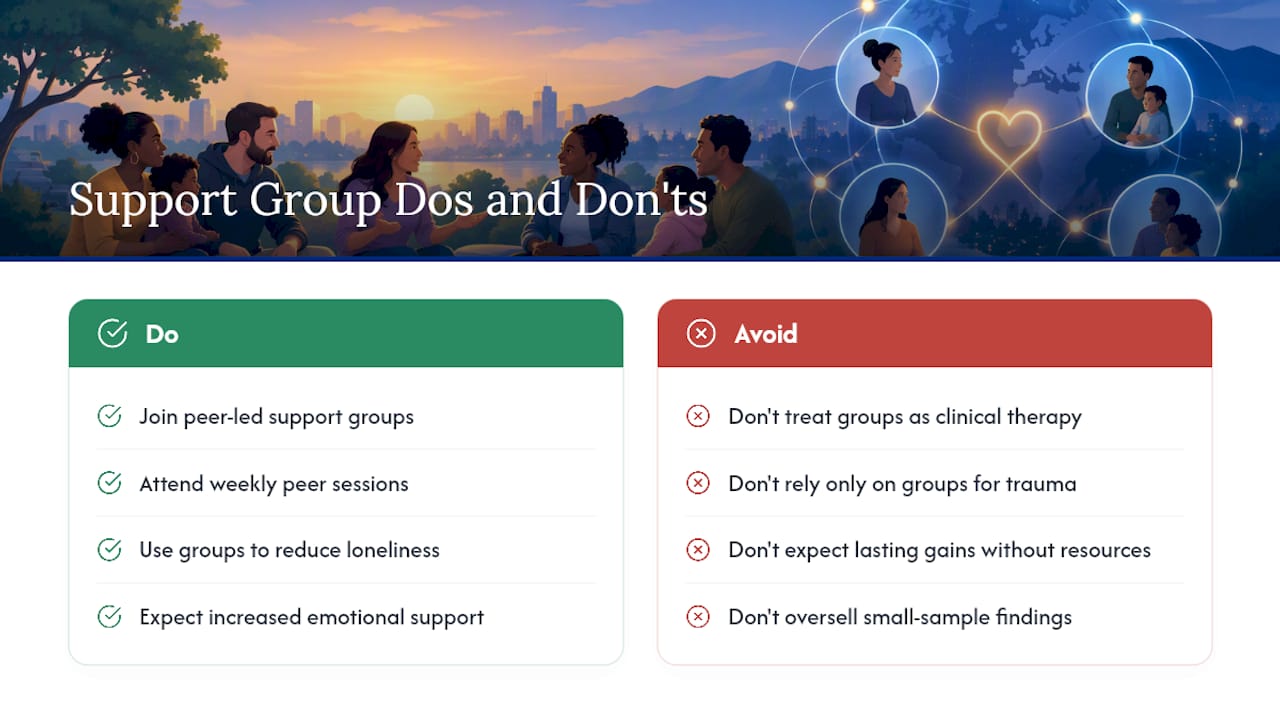
The evidence is more encouraging than most people expect from what sounds like informal peer chat. A 2026 evaluation of peer-led parent support groups found participation was linked to significant decreases in depression, trauma, and loneliness, alongside increased perceived emotional support.
A separate mixed-methods evaluation with a small sample of 22 participants found similar patterns, weekly peer-led sessions correlating with measurable drops in depression and loneliness scores. That is a small study, worth noting honestly rather than oversold, but the direction lines up with the larger evaluation.
The limit is real too: gains from peer support groups can fade if members do not also have access to additional resources like childcare, transportation, or clinical care. Support groups treat isolation and normalize the daily grind of solo parenting. They are not built to treat clinical depression or trauma on their own, which is where professional therapy for mothers or individual counseling comes in.
How Do You Vet A Single Parent Support Group?
Run through this before your first meeting, or during your first call to the organizer:
- Confirm the goal matches yours. A grief-focused group will not serve someone looking for co-parenting logistics tips.
- Ask who facilitates it. Peer volunteer or trained professional, and what happens if a conversation gets heavy.
- Ask about confidentiality rules. A group without a stated confidentiality norm is a group where your business becomes neighborhood news.
- Ask about childcare and cost. Age limits, supervision, sliding scale, and whether a fee is one-time or per meeting.
- Ask about accessibility. Virtual option, transportation help, language support if you need it.
- Ask what happens in a crisis. A group with no plan for a member in real distress is a red flag, not a quirk.
Watch for warning signs: no stated leader, no confidentiality norm, or a “group” that is really one person selling a product. If a member seems in crisis, or you notice your own symptoms are heavier than a weekly chat can hold, that is the signal to add individual counseling for women or men alongside the group, not instead of it.
Pro Tip: Ask the organizer one blunt question: “What happens if someone breaks down crying and can’t stop?” Their answer tells you more about the group’s safety than any brochure.

How Do You Join Or Start A Group Yourself?
Joining is simple: call 211, or email your library with something like, “I’m a single parent looking for a support group, do you host one or know who does?” Then sit in on one or two meetings before deciding. Watch whether people actually listen, whether the facilitator (if any) keeps things on track, and whether you leave feeling lighter or drained.
If nothing local exists, starting one is doable:
- Pick a co-host and a free venue, a library room or community center often works
- Set a consistent day and time, weekly or biweekly
- Advertise through Meetup, a private Facebook group, or Parents Without Partners
- Write a one-page charter covering confidentiality and what happens in an emergency
Why Peer Support And Professional Care Work Better Together
Peer groups do something clinical care cannot: they remind a single parent at 9pm on a bad Tuesday that they are not the only one running on fumes. But structured, facilitator-led groups tend to outperform loosely organized venting sessions, and neither replaces treatment when depression or trauma runs deep. I’d rather see a parent in a peer group AND in counseling than choosing one over the other. If your group leaves you feeling supported but you are still stuck, that gap is where professional care belongs, not a failure of the group itself.
— Carlos
Professional Support When A Group Isn’t Enough
Community groups are a strong first step, but some weeks call for more than a weekly check-in circle can give. Masteringconflict offers what peer groups are not built to provide: licensed, structured clinical care for the moments group support runs out of road. That includes individual counseling for women and men, family counseling, and structured group programs run by trained facilitators rather than volunteers.

If distance, timing, or privacy keeps you from in-person options, teletherapy puts a licensed counselor on your schedule instead of the group’s. And if conflict with a co-parent or ex is part of what’s draining you, the 4-Hour Program offers structured, professionally facilitated group work built specifically around that. Current pricing and scheduling are listed on the site. Book a consultation and find out which option actually fits what you’re carrying right now.
Sources
- Finding support when you’re a single parent — Nationwide Children’s Hospital
- Evaluation study of peer-led support groups for parents — Journal article (2026)
- Literature on perinatal and parent support — PubMed Central (expert review, 2025)
FAQ
How Do I Find Single Parent Support Groups Near Me?
Call 211 or search 211.org with your ZIP code for a current, free referral list. Back that up by checking your library, community center, or Meetup, since many local groups aren’t heavily advertised online.
Are Single Parent Support Groups Free?
Many peer-led groups at libraries, churches, or community centers are free or low-cost, though professionally facilitated programs often charge a fee. Ask about sliding-scale pricing when you call, since it is common even when not advertised.
How Long Do Support Group Meetings Usually Last?
Most meet weekly for about 60 to 90 minutes, a range linked to measurable quality-of-life improvements when the group also offers education and childcare. Shorter or less frequent meetings still help, but that window is the common benchmark.
Do Single Parent Support Groups Actually Work?
A 2026 evaluation found peer-led groups were associated with significant drops in depression, trauma, and loneliness, plus increased perceived emotional support. Benefits are strongest when paired with other resources like childcare and, when needed, individual therapy.
When Should I See A Therapist Instead Of Joining A Group?
If symptoms like depression or trauma feel severe or aren’t easing with peer support, that is the signal to add professional care. Masteringconflict offers individual and family counseling services alongside structured group programs for exactly that gap.