
6 Therapy Tested Conflict Resolution Scripts for Couples and Families

The strategies that actually reduce conflict are active listening, I-statements, emotion-regulation skills, structured time-outs, collaborative problem solving, and repair techniques. Couples benefit most from emotion-focused work; parents get more traction from coparenting-focused scripts; individuals lean on regulation skills first. Meta-analytic reviews put the benefit rate for behavioral and emotion-focused couple therapy at roughly 60 to 80 percent of distressed couples, though real-world results tend to run lower than controlled trials.
TL;DR:
- Practicing regulation, listening, and repair skills in sequence is more effective than jumping straight to solutions during conflicts.
- Consistent daily or weekly exercises, such as short check-ins and micro-experiments, produce measurable improvements within three months.
- Conflict in coparenting requires framing disagreements around the child’s well-being, with clear boundaries separating parenting from marital issues.
- If no progress occurs after several weeks of self-practice, or if serious safety concerns arise, professional clinical intervention is necessary.
- Successful resolution relies on internalizing new responses through repeated practice, emphasizing regulation skills over communication tactics alone.
Table of Contents
- Conflict Resolution Strategies Examples: What Each One Looks Like in Practice
- How to Practice These Skills Between Sessions
- Adapting These Strategies for Parents, Teens, and Family Systems
- When Self-Practice Isn’t Enough
- Why These Strategies Come From Clinical Practice, Not a Blog Template
- Common Mistakes That Undo Good Conflict Resolution Work
- What Successful Conflict Resolution Actually Looks Like
- Keeping Conflict Management Working Long After Therapy Ends
- What This Article Gets Right That Most Advice Gets Wrong
- Getting Clinical Support for Conflict That Isn’t Resolving on Its Own
- Sources
- FAQ
Conflict Resolution Strategies Examples: What Each One Looks Like in Practice
Knowing the name of a technique does nothing for you at 11 p.m. when your partner just said something that landed like a slap. What helps is knowing the exact words to reach for. Below are the six strategies clinicians use most, each with a script you can borrow tonight.
Active listening. The goal isn’t to agree. It’s to prove you heard the other person before you respond. Therapist prompt: “Tell me back what you think you heard me say, before you tell me why I’m wrong.” Micro-script: “So you’re saying you felt dismissed when I checked my phone during dinner. Is that right?” The nondefensive move is resisting the urge to correct details on the first pass. Get the feeling right before you argue the facts.
I-statements. These swap accusation for disclosure, which lowers the other person’s defenses almost automatically. Therapist prompt: “Start with what you feel, not what they did.” Micro-script: “I feel anxious when plans change last minute, and I need more notice.” Compare that to “You always cancel on me,” which invites a counterattack instead of a conversation.
Emotion-regulation skills. You cannot problem-solve on an activated nervous system. Therapist prompt: “Name where you feel it in your body right now.” Micro-script (said silently or aloud): “My chest is tight, my jaw is clenched. I need 90 seconds before I say anything.” This is the skill couples therapists teach before any repair work begins, because a dysregulated brain cannot access empathy.
Structured time-outs. Not the silent-treatment kind. A real time-out has a stated return time. Therapist prompt: “Call the pause, name the reentry time.” Micro-script: “I need twenty minutes. I’ll come back at 8:15 and we’ll finish this.” Watch for the physical signs that a time-out is overdue: raised voice, racing thoughts, the urge to win rather than resolve.
Collaborative problem solving. This comes after regulation and listening, never before. Therapist prompt: “What does each of us need, and where do those needs overlap?” Micro-script: “You need quiet after work, I need connection. Could we do fifteen quiet minutes, then talk?”
Repair techniques. Repair is what separates couples who recover from those who accumulate wounds. Therapist prompt: “What’s one thing you could say right now that would help, even a little?” Micro-script: “I was harsh earlier. That’s on me, not you.”
Pro Tip: Sequence matters more than most people realize. Regulate first, listen second, repair third, and only then problem-solve. Skipping straight to solutions while someone is still flooded almost always backfires.
How to Practice These Skills Between Sessions
Skills fade fast without repetition, and most people forget everything they learned in a session by Wednesday. A short, consistent home practice beats an occasional heroic effort.
Try this weekly rhythm:
- Two three-minute daily check-ins: “What’s one thing that went well today, and one thing that’s still bothering you?”
- One fifteen-minute weekly practice session using a real (but low-stakes) disagreement to rehearse I-statements and active listening.
- One “micro-experiment” per week: pick a single behavior to change, track it for seven days, and note what shifted.
Track outcomes simply. A notes app entry that says “used a time-out Tuesday, it worked” is more useful than a mental impression of “things feel better lately.”
Stop the exercise and step back if either partner starts raising their voice, bringing up unrelated past grievances, or feels physically unsafe. That is a signal to bring the work into a session rather than keep pushing at home.
Behavioral and emotion-focused couple therapies show measurable benefit in roughly 60 to 80 percent of distressed couples studied in controlled research. That statistic exists because people practiced between sessions, not just during them.
Consistency over intensity is the whole game here. Twelve minutes a day for a month changes more than one three-hour conversation.
Adapting These Strategies for Parents, Teens, and Family Systems
Coparenting conflict responds differently than romantic conflict, largely because the leverage point is a shared concern for the kids rather than the relationship itself. Reframing disagreements around the child’s experience, sometimes called circular questioning, tends to lower defensiveness faster than debating who’s right. One clinical model built specifically for parents uses the coparenting alliance as the entry point, producing early wins that often generalize to the marital relationship later.
Practical adaptations:
- Parent-to-parent script: “When we argue in front of him, he gets quiet for hours afterward. Can we agree to table disagreements until he’s asleep?”
- Circular question for stuck coparents: “If your daughter could describe how this argument affects her, what would she say?”
- Teen-friendly regulation language: “Your body is in fight-or-flight right now. Try pressing your feet into the floor for ten seconds before you respond.”
- Keep parenting logistics conversations separate from marital-conflict conversations. Mixing them almost guarantees both discussions go badly.
When Self-Practice Isn’t Enough
Most couples who practice consistently notice small shifts within four to six weeks and clearer change by three months. If nothing has moved by then, or if the same fight keeps repeating despite real effort, it’s time to bring in a clinician rather than keep troubleshooting alone.
Certain signs mean don’t wait at all:
- Physical violence or credible threats of harm
- Active substance misuse that escalates arguments
- Suicidal thoughts or statements from either partner
- Escalating conflict cycles that self-practice hasn’t touched after weeks of honest effort
When choosing a clinician, look for training in couples or family-systems work specifically, not general talk therapy, and ask whether teletherapy is available if scheduling or location is a barrier. The evidence base is real: meta-analytic reviews consistently show 60 to 80 percent of distressed couples improving with behavioral and emotion-focused approaches, though a trained clinician adjusts technique to fit what a workbook can’t.
Why These Strategies Come From Clinical Practice, Not a Blog Template
[author_bio] Dr. Carlos Todd founded Masteringconflict as a licensed clinical mental health counselor and psychologist, and the strategies above reflect what actually happens in session rather than repackaged internet advice.
Several programs are built around these exact skills, including anger management classes, couples counseling and intensives, family counseling for coparenting and teen-parent conflict, and teletherapy options for clients who want clinician-led work.
The organization also offers training for clinicians through mentoring and supervision, and publishes books and workbooks that extend these techniques beyond therapy.
Common Mistakes That Undo Good Conflict Resolution Work
The most common mistake is skipping regulation and jumping straight to problem solving. Two people negotiating logistics while one of them is still flooded with adrenaline will produce a worse outcome than if they’d waited twenty minutes.
A close second: turning I-statements into disguised accusations. “I feel like you’re being selfish” is not an I-statement. It’s a criticism wearing an I-statement’s clothes, and most people can feel the difference instantly, which reignites defensiveness rather than lowering it.
Time-outs without a return time are another frequent failure. An open-ended pause reads as withdrawal or punishment, not regulation, and it often escalates the exact anxiety it was meant to defuse.
Couples also tend to over-rely on one strategy, usually active listening, while ignoring repair. Listening well without ever repairing the harm leaves resentment to accumulate quietly underneath apparent progress.
Finally, parents frequently let coparenting disagreements bleed into marital conflict, and vice versa. Keeping those two arenas separate, even when they involve the same people and the same day, prevents one fight from contaminating an unrelated conversation.
Cultural context matters too. Some families communicate through deference to elders or indirect speech rather than direct I-statements, and forcing a Western therapy script onto that dynamic can backfire. A clinician familiar with the family’s cultural norms adapts the technique rather than the family adapting to the technique.
What Successful Conflict Resolution Actually Looks Like
A couple in their late thirties came into counseling after years of the same argument about household labor, restarting every few weeks with no resolution. The shift wasn’t a single breakthrough conversation. It came from consistently using structured time-outs to stop the escalation pattern, followed by I-statements that replaced “you never help” with “I feel exhausted carrying this alone.” Within roughly ten weeks, the fights hadn’t disappeared, but they resolved in twenty minutes instead of two days.
A coparenting case looked different. Two parents, separated but sharing custody, kept clashing over bedtime rules until a clinician reframed the conflict around their son’s anxiety about inconsistent routines. Once both parents saw the disagreement through his eyes, the coparenting alliance became the lever for compromise, exactly the mechanism IBSI-based interventions rely on. The rule negotiation that followed took one session instead of six months of texting fights.
A third case involved a single adult managing a short fuse at work and at home. Individual work on emotion-regulation skills, practiced daily for three minutes, cut his reported anger flare-ups by more than half within two months, based on his own tracking log rather than a clinical trial. None of these cases involved dramatic insight. They involved specific skills, practiced consistently, applied to a real recurring conflict.
Keeping Conflict Management Working Long After Therapy Ends
Skills decay without maintenance, the same way physical fitness does. Couples and families who keep their gains tend to build a small, boring, weekly checkpoint. A ten-minute Sunday conversation covering what worked and what didn’t outperforms sporadic deep talks that only happen after something blows up.

Revisit the specific scripts periodically. An I-statement that felt awkward at first usually becomes natural after a few weeks, but couples often stop using it once the crisis passes, then wonder why old patterns creep back in six months later.
Watch for life transitions that stress-test the system: a new baby, a job loss, a teenager becoming more independent. These moments predictably spike conflict, and the couples who weather them well are usually the ones who bring old tools back out early rather than waiting for a full relapse.
Repair stays the most underused long-term skill. A quick, sincere repair after a minor blowup prevents the slow accumulation of resentment that eventually surfaces as a much bigger fight. Couples who repair small ruptures immediately rarely need to repair large ones later.
What This Article Gets Right That Most Advice Gets Wrong
Most conflict advice treats every technique as interchangeable, as if active listening and time-outs solve the same problem. They don’t. Regulation comes first because a nervous system in fight-or-flight can’t process empathy, no matter how good the script is. That sequencing gets buried in most self-help content, and it’s the single biggest reason well-intentioned couples try “communication tips” and still end up in the same fight.
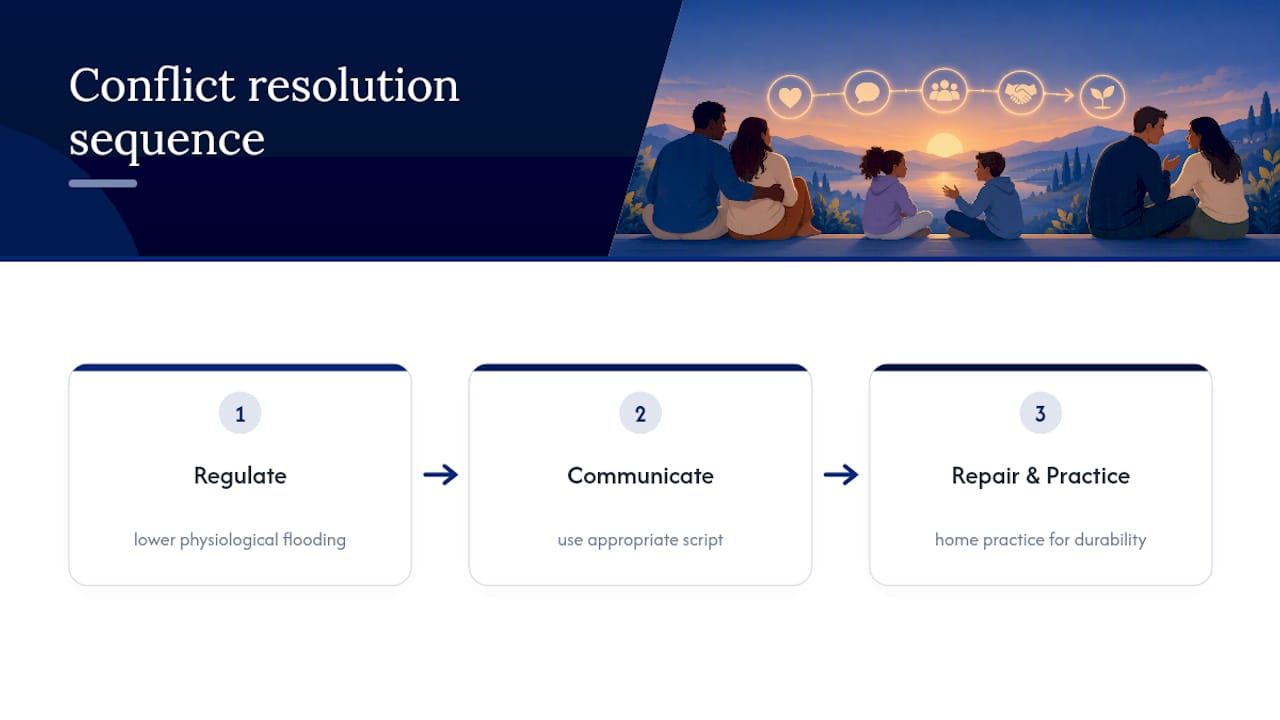
The other overlooked point: contingency-shaped change, where partners internalize new responses through repeated practice rather than following therapist instructions in the moment, tends to produce more durable shifts than rule-following alone. That’s why home practice matters as much as the session itself.
If you take one thing from this, prioritize regulation skills before anything else. Couples chase communication techniques when the real gap is nervous-system control, and no script fixes that on its own.
— Carlos
Getting Clinical Support for Conflict That Isn’t Resolving on Its Own
Reading scripts helps, but a clinician catches the pattern you can’t see from inside your own argument. Masteringconflict is built around exactly the strategies covered here, delivered by a licensed clinical mental health counselor and psychologist rather than a generic communication coach.
If anger regulation is your starting point, the anger management classes run from a single one-hour session up to an eight-hour deep dive, so you can match the commitment to how urgent the problem feels. Couples dealing with recurring conflict have options ranging from single couples sessions to more intensive structured programs for relationships that need faster movement. Families navigating coparenting or teen conflict can start with family and clinical counseling services, and teletherapy is available for anyone outside the Carolinas or Florida.
The lowest-friction first step is booking a single assessment or session rather than committing to a full program upfront. If you or someone in your household is unsafe right now, contact emergency services immediately. This isn’t a substitute for crisis care.
Sources
The strategies in this article draw on the Annual Review of Clinical Psychology’s meta-analysis of couple therapy outcomes, the Integrative Behavioral Couple Therapy and OurRelationship research, and the Family Process study on parent-focused systemic intervention. Each addresses a different piece of the puzzle: couples, digital delivery, and coparenting leverage.
- Interventions for Couples | Annual Review of Clinical Psychology
- Integrative brief systemic intervention (IBSI) for parents | Family Process
FAQ
What Are the Most Effective Conflict Resolution Strategies?
Active listening, I-statements, emotion-regulation skills, structured time-outs, collaborative problem solving, and repair techniques form the core toolkit clinicians use. Behavioral and emotion-focused approaches built on these skills help roughly 60 to 80 percent of distressed couples in controlled studies.
How Do I Use an I-Statement Without Sounding Accusatory?
Start with the feeling, not the accusation: “I feel anxious when plans change suddenly” instead of “you always do this.” If the sentence still contains the word “you” doing something wrong, it’s a criticism disguised as an I-statement.
When Should a Time-Out Be Used During an Argument?
Call a time-out when you notice a racing heart, clenched jaw, raised voice, or the urge to win rather than resolve. Always state a specific return time, such as twenty minutes, so the pause reads as regulation rather than withdrawal.
How Long Does It Take to See Results From These Strategies?
Most couples notice small shifts within four to six weeks of consistent practice and clearer change by around three months. If nothing has moved by then, a clinician can help identify what’s blocking progress.
Does Masteringconflict Offer Couples and Family Counseling?
Yes. Masteringconflict offers couples sessions, intensives, and packages, plus family counseling and anger management classes, with pricing and booking details available directly on the couples packages page and the clinical services page.