
How to Practice Assertiveness for Confident Communication

Speaking up for yourself can feel challenging in the fast-paced world of North Carolina and South Carolina. Addressing social fears, emotional worries, and mental hurdles is vital for women who want stronger voices in relationships and workplaces. By exploring the multidimensional pathways of assertiveness, you can uncover your barriers and use proven strategies to build confidence and communicate your needs with clarity. Discover how mastering assertiveness leads to greater empowerment and lasting positive change.
Table of Contents
- Step 1: Identify Personal Assertiveness Obstacles
- Step 2: Set Clear Boundaries And Goals
- Step 3: Develop Assertive Communication Techniques
- Step 4: Apply Assertiveness Skills In Real-Life Scenarios
- Step 5: Assess And Refine Your Assertiveness Progress
Quick Summary
| Key Point | Explanation |
|---|---|
| 1. Identify personal assertiveness obstacles | Recognizing barriers such as social fear and negative self-talk is essential for improving communication skills. |
| 2. Set clear boundaries and goals | Establishing specific limits and objectives helps maintain personal well-being and fosters confident interactions. |
| 3. Master assertive communication techniques | Learning strategies like using “I” statements and active listening enhances clarity and respect in conversations. |
| 4. Apply skills in real-life scenarios | Implementing assertiveness techniques in various situations reinforces confidence and protects personal boundaries. |
| 5. Assess and refine your progress | Regular self-evaluation and feedback enable ongoing development of assertiveness skills for effective communication. |
Step 1: Identify Personal Assertiveness Obstacles
Understanding and recognizing your personal assertiveness barriers is crucial for developing confident communication skills. By systematically examining the internal challenges that prevent you from expressing yourself effectively, you can create targeted strategies for improvement.
Researchers have identified multiple pathways where assertiveness obstacles emerge. Psychological dimensions of assertiveness highlight four critical areas where individuals commonly struggle:
- Social obstacles: Fear of social judgment or rejection
- Behavioral barriers: Difficulty translating thoughts into direct communication
- Emotional inhibitions: Anxiety about potential conflict or emotional vulnerability
- Mental roadblocks: Negative self-talk and limiting beliefs
To effectively map your personal assertiveness obstacles, consider conducting a self-assessment that explores these dimensions. Research on university students reveals that low self-esteem and lack of assertiveness training are significant contributors to communication challenges.

Here’s a quick reference comparing common assertiveness obstacles and matching improvement strategies:
| Obstacle Type | Typical Challenge | Effective Strategy |
|---|---|---|
| Social obstacles | Fear of judgment or rejection | Build supportive social networks |
| Behavioral barriers | Difficulty expressing thoughts directly | Practice role-playing scenarios |
| Emotional inhibitions | Anxiety about conflict or vulnerability | Develop emotional regulation |
| Mental roadblocks | Persistent negative self-talk | Use positive self-affirmations |
Start by reflecting on past interactions where you felt uncomfortable or unable to express your genuine thoughts and feelings. Notice patterns of hesitation, self-doubt, or instances where you prioritized others’ comfort over your own needs.
Recognizing your obstacles is the first step toward transforming your communication approach.
Pro Tip: Keep a communication journal to track moments when assertiveness feels challenging, helping you identify recurring patterns and emotional triggers.
Step 2: Set Clear Boundaries and Goals
Establishing clear boundaries and goals is fundamental to developing assertive communication skills and maintaining personal well-being. By defining your limits and objectives, you create a structured approach to navigating professional and personal interactions with confidence.
Understanding the importance of setting boundaries begins with recognizing your personal needs and limits. Goal-setting strategies in behavioral regulation demonstrate how defining clear objectives helps prioritize tasks and maintain motivation.
Start by implementing these practical boundary-setting techniques:
- Identify your core values: Determine what matters most to you
- Recognize personal limits: Understand where you’re comfortable saying yes or no
- Communicate expectations clearly: Use direct and respectful language
- Practice consistent enforcement: Follow through on your established boundaries
In demanding environments, establishing professional boundaries becomes crucial for managing workload and personal energy. This means learning to:
- Define specific time commitments
- Create realistic work-life balance parameters
- Communicate your availability transparently
- Learn to decline requests that exceed your capacity
Effective boundaries are not walls, but thoughtful guidelines that protect your well-being and productivity.
Pro Tip: Use a structured planning method like the Eisenhower Matrix to help prioritize tasks and reinforce your personal and professional boundaries.
Step 3: Develop Assertive Communication Techniques
Mastering assertive communication requires learning specific techniques that help you express yourself confidently and respectfully. By developing targeted communication strategies, you can transform your interactions and build stronger personal and professional relationships.
Assertive communication skills provide powerful tools for expressing your needs while maintaining mutual respect. These techniques focus on clear, direct communication that balances your interests with those of others.
Key assertive communication techniques include:
- Use “I” statements: Express feelings and needs without blaming
- Practice active listening: Show genuine interest in others’ perspectives
- Maintain confident body language: Stand tall, make eye contact
- Speak with a calm, steady tone: Control emotional reactivity
The multidimensional assertiveness model suggests developing skills across four critical domains:
This summary outlines assertiveness skill domains and where they’re most effectively applied:
| Assertiveness Domain | Core Skill | Real-Life Application Example |
|---|---|---|
| Social | Navigating group settings | Participating in team meetings |
| Behavioral | Direct communication | Asking for project clarification |
| Emotional | Expressing feelings | Sharing feedback without aggression |
| Mental | Challenging negative bias | Reframing self-limiting beliefs |
- Social assertiveness: Navigating group interactions
- Behavioral assertiveness: Translating thoughts into clear actions
- Emotional assertiveness: Regulating and expressing feelings appropriately
- Mental assertiveness: Challenging internal negative narratives
Assertive communication is not about winning, but about creating mutual understanding and respect.
Pro Tip: Record yourself in practice conversations to identify communication patterns and refine your assertive speaking style.
Step 4: Apply Assertiveness Skills in Real-Life Scenarios
Transforming assertiveness techniques from theory into practice requires strategic application across different life situations. Learning to implement these skills confidently helps you navigate complex personal and professional interactions with grace and self-respect.
Assertive communication strategies provide practical tools for expressing your needs directly and respectfully. These real-world applications help you maintain positive relationships while protecting your personal boundaries.
Key scenarios for applying assertiveness include:
- Workplace interactions: Negotiating workload and responsibilities
- Personal relationships: Setting clear emotional and physical boundaries
- Social settings: Declining invitations or requests without guilt
- Professional development: Requesting feedback and opportunities
Specific examples of assertive communication in action:
- Use calm, direct language when addressing concerns
- Maintain steady eye contact and confident body posture
- Frame requests as collaborative solutions
- Practice emotional self-regulation during tense exchanges
Implementing assertiveness across different scenarios requires understanding context and adapting your communication style accordingly.
Assertiveness is a skill that becomes more natural with consistent, mindful practice.
Pro Tip: Create a personal script library of assertive responses for common challenging situations to build confidence and reduce communication anxiety.
Step 5: Assess and Refine Your Assertiveness Progress
Continuous self-assessment is crucial for developing and maintaining assertive communication skills. By systematically evaluating your progress, you can identify strengths and areas for improvement, ensuring ongoing personal growth and communication effectiveness.
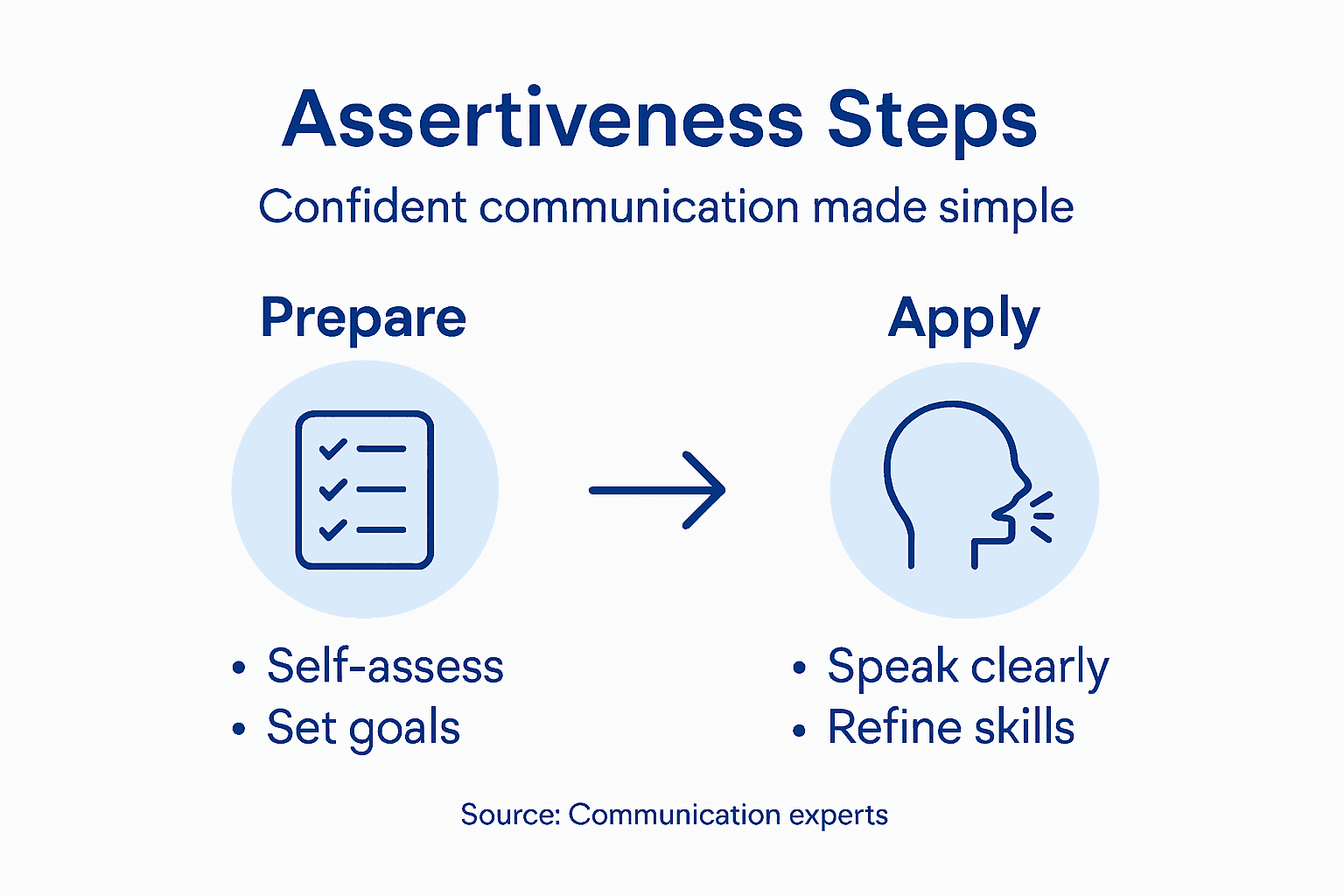
Assertiveness assessment tools provide structured methods for reflecting on your communication journey. These instruments help you gain objective insights into your current assertiveness level and potential development opportunities.
Key strategies for assessing your assertiveness progress include:
- Self-reflection journals: Track communication interactions and emotional responses
- Peer feedback: Request honest input from trusted friends or colleagues
- Video recording: Analyze your body language and communication style
- Periodic self-evaluation: Measure progress against initial communication goals
Comprehensive assertiveness measurement scales can help you:
- Identify specific communication strengths
- Recognize persistent challenges
- Set targeted improvement objectives
- Monitor long-term communication development
Progress in assertiveness is not about perfection, but consistent, intentional improvement.
Pro Tip: Create a quarterly self-assessment routine to track your assertiveness growth, using consistent evaluation metrics to maintain objective perspective.
Build Your Assertiveness with Professional Support
Struggling to overcome social fears or emotional inhibitions that block confident communication can feel overwhelming. This article highlights how recognizing personal obstacles and setting clear boundaries are essential first steps to becoming assertive. If you are ready to deepen your growth and tackle these challenges head-on, Mastering Conflict offers specialized therapy and coaching programs designed to transform these communication barriers into strengths. By working with licensed professionals, you gain access to evidence-based strategies tailored to your unique needs whether in personal relationships or professional settings.

Take control of your communication journey today. Explore our comprehensive support options including anger management, couples therapy, and individualized coaching. Visit Mastering Conflict now to start building confident communication skills that last. Your path to assertiveness and emotional well-being begins with a single step.
Frequently Asked Questions
What are common obstacles to practicing assertiveness?
Understanding common obstacles such as social fear, behavioral barriers, emotional inhibitions, and mental roadblocks is vital for practicing assertiveness. Conduct a self-assessment to identify which of these challenges resonate with you, and focus on developing targeted strategies for improvement.
How can I set clear boundaries to enhance my assertiveness?
To enhance your assertiveness, start by identifying your core values and recognizing personal limits. Communicate these boundaries clearly and practice consistently enforcing them in interactions to maintain your comfort and well-being.
What are effective techniques for assertive communication?
Effective assertive communication techniques include using “I” statements, practicing active listening, and maintaining confident body language. Implement these techniques in conversations to express your needs clearly and respectfully.
How can I apply assertiveness skills in real-life situations?
You can apply assertiveness skills by practicing them in various scenarios, such as workplace interactions and personal relationships. Create specific strategies for each situation, like preparing a calm response for a work meeting or using clear language when setting personal boundaries.
How can I assess and refine my assertiveness progress?
Assess your assertiveness progress by maintaining a self-reflection journal and seeking feedback from trusted peers. Set aside time quarterly to review your communication interactions and evaluate any progress made towards your assertiveness goals.
What steps can I take to overcome my fear of social judgment?
To overcome fear of social judgment, start by recognizing the thoughts that fuel this fear and challenge them with positive self-affirmations. Practice engaging in low-pressure social situations to gradually build your confidence in expressing yourself.
Recommended
- Master Assertive Communication Skills for Conflict Resolution – Mastering Conflict
- What are the Three R’s for Responding to Aggressive Behavior?
- 7 Practical Steps to Building Resilience in Everyday Life – Mastering Conflict
- Effective Conflict Communication – Tools for Lasting Love – Mastering Conflict
- 7 Essential Public Speaking Tips for Students’ Success|CS
- Consultative Sales Approach: Elevate Client Trust and Results
- Mastering the Art of Crucial Conversations: A Game-Changer for Business Owners – Summit Scale