
Evidence-Based Anger Management: Proven Strategies for Change

Frustration can build fast when everyday stress in North Carolina or Florida triggers strong emotional reactions that strain your closest relationships. For many Black men and women, finding ways to manage these feelings is about more than just calming down in the moment. Evidence-based anger management blends cognitive restructuring, emotional regulation, and practical skills training to target both the mental and physical roots of anger. Explore how proven approaches help you create healthier connections and strengthen your emotional well-being.
Table of Contents
- Defining Evidence-Based Anger Management Methods
- Core Techniques And Therapeutic Approaches
- Tailoring Strategies For Diverse Populations
- Benefits For Relationships And Daily Life
- Common Pitfalls And What To Avoid
Key Takeaways
| Point | Details |
|---|---|
| Evidence-Based Methods | Effective anger management incorporates cognitive restructuring, emotional regulation, and behavioral intervention to transform emotional responses. |
| Personalized Strategies | Tailoring anger management approaches to individual backgrounds and experiences enhances the relevance and effectiveness of interventions. |
| Interpersonal Benefits | Improved anger management skills contribute to better communication, reduced conflict, and stronger relationships in both personal and professional spheres. |
| Awareness of Pitfalls | Recognizing common obstacles, such as emotional suppression and over-generalization, is crucial to maintaining progress in anger management efforts. |
Defining Evidence-Based Anger Management Methods
Anger management represents a systematic, research-driven approach to understanding and transforming emotional responses. By examining anger through a scientific lens, mental health professionals have developed comprehensive strategies that address the complex psychological and physiological dimensions of this intense emotion.
Research indicates that evidence-based anger management methods fundamentally involve multiple interconnected components:
- Cognitive restructuring: Identifying and challenging negative thought patterns
- Emotional regulation: Developing skills to manage intense feelings
- Behavioral intervention: Learning constructive response techniques
- Physiological awareness: Understanding bodily signals and stress responses
These approaches are grounded in empirical research that explores anger as a multifaceted emotional phenomenon, involving intricate interactions between psychological, neurological, and behavioral systems. Cognitive-behavioral frameworks predominate, emphasizing the critical relationship between thoughts, emotions, and actions.
Professional anger management strategies typically incorporate comprehensive assessment tools and personalized intervention plans. Practitioners utilize scientifically validated techniques such as:
- Cognitive reframing techniques
- Relaxation and stress management skills
- Communication strategy training
- Emotional intelligence development
- Trigger identification and management
Neurobiological research further illuminates anger’s complex mechanisms, revealing how brain chemistry, past experiences, and learned responses contribute to emotional reactivity. This sophisticated understanding allows mental health professionals to design targeted interventions that address root causes rather than merely managing surface-level symptoms.
Pro tip: Practice self-awareness by maintaining a daily emotional journal to track anger triggers and response patterns.
Core Techniques and Therapeutic Approaches
Effective anger management relies on a sophisticated array of therapeutic interventions designed to address the complex psychological and behavioral components of emotional dysregulation. Cognitive-behavioral techniques form the foundation of most evidence-based approaches, providing structured methods for understanding and transforming anger responses.
Professional therapeutic approaches typically encompass multiple strategic components:
- Trigger identification: Recognizing personal anger activation points
- Cognitive restructuring: Challenging and reframing negative thought patterns
- Emotional regulation skills: Developing healthy emotional management techniques
- Communication training: Improving interpersonal conflict resolution abilities
- Stress management: Learning relaxation and coping mechanisms
These interventions draw from comprehensive research demonstrating the interconnected nature of thoughts, emotions, and behaviors. Practitioners utilize scientifically validated methodologies that target both immediate symptom management and long-term emotional intelligence development.
Military and veteran populations have been particularly instrumental in refining anger management approaches. Research highlights several key therapeutic strategies:
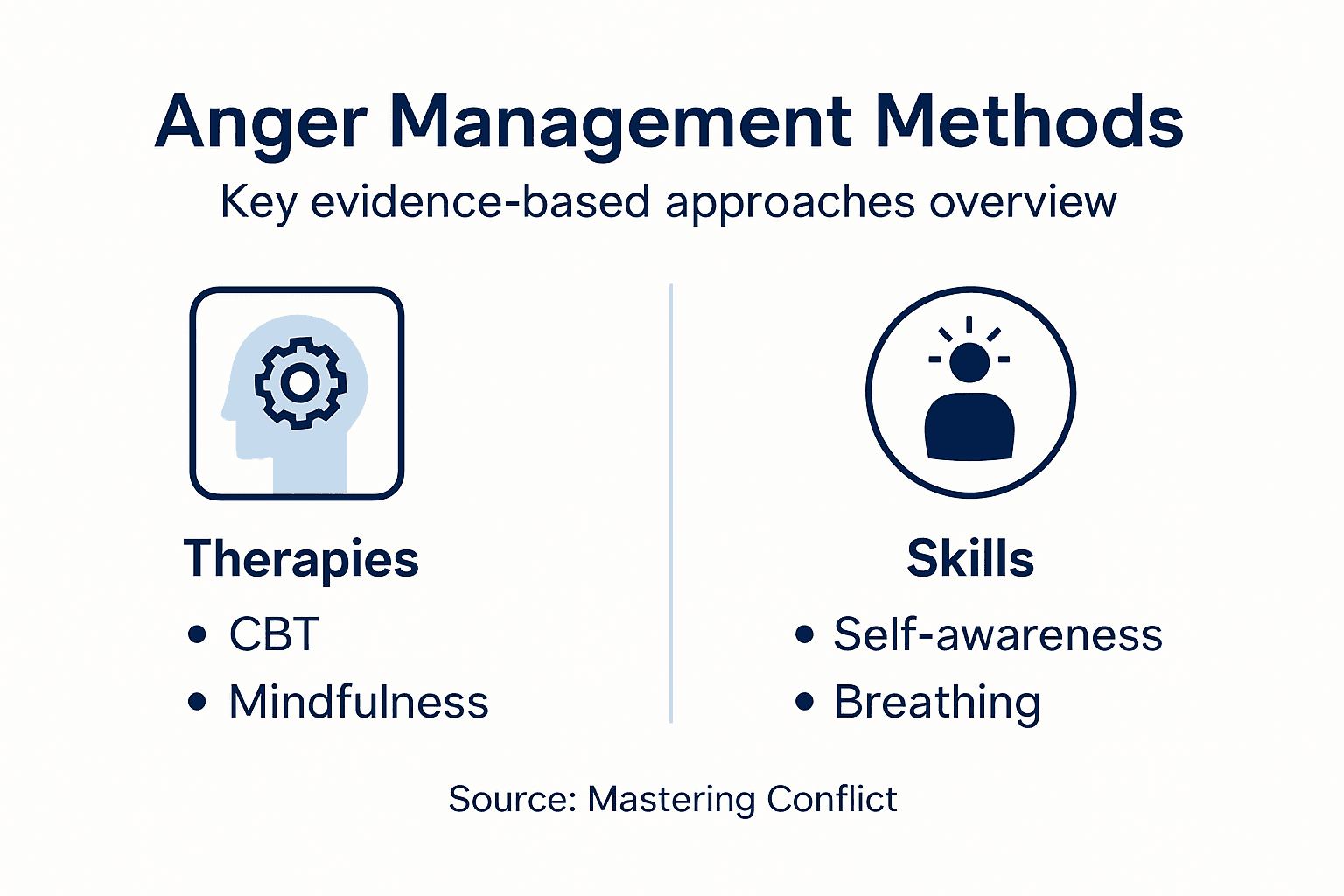
- Cognitive-behavioral therapy (CBT)
- Mindfulness-based interventions
- Stress inoculation training
- Exposure therapy
- Group support interventions
Effective anger management is not about suppressing emotions, but about understanding and channeling them constructively.
The most successful interventions integrate multiple approaches, recognizing that anger is a complex emotional experience requiring nuanced, personalized treatment strategies. Neurobiological research continues to reveal how targeted interventions can fundamentally reshape emotional responses and neural pathways.
Here’s a comparison of primary therapeutic approaches used in anger management:
| Approach | Target Population | Distinguishing Feature |
|---|---|---|
| Cognitive-Behavioral Therapy | General, clinical, and veterans | Restructures negative thinking |
| Mindfulness-Based Interventions | Military, trauma, general | Builds present-moment awareness |
| Stress Inoculation Training | High-stress professions, veterans | Gradual exposure to triggers |
| Exposure Therapy | PTSD, trauma, high reactivity | Desensitizes through repetition |
| Group Support Interventions | Veterans, youth, general | Peer learning and empathy focus |
Pro tip: Practice mindful breathing techniques for 5 minutes daily to develop emotional regulation skills and reduce stress reactivity.

Tailoring Strategies for Diverse Populations
Anger management is not a one-size-fits-all approach. Culturally sensitive interventions recognize the unique psychological, social, and emotional contexts that shape individual experiences of anger across different populations.
Key considerations for personalized anger management strategies include:
- Cultural background: Understanding cultural norms around emotional expression
- Individual trauma history: Recognizing personal experiences that influence emotional responses
- Socioeconomic factors: Addressing systemic stressors and environmental influences
- Personal communication styles: Adapting techniques to individual communication preferences
- Mental health context: Tailoring approaches to specific psychological needs
Professionals must develop nuanced approaches that respect individual differences while maintaining evidence-based principles. This requires a deep understanding of how various factors intersect to create unique emotional landscapes.
Specialized population approaches include targeted interventions for:
- Military veterans with PTSD
- Urban youth experiencing community violence
- Survivors of domestic abuse
- Professional athletes managing performance stress
- Individuals with neurodevelopmental differences
Effective anger management is about understanding individual context, not applying universal solutions.
The most sophisticated interventions integrate multiple perspectives, recognizing that emotional regulation is deeply personal. Neurobiological research continues to reveal the complex ways individual experiences shape emotional responses.
Key factors to consider when tailoring anger management programs for diverse individuals:
| Factor | Example Influence on Treatment | Reason for Importance |
|---|---|---|
| Cultural Background | Adapts communication styles | Ensures cultural relevance |
| Trauma History | Adjusts therapeutic pacing | Respects personal sensitivities |
| Socioeconomic Status | Considers access to resources | Addresses systemic barriers |
| Communication Style | Selects preferred interventions | Improves engagement and outcomes |
Pro tip: Work with a culturally competent therapist who understands your unique background and specific emotional challenges.
Benefits for Relationships and Daily Life
Anger management transcends individual healing, offering profound improvements in interpersonal dynamics and overall quality of life. Psychological well-being emerges through effective emotional regulation, creating positive ripple effects across personal and professional domains.
Significant benefits of anger management include:
- Enhanced communication skills: Learning to express emotions constructively
- Reduced relationship conflicts: Minimizing destructive interaction patterns
- Improved emotional intelligence: Developing deeper self-awareness
- Better stress management: Creating healthier coping mechanisms
- Increased personal resilience: Building emotional strength and adaptability
These transformative skills directly impact multiple life dimensions. In personal relationships, individuals become more empathetic listeners, capable of navigating complex emotional landscapes with grace and understanding. Professional environments benefit from increased emotional regulation, leading to more collaborative and productive interactions.
Key relationship improvements manifest through:
- More authentic and vulnerable communication
- Decreased likelihood of verbal or physical aggression
- Greater emotional safety for partners and family members
- Improved conflict resolution abilities
- Stronger, more meaningful connections
Emotional intelligence is not about suppressing anger, but understanding and managing it effectively.
The most profound transformations occur when individuals recognize anger as a signal, not a sentence. Neurological research continues to demonstrate how targeted interventions can fundamentally reshape emotional response patterns, creating lasting positive change.
Pro tip: Practice active listening and pause before responding during emotionally charged conversations to create space for thoughtful communication.
Common Pitfalls and What to Avoid
Navigating anger management successfully requires awareness of potential obstacles that can derail progress. Common treatment limitations compromise intervention effectiveness, making it crucial to understand and proactively address these challenges.
Major pitfalls individuals often encounter include:
- Over-generalization: Applying identical strategies across different emotional contexts
- Emotional suppression: Attempting to completely eliminate anger instead of managing it
- Inconsistent practice: Abandoning techniques after initial difficulties
- Lack of self-awareness: Failing to identify underlying emotional triggers
- Resistance to professional guidance: Believing self-management is always sufficient
Understanding these potential roadblocks is essential for developing a sustainable anger management approach. Many individuals mistakenly believe that anger management is a linear process, when in reality, it requires continuous adaptation and personalized strategies.
Critical warning signs that your approach might be ineffective include:
- Recurring intense emotional outbursts
- Persistent relationship conflicts
- Inability to recognize personal anger patterns
- Feeling consistently overwhelmed by emotions
- Avoiding challenging emotional situations
Effective anger management is a journey of continuous learning and personal growth, not a destination.
Successful intervention requires a holistic approach that integrates psychological understanding with practical skill development. Recognizing that setbacks are natural can help maintain motivation and commitment to personal emotional growth.
Pro tip: Regularly review and adjust your anger management strategies, treating them as evolving tools rather than fixed solutions.
Transform Your Life with Evidence-Based Anger Management
Understanding and managing anger is a complex challenge that requires more than just willpower. If you recognize patterns of intense emotional outbursts, recurring conflicts in relationships, or difficulty identifying your anger triggers, you are not alone. This article highlights essential concepts such as cognitive restructuring, emotional regulation, and tailored therapeutic approaches that connect directly to your goals of lasting change and improved emotional intelligence.
At Mastering Conflict, we specialize in professional, evidence-based anger management solutions designed to meet your unique needs. Whether you are seeking personalized counseling, structured anger management classes, or coaching programs that deepen self-awareness and resilience, we provide expert support grounded in the latest psychological and neurobiological research. Our services include targeted interventions for diverse populations including women, men, teens, and Black/African American communities, ensuring culturally sensitive care.
Take the first step toward healthier emotional regulation and stronger relationships today. Visit Mastering Conflict to explore our full range of anger management and conflict resolution services. If you want to understand your anger patterns better or start a path toward personal growth, schedule a consultation with our licensed professionals now. Your journey toward lasting change and emotional balance begins here.
Frequently Asked Questions
What are evidence-based anger management methods?
Evidence-based anger management methods are systematic, research-driven approaches that utilize cognitive restructuring, emotional regulation, behavioral interventions, and physiological awareness to help individuals understand and manage their anger effectively.
How can cognitive restructuring help in anger management?
Cognitive restructuring challenges and reframes negative thought patterns, helping individuals to change the way they interpret and respond to triggering situations, ultimately reducing anger responses.
What role does emotional regulation play in managing anger?
Emotional regulation involves developing skills to manage intense feelings, allowing individuals to respond to anger triggers in a healthier way without resorting to destructive behaviors.
Why is it important to tailor anger management strategies to individual needs?
Tailoring anger management strategies is crucial because each person’s experience of anger is shaped by their cultural background, trauma history, socioeconomic factors, and communication styles, making a one-size-fits-all approach ineffective.