
What Is Adolescent Counseling and Why It Matters

Every parent faces moments when their teenager’s mood shifts suddenly or communication breaks down, leaving families in North and South Carolina searching for answers. Adolescents often struggle with anxiety, depression, or identity issues that can feel overwhelming for everyone involved. This guide explains what adolescent counseling means, highlights confidential and supportive spaces, and shows how tailored approaches help your teen build resilience through online resources that fit your family’s needs.
Table of Contents
- Adolescent Counseling Definition And Key Concepts
- Types Of Adolescent Counseling And Approaches
- How Adolescent Counseling Works In Practice
- Legal And Ethical Requirements For Parents
- Risks, Costs, And Common Mistakes To Avoid
Key Takeaways
| Point | Details |
|---|---|
| Adolescent Counseling Focuses on Unique Needs | It addresses the specific emotional and developmental challenges faced by teenagers, providing a tailored approach to mental health support. |
| Confidential and Supportive Environment | A crucial aspect of counseling is offering teens a safe space to express themselves without judgment, fostering trust and engagement. |
| Various Therapeutic Approaches Available | Different methods like Cognitive Behavioral Therapy and Person-Centered Therapy are utilized to meet individual needs, emphasizing personalized care. |
| Early Intervention is Key | Timely counseling can prevent minor issues from escalating into significant problems, highlighting the importance of addressing mental health challenges early. |
Adolescent counseling definition and key concepts
Adolescent counseling is a specialized form of mental health support designed specifically for teenagers navigating the complex emotional, behavioral, and developmental challenges of their teen years. Unlike counseling for adults, adolescent counseling recognizes that teens face unique pressures, identity questions, and social dynamics that require tailored therapeutic approaches.
At its core, adolescent counseling provides a confidential and supportive space where teenagers can explore their feelings, concerns, and struggles without judgment. This safe environment is critical because many teens feel misunderstood by parents, teachers, or peers. A counselor becomes a trusted neutral person who listens and helps them process what’s happening in their lives.
Understanding the Core Purpose
The primary goal of adolescent counseling is to promote personal insight, emotional development, and positive behavioral change. Counselors help teens understand why they feel or act certain ways, then equip them with coping skills to handle stress, anxiety, depression, and relationship conflicts.

Globally, one in seven adolescents experiences a mental disorder, with depression, anxiety, and behavioral issues being the most common. Effective counseling addresses these challenges while also building resilience and emotional strength.
Key therapeutic approaches include:
- Cognitive Behavioral Therapy (CBT): Helps teens identify negative thought patterns and replace them with healthier thinking
- Person-Centered Therapy: Focuses on the teen’s own perspective and strengths rather than labeling them as “problems”
- Existential Counseling: Helps teens explore identity, purpose, and meaning during these formative years
What Makes It Effective
Effective adolescent counseling doesn’t exist in isolation. Counselors consider the teen’s entire environment—family dynamics, peer relationships, school stress, and cultural background. Your teen’s struggles aren’t just individual; they’re shaped by everything happening around them.
A skilled counselor also practices cultural sensitivity and ethical integrity. This means understanding your family’s values, background, and communication style. If you’re seeking mental health support tailored to your teen, the counselor should respect your family’s unique perspective.
Counseling also differs from therapy in scope. While therapy often involves deeper, longer-term work, counseling typically focuses on specific issues—handling a breakup, managing school anxiety, or navigating family conflict.
Adolescent counseling works best when teens feel heard and when the counselor understands both their individual struggles and their family context.
Why Timing Matters
The teenage years are when many mental health challenges first emerge. Early intervention through counseling can prevent small issues from becoming larger problems that follow them into adulthood. Your teen’s willingness to open up now matters significantly.
In North and South Carolina, online counseling options make it easier to access specialized adolescent support without lengthy waitlists. This accessibility removes barriers that might otherwise prevent your teen from getting help.
Pro tip: Look for counselors who specialize in adolescent work and who explain their approach clearly during an initial consultation—your teen is more likely to engage with someone they feel understands their stage of life.
Types of adolescent counseling and approaches
Adolescent counseling isn’t one-size-fits-all. Different therapeutic approaches work better for different teens depending on their specific struggles, personality, and what they’re dealing with. Understanding these approaches helps you recognize what your teen might benefit from most.
Individual Therapy Approaches
Cognitive Behavioral Therapy (CBT) is one of the most widely used approaches for teens. It focuses on the connection between thoughts, feelings, and behaviors. When your teen feels anxious about school, a CBT counselor helps them identify the negative thoughts driving that anxiety, then teaches them to challenge and replace those thoughts with more realistic ones.
Person-Centered Therapy takes a different angle. Instead of the counselor directing the conversation or “fixing” problems, this approach trusts your teen’s own insights and strengths. The counselor listens deeply and helps your teen discover their own answers. This works well for teens who feel judged or misunderstood.
Existential Counseling helps teens explore big questions about identity, purpose, and meaning. This approach is especially helpful during adolescence when teens are naturally asking “Who am I?” and “What matters to me?” It addresses the deeper existential concerns that pop up during these formative years.
When these approaches are tailored to individual needs, they effectively support teens coping with anxiety, depression, and identity issues.
Here is a comparison of common adolescent counseling approaches and their best-fit scenarios:
| Approach | Best For | Counselor Role |
|---|---|---|
| Cognitive Behavioral (CBT) | Teens with anxiety/depression | Instructor and skill-builder |
| Person-Centered | Teens feeling judged/isolated | Listener and supporter |
| Existential | Teens seeking meaning/identity | Guide in exploration |
| Group Therapy | Teens needing peer connection | Facilitator of interaction |
| DBT (group) | Teens with emotional regulation needs | Coach in real-time skills |
Group Therapy and Peer-Based Approaches
Group therapy offers something individual counseling cannot: peer connection and real-time social learning. Group therapy fosters social competencies and emotional expression within a peer context where teens realize they’re not alone in their struggles.
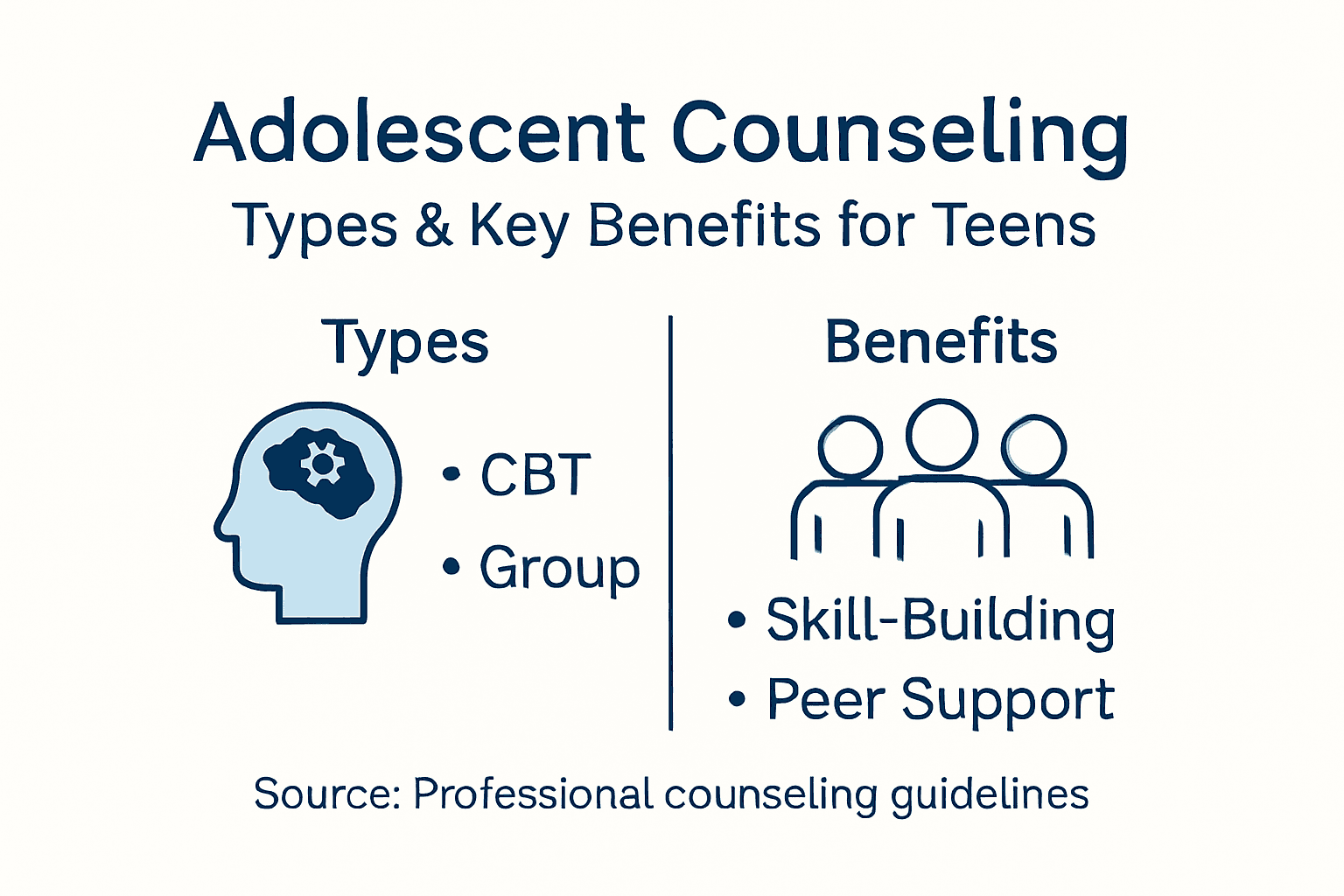
Your teen hears others their age facing similar challenges. This normalization is powerful. Group therapy also builds social skills because teens practice communicating and supporting each other in real time.
Dialectical Behavior Therapy (DBT) adapted for groups teaches teens emotional regulation, distress tolerance, mindfulness, and interpersonal effectiveness. This structured approach works particularly well for teens dealing with intense emotions or self-harm behaviors.
Specialized Approaches for Specific Issues
Some counseling focuses on particular challenges:
- Family-Based Counseling: Addresses family dynamics and communication patterns affecting your teen
- Trauma-Focused CBT: Helps teens process traumatic experiences safely
- Motivational Interviewing: Helps reluctant teens increase their own motivation for change
- Art or Expressive Therapy: Allows teens who struggle with words to express feelings through creative outlets
The most effective counseling approach matches your teen’s learning style, personality, and the specific issues they’re facing.
Choosing the Right Fit
Your teen’s preferences matter. Some teens connect better with structured approaches like CBT. Others need the non-judgmental space of person-centered therapy. A skilled counselor will explain their approach and may blend techniques based on what works for your specific teen.
If your teen struggles with peer relationships or social anxiety, group therapy or conflict resolution strategies might complement individual work. The goal is finding what helps your teen actually open up and engage.
Pro tip: Ask potential counselors which approaches they specialize in and why they’d recommend a particular one for your teen’s specific situation—this shows they’re thinking about personalized care rather than a standard program.
How adolescent counseling works in practice
Adolescent counseling isn’t just talking. It’s a structured, intentional process where trained counselors use specific skills and evidence-based techniques to help your teen move forward. Knowing what actually happens in sessions can ease your anxiety about whether counseling will work.
Building the Foundation: The Therapeutic Alliance
The first and most critical step is building trust. Your teen won’t open up to someone they don’t feel safe with or who doesn’t understand them. A skilled counselor spends early sessions getting to know your teen, asking questions without judgment, and showing genuine interest in their world.
This isn’t forced. The counselor listens carefully to understand your teen’s perspective, values, and what matters to them. They also explain how counseling works and what your teen can expect.
Assessment and Planning
Counselors assess your teen’s emotional, cognitive, and social development to understand where they are developmentally and what’s really going on beneath the surface. They ask questions about family dynamics, school, friendships, sleep, and mood patterns.
From this assessment, the counselor creates a treatment plan with specific goals. Instead of vague objectives like “feel better,” effective goals are concrete: “Reduce anxiety before tests” or “Have one conversation with a peer each week.”
Practical Intervention Techniques
Once goals are set, counselors use evidence-based practices like trauma-focused CBT and mindfulness to help your teen make actual changes. Here’s what you might see:
- Cognitive work: Your teen learns to identify unhelpful thought patterns and test whether they’re actually true
- Behavioral assignments: Between sessions, your teen practices new skills (like speaking up in class or managing anger)
- Mindfulness exercises: Simple techniques to help your teen notice thoughts without getting pulled into spirals
- Role-play: The counselor and teen practice difficult conversations so your teen feels prepared
Ongoing Progress and Adaptation
Counseling isn’t static. Each session builds on the previous one. The counselor tracks progress toward goals and adjusts approaches if something isn’t working. If CBT techniques aren’t clicking, they might try something different.
Your teen also develops skill-building and emotional regulation capacity over time. They’re not just talking about problems; they’re actively learning to handle them differently.
Navigating Confidentiality and Boundaries
A crucial part of counseling practice involves understanding confidentiality in counseling and when counselors must communicate with parents. Most counselors keep sessions private unless your teen is at risk of harming themselves or others, or abuse is happening.
Clear communication about these boundaries builds trust. Your teen needs to know what’s confidential and what requires parent notification.
Effective counseling combines professional skill, structured techniques, and genuine human connection that makes your teen feel truly heard.
Integration Across Settings
For teens in North and South Carolina, counseling works best when it integrates with their real life. School counselors, therapists in clinics, and those offering online counseling all coordinate when possible. Your teen applies what they learn in sessions to actual challenges at home, school, and with peers.
Pro tip: Ask your counselor to explain what they’re doing and why during sessions, then ask your teen afterward what they learned—this keeps you informed while respecting your teen’s privacy and reinforces that counseling is an active, collaborative process.
Legal and ethical requirements for parents
Parental involvement in adolescent counseling isn’t optional—it’s required by law in most situations. Understanding what’s legally required and what’s ethically sound helps you navigate the process confidently and ensures your teen gets proper care.
Parental Consent and Involvement
Parental consent is typically required before counseling begins for teens under 18. In North and South Carolina, counselors must obtain written permission from a parent or legal guardian before starting treatment, with limited exceptions.
The main exception involves mature minors or emancipated teens who can legally make their own healthcare decisions. These rules vary by state, so clarify your teen’s status when booking counseling services.
Once counseling starts, your involvement level depends on the counselor’s approach and your teen’s needs. Some counselors invite parents into sessions occasionally. Others keep sessions private but update parents on progress.
Understanding Confidentiality Rules
Confidentiality requirements create complex situations where counselors balance your teen’s developing autonomy with your legal rights. This isn’t simple because your teen deserves privacy, but you also have legal guardianship responsibilities.
Here’s what counselors typically keep confidential:
- Personal thoughts and feelings your teen shares
- Family dynamics they discuss
- Their struggles with identity or relationships
- Academic or social challenges
Counselors must break confidentiality in these situations:
Use this quick reference to understand when confidentiality may be broken in adolescent counseling:
| Situation | Counselor Action | Parent Notification |
|---|---|---|
| Threat of self-harm | Break confidentiality | Required |
| Evidence of abuse | Report and inform | Required |
| Substance use discussed | Assess risk, may notify | Depends on severity |
| Routine session insights | Maintain confidentiality | Not required |
| Emancipated or mature minor | Follow law, may keep private | Varies by state |
- Your teen threatens to harm themselves or others
- There’s evidence of abuse or neglect
- Your teen reports illegal activity that poses immediate danger
- You’re explicitly granted access by law
Confidentiality protects your teen’s willingness to be honest while safety concerns override privacy in critical situations.
What You Need to Know About Information Sharing
Counselors work within professional ethical codes and local laws, which vary by location. North and South Carolina have specific rules about when counselors must contact parents. Most require notification if your teen is in crisis or at risk of harm.
For routine progress, counselors might share general updates like “Your teen is engaging well in counseling” without disclosing specific details. This balance respects your teen’s privacy while keeping you informed.
Before counseling starts, the counselor should explain their confidentiality policy clearly. Ask specific questions: What happens if my teen talks about substance use? What if they’re having thoughts of self-harm?
Your Role as a Parent
Your responsibilities include providing accurate information during intake, following through with any recommendations between sessions, and maintaining consistency at home. If the counselor suggests behavioral strategies, implementing them reinforces what your teen learns.
You’re also responsible for transportation, payment, and ensuring your teen attends appointments. Some counselors ask you to complete brief questionnaires about your teen’s behavior at home to track progress.
Staying Informed While Respecting Boundaries
You can ask your teen about counseling without pressuring them. Try “How did it go today?” rather than “What did you tell the counselor?” This shows interest while respecting their privacy.
Communicate directly with the counselor about information you need. Effective providers balance sharing enough information to keep you involved with protecting your teen’s therapeutic space.
Pro tip: At your first contact with the counselor, ask them to explain their confidentiality policy in writing and clarify exactly what circumstances would require them to contact you—this removes confusion later and builds trust.
Risks, costs, and common mistakes to avoid
Adolescent counseling is beneficial, but like any healthcare service, it comes with costs and potential pitfalls. Knowing what to watch for helps you find quality care and avoid wasting time or money on ineffective approaches.
Understanding the Financial Investment
Counseling costs vary significantly based on location, counselor credentials, and session frequency. In North and South Carolina, individual therapy sessions typically range from $75 to $200 per session without insurance. Online counseling often costs less than in-person sessions.
Insurance coverage depends on your plan. Many plans cover mental health services, but copays and deductibles apply. Check your policy before booking to understand your out-of-pocket costs.
Some counselors offer sliding scale fees based on income. Non-profit organizations and community mental health centers sometimes provide lower-cost options. Understanding counseling costs upfront prevents financial surprises.
Common Counselor Mistakes to Avoid
Not all counselors are equally skilled with adolescents. Watch out for these red flags:
- Breaching confidentiality without clear safety concerns
- Imposing personal beliefs rather than guiding your teen’s own thinking
- Rushing solutions instead of taking time to build trust
- Judgmental attitudes that make your teen feel misunderstood
- Poor cultural competence that ignores your family’s values and background
Common mistakes in adolescent counseling include failing to build strong therapeutic alliance and neglecting ongoing professional development.
Recognizing When Counseling Isn’t Working
It’s normal for the first few sessions to feel awkward. Your teen needs time to adjust. However, after 4-6 sessions, you should notice some positive shift—your teen seems more willing to attend, talks about insights from sessions, or shows behavioral improvement.
If your teen still resists counseling after several weeks, the fit might be wrong. Sometimes switching counselors or trying a different approach makes all the difference. Don’t force a bad match.
The best counselor is someone your teen trusts and communicates with, not necessarily the most credentialed or expensive option.
Risks Specific to Adolescent Counseling
Adolescents face unique vulnerabilities in therapy. Emotional intensity is normal for teens, but counselors should help manage it, not amplify it. Your teen’s emotional vulnerability requires careful handling.
Other risks include:
- Premature termination if your teen doesn’t feel heard early on
- Dependency on the counselor rather than developing independence
- Ineffective treatment if the counselor doesn’t adapt strategies to your teen’s developmental stage
- Miscommunication about confidentiality creating distrust
Mistakes Parents Make
Parents sometimes undermine counseling without realizing it. Common errors include:
- Pressuring your teen to “open up” about what they discussed
- Using counseling as punishment (“You’re going to therapy”)
- Ignoring counselor recommendations because they conflict with your parenting style
- Booking counseling without your teen’s input, making them feel controlled
- Expecting immediate behavior change before the work takes hold
What Quality Counseling Looks Like
A skilled counselor maintains clear professional boundaries, respects your teen’s developing autonomy, and actively listens without interrupting or problem-solving prematurely. They adapt their approach to your teen’s age and needs, not treating a 13-year-old like a 17-year-old.
They also communicate clearly with you about progress and concerns without violating confidentiality. This transparency builds trust on all sides.
Pro tip: Interview potential counselors about how they handle confidentiality, what happens if progress stalls, and how they adapt their approach—these answers reveal their commitment to your teen’s actual growth rather than following a rigid program.
Support Your Teen’s Mental Health Journey with Expert Adolescent Counseling
Navigating adolescence is challenging for both teens and parents. If your teen is struggling with anxiety, identity questions, or emotional regulation, specialized adolescent counseling can provide the safe, supportive space they need to grow towards resilience. At Mastering Conflict, we understand that effective counseling requires a tailored approach that respects your teen’s unique experiences and family background. Our clinical interventions draw on proven methods like cognitive behavioral therapy and person-centered approaches to help teens build insight and positive coping skills.
Take the crucial step today to help your teen thrive. Explore how our online and in-person counseling services in North and South Carolina can make mental health support accessible and personalized. Visit Mastering Conflict now to learn more about our dedicated individual therapy for teens and how our expert team can guide your family through this pivotal time. Don’t wait for the challenges to grow. Get professional help from trusted clinicians who prioritize your teen’s voice and progress.
Frequently Asked Questions
What is adolescent counseling?
Adolescent counseling is a specialized form of mental health support tailored for teenagers who are navigating the emotional and developmental challenges of their teen years. It provides a confidential and supportive space for teens to explore their feelings and concerns.
Why is adolescent counseling important?
Adolescent counseling is important because many mental health challenges, such as anxiety and depression, emerge during the teenage years. Early intervention helps prevent small issues from escalating into larger problems that can impact adulthood.
What approaches are commonly used in adolescent counseling?
Common approaches include Cognitive Behavioral Therapy (CBT), Person-Centered Therapy, and Existential Counseling. Each approach targets different issues, helping teens develop coping skills, explore their identity, and gain insights into their behavior.
How can parents support their teen during counseling?
Parents can support their teen by being involved in the counseling process, respecting confidentiality, and encouraging open communication about their experiences. It’s essential to provide a supportive home environment where teens feel comfortable discussing their challenges.
Recommended
- Therapy for Teens Explained: Supporting Behavioral Change – Mastering Conflict
- Conflict Resolution for Adolescents: Parent Strategies That Work – Mastering Conflict
- Teens Counseling Therapist in Charlotte, NC 28262
- Mental Health Counseling Explained: Impactful Solutions – Mastering Conflict
- Understanding Mental Health Abroad: Key Concepts Explained