
Role of Mediation in Families – Building Peaceful Solutions

Every parent faces the challenge of finding common ground during family conflict, especially when emotions run high and children watch closely. In North Carolina and South Carolina, many turn to family mediation hoping for relief, yet this process can seem mysterious or even intimidating. By understanding what family mediation actually involves—and what it cannot do—parents can make informed decisions that put their children’s wellbeing and long-term family peace first.
Table of Contents
- What Family Mediation Involves and Gets Wrong
- Types of Family Mediation for Parents and Children
- How the Mediation Process Works Step-By-Step
- Real-World Benefits and When Mediation Helps Most
- Comparing Mediation, Counseling, and Legal Action
Key Takeaways
| Point | Details |
|---|---|
| Mediation is a Structured Process | It involves a trained mediator facilitating discussions rather than making decisions for the parties. |
| Common Misconceptions Exist | Many believe mediation guarantees solutions or is binding; it is not a replacement for therapy or individual representation. |
| Preparation is Essential | Effective mediation requires clear goals, emotional regulation, and adequate documentation from both parties. |
| Mediation Types Vary | Different approaches like facilitative, evaluative, and transformative mediation cater to various family needs and conflict situations. |
What Family Mediation Involves and Gets Wrong
Family mediation sounds straightforward: a neutral third party helps family members communicate and reach agreements. Reality is messier. Most people enter mediation with misconceptions about what actually happens and what mediators can (or cannot) do for them.
What Family Mediation Actually Involves
Mediation is a structured process, not casual discussion. A trained mediator guides conversations between family members—typically parents, spouses, or adult children—to address disputes over property division, custody, visitation, support payments, or inheritance. The mediator doesn’t make decisions for you. Instead, they help clarify issues, reduce emotional escalation, and facilitate problem-solving.
The process usually follows these stages:
- Opening meeting: Mediator explains the process, establishes ground rules, and confirms confidentiality
- Individual sessions: Private meetings with each party to understand their concerns and priorities
- Joint sessions: Facilitated conversations where parties work toward agreement
- Draft agreement: Mediator documents any consensus and may recommend legal review
Family mediation has evolved significantly since being introduced as an alternative to court processes, becoming increasingly central to modern family dispute resolution.
Common Misconceptions
Parents in North Carolina and South Carolina often expect mediation to solve problems it simply cannot address.
Mediation does not replace therapy or counseling. If your teenager is struggling with the separation or your spouse has unresolved anger issues, mediation won’t heal those wounds. Those require clinical intervention from a qualified mental health professional. Mediation addresses agreements, not underlying emotional wounds.
Mediation is not binding unless you sign off on it. Some families think once they sit down with a mediator, the outcome is final. Wrong. You maintain complete control. If you disagree with a proposed settlement, you walk away—no agreement, no obligation.
Mediation cannot force cooperation. If one party refuses to negotiate in good faith or actively sabotages the process, mediation fails. A mediator cannot compel honesty about finances, drug use, or abuse. The process depends on voluntary participation.
Mediation won’t work if abuse is present. Many families assume mediation can handle situations involving domestic violence, substance abuse, or intimidation. It cannot. These situations require court intervention and individual representation.
What Gets Overlooked
Families often underestimate the skill required to navigate mediation effectively. You need clarity about what you actually want, not what you think you should want. You need emotional regulation so anger doesn’t derail conversations. You need honest assessment of your situation.
Many also fail to prepare adequately. Coming unprepared with financial documents, custody concerns undefined, or without thinking through your priorities wastes time and money.
Mediation works best when both parties genuinely want resolution and can engage respectfully, even when disagreeing.
Pro tip: Before entering mediation, work with a family counselor or therapist to clarify your goals and develop emotional regulation skills—you’ll negotiate more effectively when you’re grounded.
Types of Family Mediation for Parents and Children
Not all mediation looks the same. Different approaches work better for different situations, and skilled mediators often blend styles depending on what your family actually needs. Understanding these types helps you know what to expect when you walk into a mediator’s office.
Facilitative Mediation
This is the most common approach in family disputes. The mediator stays neutral and guides conversation without offering opinions or solutions. They ask questions, help clarify positions, and keep both parents focused on problem-solving rather than blame.
Facilitative mediation works well when parents can communicate reasonably and both want to reach agreement. The mediator doesn’t tell you what’s fair—you decide that together. This approach respects your autonomy and gives you ownership of the outcome.
Evaluative Mediation
Here, the mediator offers assessments about what a court might decide if your case went to trial. They’ve typically trained in law or have extensive dispute resolution experience. They might say, “Based on North Carolina custody guidelines, a judge would likely favor this arrangement.”
Evaluative mediation appeals to parents who want realistic predictions about court outcomes. It can speed decisions when people understand the legal landscape. However, it shifts power toward the mediator rather than keeping it with you and your co-parent.
Transformative Mediation
Different mediation styles influence outcomes by shaping how parents approach cooperation and problem-solving. Transformative mediation focuses on shifting the dynamic itself—moving from blame and defensiveness to understanding and mutual respect. It’s slower than other approaches but aims for deeper relationship repair.
This works best when parents have time and genuinely want to improve their relationship for the sake of the children.
Shuttle Mediation
The mediator meets with each parent separately rather than bringing them together. This approach prevents escalation when emotions run hot or when safety concerns exist. Information moves between parties, but direct confrontation stays off the table.

Shuttle mediation takes longer and can feel disconnected, but it protects people who feel threatened or unsafe in joint sessions.
Tailored Approaches
Many mediators use eclectic approaches tailored to your specific conflict and family circumstances. They might start facilitative, shift evaluative when you need legal reality-checking, then add transformative elements to improve your working relationship with your co-parent.
The best mediator adapts to what your family needs—not forcing one method onto every case.
Here’s a concise overview of the main mediation styles and their ideal situations:
| Mediation Approach | Mediator Role | Best Situation | Potential Challenge |
|---|---|---|---|
| Facilitative | Neutral guidance | Parents communicate well | May stall if issues are emotional |
| Evaluative | Offers legal insight | Need realistic legal outcomes | Can reduce parental autonomy |
| Transformative | Enhances understanding | Want deeper relationship repair | Slower progress, higher emotional investment |
| Shuttle | Separates meetings | Safety or high conflict | Less direct communication, longer process |
| Tailored/Eclectic | Adapts methods | Complex or changing disputes | Requires mediator skill and flexibility |
Choosing the Right Fit
Consider these factors when selecting a mediation type:
- Safety concerns: Choose shuttle if abuse, intimidation, or threats exist
- Communication ability: Facilitative if you can talk respectfully; evaluative if emotions block progress
- Goal: Do you just want an agreement, or do you want to rebuild the co-parenting relationship?
- Timeline: Transformative takes longer; evaluative moves faster
- Children’s involvement: Some approaches work better when addressing parenting plans with kids in mind
The most effective mediation matches the style to your family’s actual needs, not what looks best on paper.
Pro tip: Ask potential mediators about their experience with high-conflict situations and whether they blend mediation styles—one-size-fits-all approaches rarely work for complex family disputes.
How the Mediation Process Works Step-By-Step
Mediation follows a predictable structure, though the pacing and emphasis vary based on your situation. Knowing what happens at each stage removes uncertainty and helps you prepare mentally. Here’s what unfolds in a typical family mediation.
Step 1: Planning and Preparation
Before you sit down, the mediator handles logistics. They’ll confirm who’s attending, explain fees, collect basic information about your dispute, and arrange the physical space. Some mediators send pre-mediation questionnaires asking about your main concerns and desired outcomes.
You’ll sign confidentiality agreements promising what’s discussed stays private. This protection encourages honest conversation. Come prepared with financial documents, custody concerns written down, and realistic goals—not wishes, but achievable outcomes.
Step 2: Mediator’s Opening and Ground Rules
The mediation session starts with the mediator explaining the process, their role, and ground rules. They’ll emphasize neutrality and clarify they won’t impose solutions. They’ll outline confidentiality limits and explain how long the process typically takes.
Ground rules usually include no interrupting, no name-calling, no threats, and staying focused on issues rather than attacking character. These rules create safety for honest conversation.
Step 3: Opening Statements
Each parent gets uninterrupted time to explain their perspective. You won’t be cross-examined or challenged. The mediator listens and takes notes. This isn’t about winning—it’s about ensuring both viewpoints are heard and understood.
Your opening statement should cover your main concerns, what matters most to you, and what resolution looks like from your angle. Stay factual and avoid inflammatory language.
Step 4: Joint Discussion
Once both perspectives are on the table, the mediator guides conversation toward identifying underlying interests. Why do you want primary custody? What matters about the financial arrangement? Understanding how mediation unfolds helps you recognize when you’re stuck in positions versus exploring actual needs.
This stage clarifies what really matters versus what’s negotiable.
Step 5: Private Caucuses
The mediator meets with each parent separately in confidential sessions. You can speak freely without your co-parent hearing. The mediator won’t repeat everything you say without permission, though they may use information to guide discussions.
Use caucus time to be honest about fears, flexibility on issues, and realistic assessment of your situation. This is where vulnerability helps move toward resolution.
Step 6: Negotiation and Agreement
The mediation process concludes when parties reach settlement or decide further negotiation won’t work. If agreement emerges, the mediator drafts language capturing what you’ve decided. You’ll likely review this with an attorney before signing.
The entire process typically takes 2-4 sessions over several weeks, though complex disputes need more time.
What to Expect Emotionally
Mediation can feel frustrating when progress stalls. You might hear things that sting. You’ll face moments where compromise feels like losing. Expect discomfort. That’s normal and often necessary for movement.
Stay focused on your children’s wellbeing and your long-term peace. Short-term irritation beats years of court battles.
Successful mediation requires showing up willing to listen and adjust your position when new information emerges.
Pro tip: Bring a support person to waiting areas if allowed, and schedule mediation sessions when you’re well-rested and can think clearly—morning sessions often work better than afternoons when frustration builds.
Real-World Benefits and When Mediation Helps Most
Mediation isn’t just an alternative to court—it delivers measurable outcomes that families actually care about. Understanding when mediation works best helps you decide whether it fits your situation.
Concrete Benefits That Matter
Mediation reduces the emotional toll on everyone, especially children. Court battles drag on for months or years, keeping conflict alive. Mediation typically wraps up in weeks. Your kids see you working toward solutions instead of fighting in depositions and courtrooms.
Research shows family mediation reduces conflict intensity and promotes cooperative decision-making between parents. You develop skills for ongoing communication after the agreement ends. These patterns matter when your children still have two parents to navigate for years ahead.
Cost Savings
Litigation is expensive. Court fees, attorney hourly rates, expert witnesses, and lengthy proceedings drain savings. Mediation costs a fraction of that—typically $1,500 to $5,000 total versus $15,000 to $50,000+ for court battles.
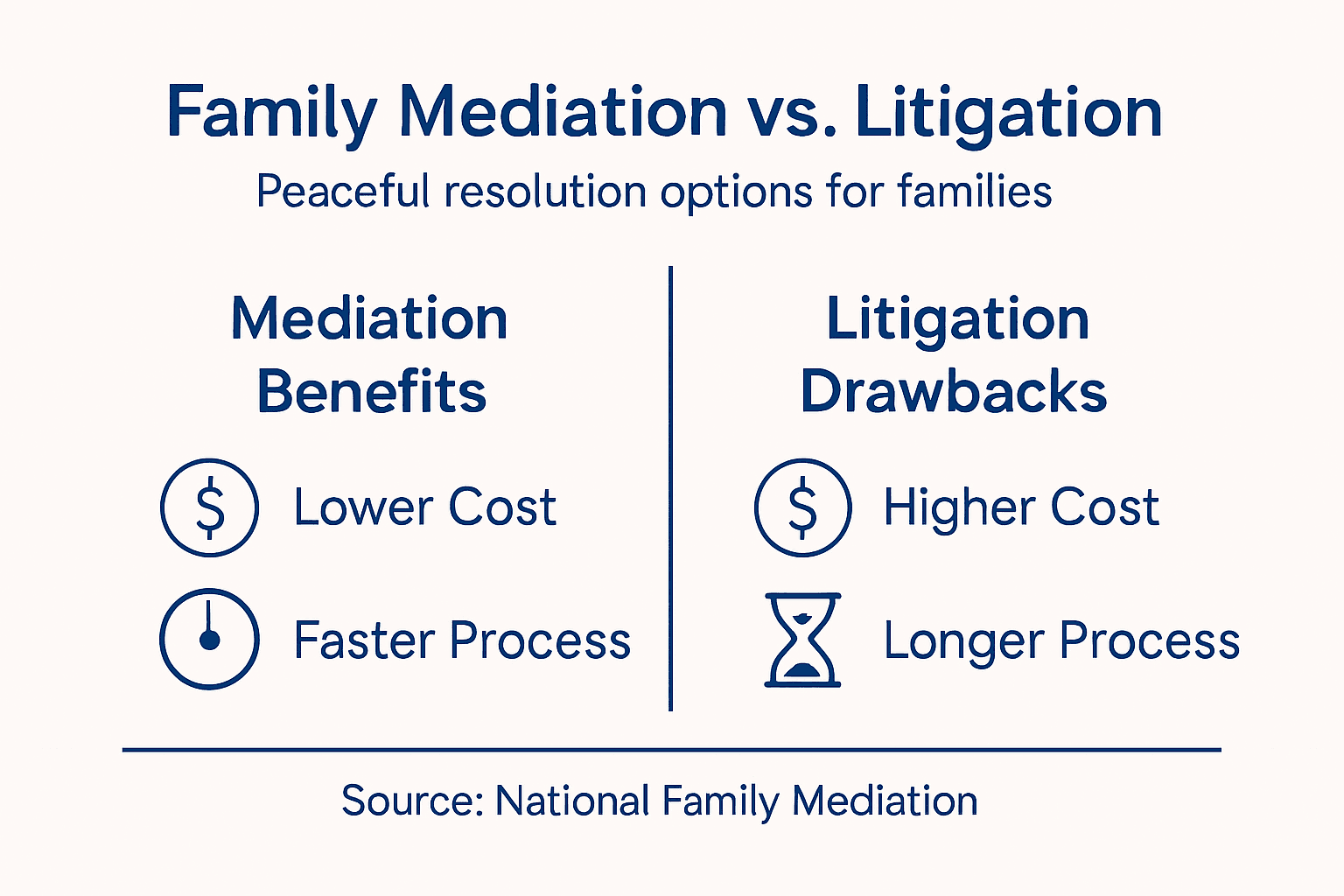
That money stays in your family’s pocket for your children’s needs instead of lawyers’ accounts.
Control Over Outcomes
In court, a judge decides your fate based on legal standards and limited information. In mediation, you control the agreement. You know your family better than any judge. You can craft creative solutions that work for your actual circumstances, not just legal minimums.
You might agree on flexible visitation around your teen’s sports schedule or unique financial arrangements that reflect your values.
When Mediation Works Best
Mediation succeeds when both parents genuinely want resolution and can engage respectfully. You don’t need to like each other—you need willingness to negotiate.
Mediation works well for:
- Relatively cooperative divorces: Parents disagree on details but share commitment to children’s wellbeing
- Custody disputes with reasonable parents: Both want active involvement and can prioritize kids over anger
- Financial disagreements: Property division, support calculations, and asset splits where both parties are honest
- Post-divorce modifications: Changing custody or support when circumstances shift
- Sibling or inheritance disputes: Family disagreements without safety concerns
When Mediation Doesn’t Work
Mediation fails when one party refuses good faith negotiation or when power imbalances prevent fair agreements. Safety issues—domestic violence, substance abuse, child abuse—require court intervention and legal protection first.
Mediation also struggles when one parent has untreated mental health crises, severe addiction, or actively sabotages discussions.
Child-Inclusive Mediation
Some mediators involve children in age-appropriate ways. Teenagers can explain their preferences about custody arrangements. This approach helps children feel heard and gives parents insights into what actually matters to their kids versus assumptions.
However, child-inclusive mediation remains underused despite evidence supporting its effectiveness. Ask mediators about involving your children.
Getting Started
If mediation seems right, find a mediator trained in family disputes. Check credentials, ask about their approach to safety screening, and confirm they’ve handled cases similar to yours. In North Carolina and South Carolina, ask about mediators affiliated with family law courts.
Mediation works best when both parents prioritize long-term family stability over short-term vindication.
Pro tip: Before committing to mediation, have individual consultations with a family law attorney to understand your legal rights and realistic outcomes—this clarity prevents regret later.
Comparing Mediation, Counseling, and Legal Action
Families often face a confusing choice: should we try counseling, mediation, court, or some combination? Each serves different purposes. Understanding what each does—and doesn’t do—helps you choose the right path for your situation.
What Each Approach Does
Counseling addresses emotional and psychological issues. A therapist helps individuals or families process grief, anger, trauma, and relationship patterns. Counseling doesn’t resolve legal disputes or make binding agreements. It heals wounds.
Mediation resolves specific disagreements through facilitated negotiation. A neutral mediator helps parents reach concrete agreements about custody, finances, or property. Mediation addresses practical problems but isn’t therapy. You might still feel hurt after mediation—you just have a workable plan.
Legal action involves courts making binding decisions based on law. Judges interpret custody guidelines, property division rules, and support calculations. Courts enforce outcomes through legal authority. But litigation is adversarial, expensive, and slow.
When to Use Counseling
Choose counseling when your family struggles emotionally. Your teenager is depressed about the divorce. Your spouse shows signs of untreated anxiety. You’re cycling through anger you can’t control. These issues won’t resolve through mediation or court—they need professional mental health intervention.
Finding a family counselor trained in divorce or family transitions helps children and adults process the emotional impact of family conflict.
Counseling works alongside mediation. Mediate the custody agreement. Counsel the teen who struggles with it.
When to Use Mediation
Mediation works when you need practical agreements and both parents can negotiate respectfully. You disagree on custody details, support amounts, or property division. Neither party seeks punishment—you just need a workable plan.
Mediation as a less adversarial alternative to litigation enables collaborative resolution while addressing both emotional and practical concerns.
Mediation saves time, money, and emotional energy compared to court battles.
When Legal Action Becomes Necessary
Court is needed when safety concerns exist, parties refuse good faith negotiation, or one parent acts dishonestly. Domestic violence, child abuse, substance abuse affecting parenting, or hidden assets require legal intervention. A judge can protect vulnerable parties and enforce compliance.
Court is also necessary when mediation fails and you still need binding decisions.
The Best Approach: Combination Strategy
Many families benefit from using all three strategically:
- Start with counseling: Parents process emotions individually before negotiating
- Move to mediation: Reach practical agreements about custody and finances
- Add counseling for kids: Help children adjust to new arrangements
- Use court only if needed: If agreements break down or safety concerns emerge
This sequence prevents emotional baggage from derailing practical negotiations and provides healing alongside structure.
Comparison Table
| Aspect | Counseling | Mediation | Legal Action |
|---|---|---|---|
| Addresses | Emotional healing | Practical agreements | Binding decisions |
| Cost | $100-$300/session | $1,500-$5,000 total | $15,000-$100,000+ |
| Timeline | Ongoing or 6-12 weeks | 2-4 weeks | 6-18 months |
| Control | You control your healing | You shape the agreement | Judge decides |
| Privacy | Confidential | Confidential | Public record |
Below is a quick guide comparing emotional, practical, and legal outcomes across family resolution methods:
| Outcome Type | Counseling | Mediation | Legal Action |
|---|---|---|---|
| Emotional Healing | Works through trauma and stress | Can reduce tension, not heal wounds | Often increases stress and anxiety |
| Practical Agreements | Indirect, supports collaboration | Directly produces custody, financial agreements | Enforces legal arrangements regardless of feelings |
| Long-Term Impact | Improves family dynamics over time | Builds communication skills for future issues | Finalizes disputes but may strain relationships |
The most effective family resolution uses counseling to heal, mediation to solve, and court only when absolutely necessary.
Pro tip: Don’t force mediation before emotional readiness—a few counseling sessions often make mediation far more productive by clearing emotional interference that blocks negotiation.
Discover Peaceful Solutions for Family Conflicts with Expert Support
Navigating family mediation can feel overwhelming when emotions run high and misunderstandings cloud judgment. This article highlights how mediation requires more than just good intentions—it demands clear communication, emotional regulation, and tailored approaches to truly resolve disputes. If you or your family are struggling with emotional barriers, safety concerns, or the challenge of creating lasting agreements, expert guidance is essential.

Take control of your family’s future today by combining practical mediation with professional mental health support. At Mastering Conflict, we specialize in comprehensive conflict resolution services including anger management, family counseling, and personalized therapy designed to enhance your ability to negotiate and heal. Learn how to manage emotional challenges that interfere with mediation and build peaceful, sustainable agreements. Start your journey toward resolution by visiting our family counseling services and discover tailored programs that fit your unique needs. Don’t wait—effective mediation begins with emotional readiness and skilled support available now at Mastering Conflict.
Frequently Asked Questions
What is family mediation?
Family mediation is a structured process where a neutral third party, known as a mediator, helps family members communicate and reach agreements regarding disputes such as custody, property division, or support payments.
How does the family mediation process work?
The mediation process typically involves several stages: an opening meeting where the mediator explains the process, individual sessions with each party, joint sessions for facilitated discussions, and drafting an agreement based on any consensus reached.
What are common misconceptions about family mediation?
Common misconceptions include the belief that mediation is legally binding without an agreement, that it replaces therapy, or that it can force cooperation between parties. In reality, mediation requires voluntary participation and does not address underlying emotional issues.
When is family mediation most effective?
Family mediation is most effective when both parties genuinely want resolution and are willing to engage respectfully. It works well for cooperative divorces, custody disputes, financial disagreements, and when both parties prioritize workable arrangements for the future.
Recommended
- Navigating Family Conflict for Positive Relationships – Mastering Conflict
- Family Conflict Resolution Services: Transforming Relationships – Mastering Conflict
- Conflict Resolution for Families: Tools, Tips, and Teletherapy 2025 – Mastering Conflict
- Understanding Family Conflict Resolution Strategies – Mastering Conflict
- How Mediation Can Help You Resolve Conflict During Divorce
- adhd家庭生活指引:提升亲子沟通与情绪调节全流程 – MOMORO & Friends