Conflict Management Skills: Enhancing Therapy Outcomes

More than 60 percent of American mental health professionals report that unresolved conflict often delays client progress. In North Carolina and South Carolina, clinicians regularly encounter interpersonal tensions that cross cultural and demographic lines, especially with minority populations. Effective conflict management is more than theory—it shapes how practitioners guide clients through complex emotional challenges. This resource uncovers advanced skills and debunks myths, giving you practical strategies to transform conflict into opportunities for growth and understanding.
Table of Contents
- Conflict Management Skills Defined and Debunked
- Major Conflict Types and Management Styles
- Core Techniques for Effective Conflict Resolution
- Applying Skills in Diverse Clinical Practice
- Risks, Limitations, and Practitioner Pitfalls
Key Takeaways
| Point | Details |
|---|---|
| Conflict Management Skills | These skills involve emotional intelligence and strategic thinking to address conflicts constructively. |
| Types of Conflict | Understanding the distinction between interpersonal, intragroup, and organizational conflicts is essential for effective management. |
| Core Techniques | Skills such as active listening and emotional awareness build empathy and enhance problem-solving capabilities in conflict scenarios. |
| Risks and Limitations | Practitioners must be aware of their biases and the limitations of relying on a single conflict management style to avoid escalating tensions. |
Conflict Management Skills Defined and Debunked
Conflict management skills represent a complex psychological toolkit designed to navigate interpersonal tensions effectively. These skills go beyond simple communication techniques, encompassing emotional intelligence, strategic thinking, and adaptive problem solving. The International Chamber of Commerce defines conflict management as both proactive and reactive processes aimed at preventing destructive disputes while preserving critical relationships.
Traditional misconceptions portray conflict as inherently negative, but contemporary research reveals a nuanced perspective. Conflict, when managed skillfully, can actually stimulate innovation, enhance understanding, and strengthen interpersonal dynamics. Mental health professionals understand that conflict represents an opportunity for growth rather than a problem to be eliminated. By developing sophisticated conflict management abilities, therapists can transform potentially volatile interactions into constructive dialogues that promote mutual understanding and personal development.
At its core, conflict management requires practitioners to cultivate multiple layers of awareness: emotional self-regulation, situational analysis, and systemic understanding. These skills involve recognizing personal triggers, understanding underlying motivations, and creating communication strategies that validate multiple perspectives simultaneously. Conflict-intelligent leadership demands expanding one’s perspective beyond immediate interpersonal dynamics to consider broader contextual and systemic factors.
Pro tip: Practice active listening techniques that focus on understanding underlying emotions rather than immediately proposing solutions during conflict scenarios.
Major Conflict Types and Management Styles
Conflict is a multifaceted phenomenon that manifests in various forms across different interpersonal and organizational contexts. Research identifies several primary conflict types, including interpersonal, intragroup, and organizational conflicts, each demanding unique management approaches. Empirical studies reveal that understanding these distinctions is crucial for developing effective intervention strategies.
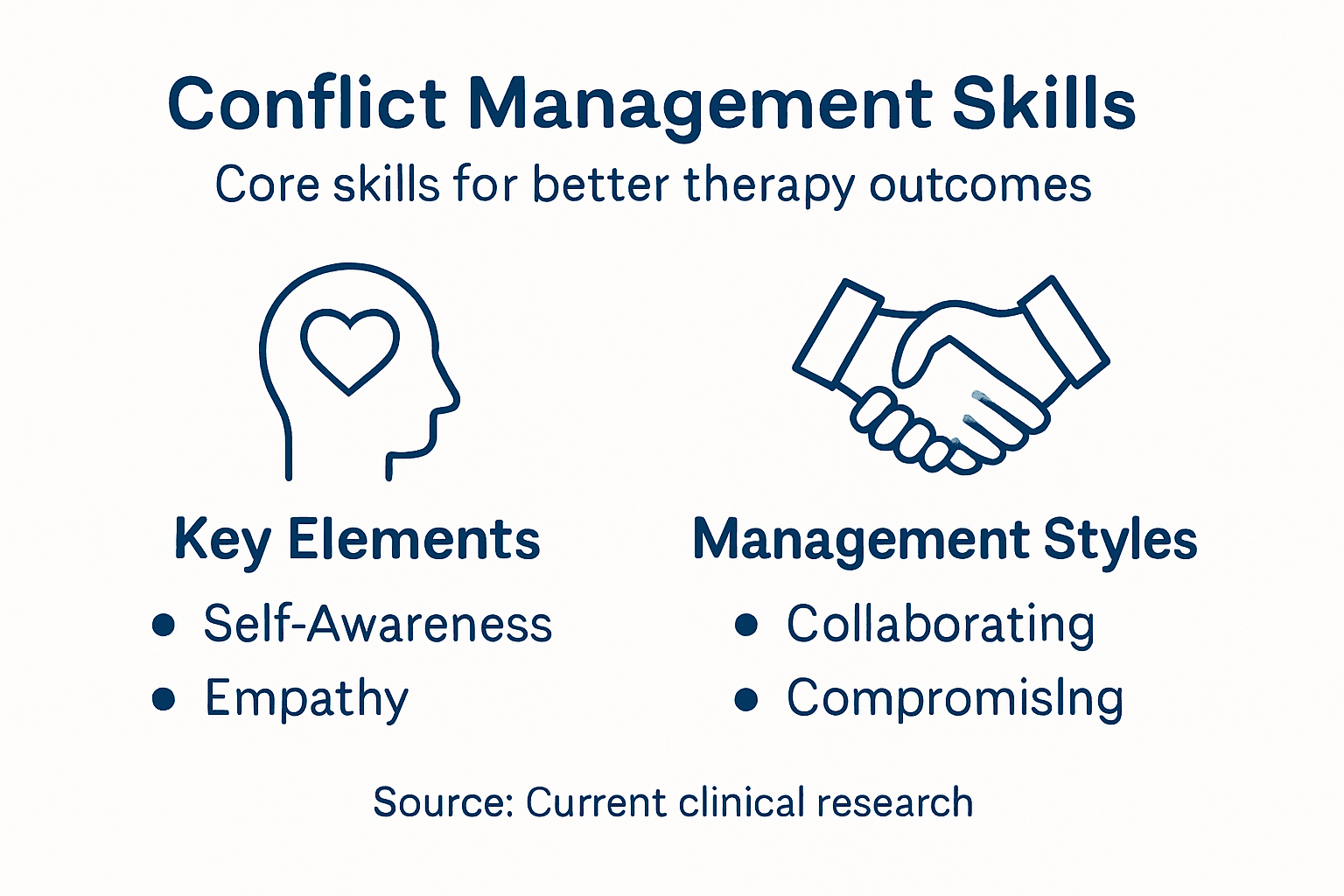
Mental health professionals typically recognize five primary conflict management styles: competing, accommodating, avoiding, collaborating, and compromising. Each style represents a different approach to addressing and resolving conflicts. The competing style involves assertively pursuing one’s own interests, while accommodating focuses on preserving relationships by yielding to others. Avoiding represents a strategy of withdrawing from or postponing conflict, whereas collaborating seeks to find mutually beneficial solutions that satisfy all parties’ core needs.
Here’s a summary of major conflict management styles and typical clinical outcomes:
| Conflict Style | Key Approach | Likely Clinical Impact |
|---|---|---|
| Competing | Assertive, self-focused | May resolve quickly, risks tension |
| Accommodating | Yielding to others’ needs | Preserves relationships, risks unmet needs |
| Avoiding | Withdrawal or delay | Reduces immediate friction, may prolong issues |
| Collaborating | Seek full consensus | Enhances trust and mutual growth |
| Compromising | Balanced concessions | Achieves quick settlement, may leave needs partially unmet |
Leadership development research emphasizes the importance of flexibility in conflict management. Practitioners must develop the ability to recognize their default conflict style and adapt their approach based on the specific context and conflict type. This adaptive approach requires emotional intelligence, strategic thinking, and a nuanced understanding of interpersonal dynamics. Successful conflict management is not about eliminating conflict, but transforming it into an opportunity for growth, understanding, and constructive problem solving.
Pro tip: Develop a personal conflict style assessment to identify your default approach and practice alternative strategies for more effective interpersonal resolution.
Core Techniques for Effective Conflict Resolution
Conflict resolution requires a sophisticated approach that integrates multiple interconnected techniques. Core conflict resolution skills encompass emotional awareness, cultural sensitivity, constructive feedback, active listening, trust-building, and strategic problem-solving. These techniques collectively create a comprehensive framework for transforming potentially destructive interactions into opportunities for mutual understanding and growth.
Mental health professionals must develop nuanced communication strategies that go beyond simple dialogue. Active listening involves deeply understanding the underlying emotions and perspectives driving conflict, rather than merely hearing surface-level statements. Emotional awareness allows practitioners to recognize and manage their own emotional reactions while simultaneously creating a safe space for clients to express complex feelings without judgment. Trust-building becomes critical in this process, as clients must feel genuinely supported and understood before meaningful resolution can occur.

Proactive conflict management strategies emphasize early intervention and structured approaches to dispute resolution. This includes developing internal policies, raising awareness about potential conflict triggers, and implementing mediation techniques that prioritize collaborative problem-solving. Practitioners should focus on creating environments that encourage open communication, validate diverse perspectives, and develop mutually beneficial solutions that address the core needs of all parties involved.
For quick reference, here are core techniques used in effective conflict resolution and their main purposes:
| Technique | Primary Purpose | Enhances Resolution By |
|---|---|---|
| Emotional Awareness | Recognize/manage emotions | Builds empathy and safety |
| Active Listening | Understand deeper meaning | Reduces defensiveness |
| Constructive Feedback | Offer actionable insights | Facilitates positive change |
| Trust-Building | Foster reliable relationships | Encourages openness |
| Problem-Solving | Find practical solutions | Addresses root causes |
Pro tip: Practice reflective listening by paraphrasing and confirming understanding before responding, which helps validate clients’ experiences and reduces defensive reactions.
Applying Skills in Diverse Clinical Practice
Conflict management requires sophisticated adaptation across different clinical environments. Social-based learning frameworks demonstrate how mental health professionals can effectively teach and implement relational conflict resolution techniques that foster inclusiveness and perspective-taking across diverse populations. Understanding contextual nuances becomes critical when navigating complex interpersonal dynamics in therapeutic settings.
Practitioners must develop flexible approaches that recognize cultural, demographic, and individual differences. This means moving beyond standardized techniques to create personalized intervention strategies. Each client brings unique communication patterns, emotional histories, and relationship dynamics that require thoughtful, individualized conflict resolution methods. Emotional intelligence plays a crucial role in recognizing subtle communication barriers and creating safe, supportive environments that encourage authentic dialogue and mutual understanding.
Leadership strategies for conflict management emphasize transparency, clear policy development, and proactive interventions tailored to specific organizational cultures. Mental health professionals should create structured yet flexible frameworks that allow for dynamic responses to emerging conflict scenarios. This approach requires continuous learning, self-reflection, and a commitment to understanding the unique contextual factors that influence conflict resolution across different clinical populations.
Pro tip: Develop a personal cultural competence checklist to systematically assess and improve your ability to adapt conflict resolution techniques across diverse client backgrounds.
Risks, Limitations, and Practitioner Pitfalls
Conflict management is a nuanced discipline fraught with potential challenges that can undermine therapeutic effectiveness. Emotional intelligence deficits represent one of the most significant risks, where practitioners may inadvertently escalate conflicts by misreading emotional dynamics or applying inappropriate intervention strategies. Mental health professionals must recognize that their own emotional responses and biases can significantly impact conflict resolution outcomes.
Practitioners frequently encounter limitations stemming from rigid adherence to single conflict management styles. This approach fails to acknowledge the complex, multidimensional nature of interpersonal conflicts. Common pitfalls include overreliance on confrontational techniques, insufficient emotional attunement, and a lack of adaptability. Some professionals mistakenly view conflict as a problem to be eliminated rather than a dynamic process requiring nuanced navigation. This perspective can lead to superficial resolutions that do not address underlying relational or emotional tensions.
Comprehensive conflict management strategies emphasize the importance of proactive training and continuous skill development. Practitioners must be aware of potential escalation risks, including inadequate engagement of involved parties, premature interventions, and failure to create safe communication environments. The most effective professionals develop a reflective practice that allows them to continuously assess and adjust their approach, recognizing that each conflict scenario requires a unique and contextually sensitive response.
Pro tip: Regularly record and review your conflict intervention sessions to identify personal biases and areas for improvement in your conflict management approach.
Transform Your Conflict Management Skills for Better Therapy Outcomes
The article highlights how developing emotional awareness, active listening, and adaptive conflict management styles transforms potentially destructive conflicts into growth opportunities. If you are struggling with navigating complex interpersonal tensions in therapy or in your personal life, you are not alone. Many face challenges like unresolved anger, ineffective communication, or difficulty managing diverse emotional dynamics. Mastering these key skills can lead to deeper understanding, stronger trust, and more meaningful resolutions.
Take the next step toward enhancing your conflict resolution abilities with Mastering Conflict. Whether you are seeking professional clinical interventions like anger management classes and specialized counseling or looking for coaching programs tailored to your unique needs, our evidence-based services offer personalized support. Mental health professionals can also benefit from expert mentoring and supervision to refine their skills. Visit Mastering Conflict to access trusted resources and schedule a session that empowers you to manage conflict skillfully today.
Frequently Asked Questions
What are the key components of conflict management skills?
Conflict management skills involve emotional intelligence, strategic thinking, and adaptive problem-solving. Practitioners must recognize personal triggers, understand underlying motivations, and create effective communication strategies to validate multiple perspectives.
What are the primary conflict management styles?
The primary conflict management styles include competing, accommodating, avoiding, collaborating, and compromising. Each style has different approaches and impacts, affecting how conflicts are resolved and relationships are maintained.
How can mental health professionals enhance their conflict resolution techniques?
Mental health professionals can enhance their conflict resolution techniques by practicing active listening, developing emotional awareness, building trust, and using constructive feedback. These strategies help in creating a supportive environment for clients and promote mutual understanding.
What are some common pitfalls in conflict management that practitioners should avoid?
Common pitfalls include emotional intelligence deficits, rigid adherence to a single conflict management style, and viewing conflict as purely negative. Practitioners should adapt their approaches based on the specific context of each conflict to achieve effective resolutions.