
Women’s Empowerment Counseling: Transforming Self-Confidence

For many women in North Carolina and South Carolina, the struggle to break free from limiting beliefs and social expectations can feel isolating. Counseling empowers women to develop critical consciousness, build self-confidence, and challenge narratives shaped by societal pressures. This article explores how women’s empowerment counseling supports lasting personal growth through recognizing unique challenges, embracing resilience, and helping women reclaim their agency.
Table of Contents
- Defining Women’s Empowerment Counseling
- Key Therapeutic Approaches For Empowerment
- Addressing Unique Challenges Faced By Women
- Building Self-Confidence And Setting Boundaries
- Legal, Ethical, And Privacy Considerations
- Common Mistakes And Access Barriers To Avoid
Key Takeaways
| Point | Details |
|---|---|
| Women’s Empowerment Counseling | This counseling approach addresses systemic challenges and promotes women’s psychological well-being through critical consciousness and personal agency. |
| Therapeutic Approaches | Empowerment counseling employs collaborative strategies like narrative therapy and feminist group techniques to foster personal growth and societal change. |
| Unique Challenges | Women face complex mental health challenges rooted in systemic inequalities, necessitating targeted empowerment strategies for improved resilience. |
| Ethical Considerations | Maintaining confidentiality and recognizing power dynamics is crucial in empowerment counseling to create a safe space for women. |
Defining Women’s Empowerment Counseling
Women’s empowerment counseling represents a transformative approach to mental health that goes beyond traditional therapeutic models by addressing systemic challenges unique to women’s experiences. This specialized form of counseling focuses on helping women develop critical consciousness, recognize their inherent strengths, and navigate complex social dynamics that often limit personal growth.
At its core, empowerment counseling is rooted in understanding how external societal pressures and internalized beliefs impact women’s psychological well-being. Feminist approaches in counseling reveal that this therapeutic method is not just about individual healing, but about challenging broader social structures that perpetuate gender inequity.
Key components of women’s empowerment counseling include:
- Recognizing and dismantling internalized oppressive narratives
- Developing personal agency and self-determination
- Building resilience against systemic barriers
- Cultivating emotional intelligence and self-awareness
- Strengthening individual and collective power
By integrating psychological support with social awareness, conceptual frameworks for measuring empowerment emphasize that this counseling approach is fundamentally about supporting women’s journey toward complete self-actualization. It’s a holistic process that acknowledges women’s experiences as complex, multidimensional, and deeply interconnected with broader social contexts.
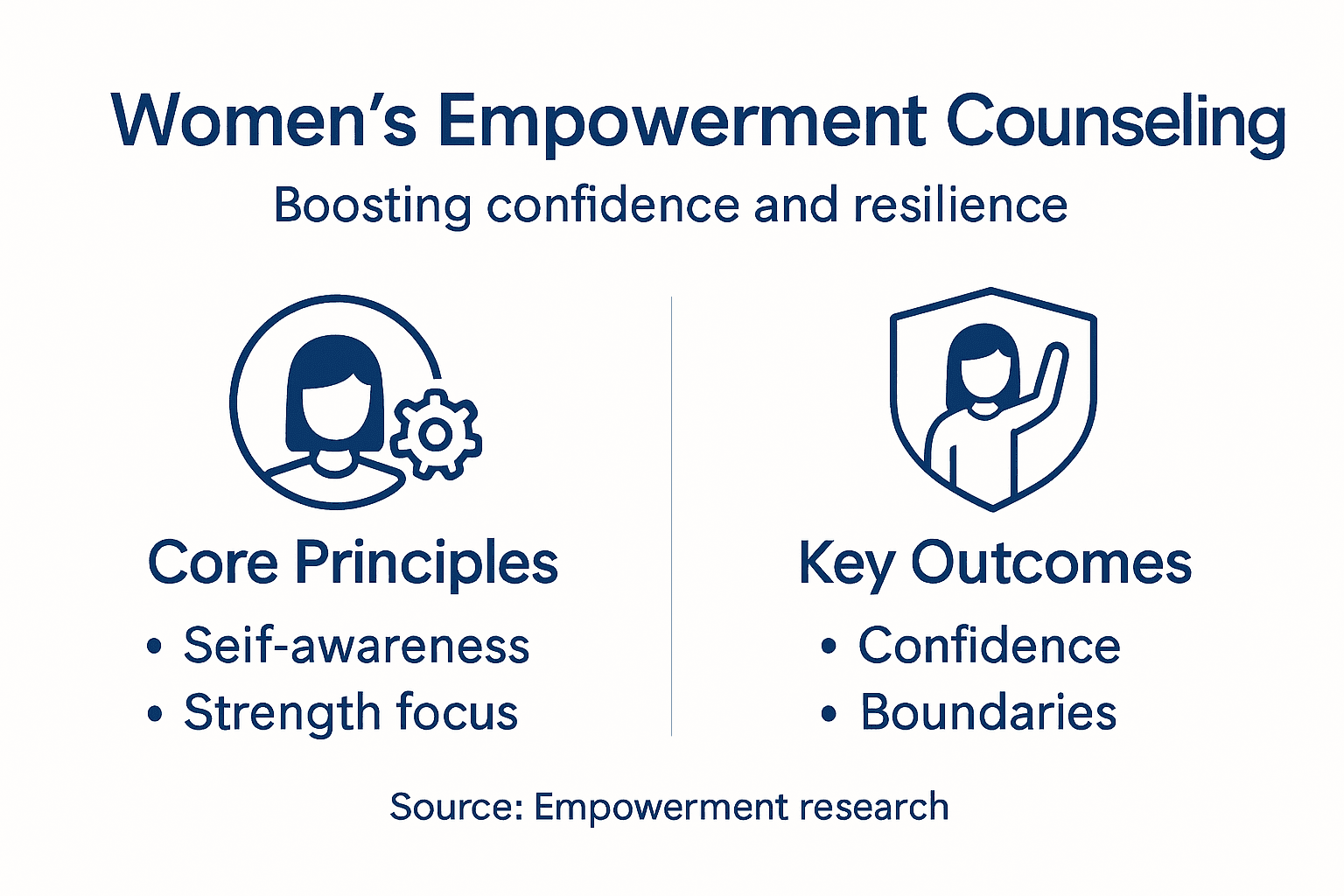
Pro tip: Start your empowerment journey by identifying one personal narrative that no longer serves your growth and commit to challenging its underlying assumptions.
Key Therapeutic Approaches for Empowerment
Women’s empowerment counseling employs several sophisticated therapeutic approaches designed to address the complex psychological and social challenges women encounter. Empowerment feminist therapy stands out as a transformative method that goes beyond individual healing to challenge systemic oppression and promote broader social change.
The primary therapeutic approaches in women’s empowerment counseling include critical strategies that foster personal growth and societal transformation. Collaborative counseling emerges as a powerful technique, where therapists work alongside clients as partners rather than hierarchical experts. This approach recognizes women’s inherent strengths and capacities, shifting away from traditional deficit-based models of mental health treatment.
Key therapeutic approaches include:
- Narrative therapy to reframe personal experiences
- Feminist group counseling techniques
- Intersectional awareness and analysis
- Strength-based psychological interventions
- Critical consciousness development
Group counseling programs have proven particularly effective in enhancing psychological empowerment. These programs create supportive networks that validate women’s experiences, provide collective healing opportunities, and build resilience through shared understanding and mutual support.
Therapeutic strategies in empowerment counseling fundamentally aim to transform not just individual mindsets, but broader social narratives about women’s capabilities, challenges, and potential. By integrating psychological support with social awareness, these approaches help women develop robust emotional intelligence and agency.
Here’s how major therapeutic approaches differ in women’s empowerment counseling:
| Approach | Primary Focus | Distinguishing Feature |
|---|---|---|
| Narrative Therapy | Reframing personal stories | Emphasizes meaning-making |
| Feminist Group Counseling | Shared support and validation | Builds collective agency |
| Intersectional Analysis | Addressing layered identities | Considers race/class/gender |
| Strength-Based Interventions | Leveraging innate resources | Highlights existing capabilities |
| Critical Consciousness | Societal awareness and action | Promotes active social change |
Pro tip: During counseling, actively document your personal strengths and achievements to build a comprehensive narrative of your resilience and potential.
Addressing Unique Challenges Faced by Women
Women encounter a complex landscape of mental health challenges that require nuanced, compassionate, and strategic therapeutic interventions. Mental health experiences during crisis situations reveal profound vulnerabilities specific to women’s social, economic, and cultural contexts, highlighting the critical need for targeted empowerment counseling approaches.

The challenges women face are multifaceted and deeply rooted in systemic inequalities. Gender role expectations create significant psychological pressures, compelling women to navigate conflicting societal demands while maintaining personal authenticity. These expectations manifest in various domains, including professional advancement, familial responsibilities, and personal development.
Key unique challenges for women include:
- Persistent gender-based discrimination
- Workplace inequality and glass ceiling effects
- Disproportionate domestic and emotional labor
- Intersectional experiences of marginalization
- Higher vulnerability to gender-based violence
- Complex work-life balance expectations
Feminist counseling approaches explicitly recognize these systemic challenges, providing a framework that addresses power imbalances and supports women’s holistic healing. By acknowledging societal constraints, counselors can develop more effective, personalized intervention strategies that empower women to challenge and transform restrictive narratives.
Understanding these challenges requires a comprehensive approach that considers individual experiences within broader social contexts. Empowerment counseling becomes a transformative process of recognizing, challenging, and ultimately transcending systemic limitations.
Below is a summary of challenges and tailored empowerment strategies for women:
| Unique Challenge | Empowerment Strategy | Key Outcome |
|---|---|---|
| Gender-based discrimination | Assertiveness training | Increased self-advocacy |
| Workplace glass ceiling | Leadership skill development | Greater professional mobility |
| Emotional labor overload | Boundary-setting techniques | Improved personal balance |
| Intersectional marginalization | Culturally competent care | Enhanced inclusivity |
| Vulnerability to gendered violence | Trauma-informed interventions | Safer healing environment |
Pro tip: Document your personal experiences of challenge and resilience, creating a narrative that highlights your strength and agency.
Building Self-Confidence and Setting Boundaries
Self-confidence and personal boundaries form the cornerstone of women’s psychological empowerment, representing critical mechanisms for personal growth and autonomy. Psychological empowerment frameworks reveal that building inner strength is a deliberate, strategic process involving cognitive restructuring and assertiveness development.
The journey of building self-confidence requires understanding internal power dynamics and recognizing one’s inherent worth beyond societal expectations. Women often struggle with internalized limiting beliefs that undermine their sense of agency, making boundary-setting a crucial skill for personal transformation. These boundaries serve as protective mechanisms, allowing women to define their personal and professional limits with clarity and conviction.
Key strategies for building self-confidence and setting boundaries include:
- Identifying personal values and non-negotiable limits
- Practicing assertive communication techniques
- Recognizing and challenging negative self-talk
- Developing emotional intelligence
- Creating supportive personal and professional networks
- Learning to say no without guilt
Women’s empowerment research emphasizes the concept of ‘power within’ – an internal resource that enables women to assert themselves authentically. This approach goes beyond external validation, focusing on developing a robust internal narrative that supports personal boundaries and self-respect.
Successful boundary-setting involves consistent practice, self-reflection, and a commitment to personal growth. It requires women to understand that setting boundaries is not an act of aggression, but a fundamental form of self-care and personal respect.
Pro tip: Create a personal boundary script that clearly and compassionately communicates your limits in various life scenarios.
Legal, Ethical, and Privacy Considerations
Women’s empowerment counseling operates within a complex landscape of legal, ethical, and privacy considerations that demand rigorous professional standards and unwavering commitment to client protection. Feminist counseling frameworks emphasize the critical importance of maintaining comprehensive confidentiality while simultaneously advocating for clients’ broader social justice needs.
Ethical practice in empowerment counseling requires a delicate balance between individual client care and systemic awareness. Counselors must navigate sensitive personal histories, potential trauma experiences, and the broader societal contexts that shape women’s psychological landscapes. This demands not just technical competence, but deep emotional intelligence and a nuanced understanding of power dynamics.
Key ethical considerations include:
- Maintaining strict client confidentiality
- Obtaining informed and ongoing consent
- Recognizing and managing potential power imbalances
- Respecting client autonomy and self-determination
- Protecting client data through secure communication channels
- Understanding mandatory reporting requirements
- Implementing culturally sensitive intervention strategies
Privacy considerations extend beyond traditional counseling boundaries, requiring sophisticated approaches to digital communication, record-keeping, and client information management. Counselors must implement robust protocols that protect client identities while enabling effective therapeutic interventions.
Ethical counseling is not just about following rules, but about creating a safe, empowering space where women can explore their experiences without fear of judgment or breach of trust.
Pro tip: Always review and update your privacy policies to ensure they meet the most current legal and ethical standards for client protection.
Common Mistakes and Access Barriers to Avoid
Sociocultural context and intersectional challenges represent critical considerations in women’s empowerment counseling, where overlooking individual complexity can significantly undermine therapeutic effectiveness. Understanding and navigating these nuanced barriers requires a sophisticated, holistic approach that recognizes the multidimensional nature of women’s experiences.
Common mistakes in empowerment counseling often stem from overgeneralized, one-size-fits-all approaches that fail to acknowledge the unique intersections of identity, including race, class, sexual orientation, disability status, and cultural background. These reductive methodologies can inadvertently reinforce the very systemic barriers counseling aims to dismantle, potentially causing additional psychological harm.
Key mistakes and access barriers include:
- Neglecting intersectional perspectives
- Assuming uniform experiences across different demographic groups
- Implementing culturally insensitive intervention strategies
- Maintaining rigid, hierarchical therapeutic relationships
- Overlooking economic and systemic barriers to access
- Failing to provide linguistically appropriate services
- Perpetuating colonial or dominant cultural narratives
Access barriers extend beyond theoretical considerations, manifesting in practical challenges that can prevent women from seeking or receiving effective counseling. These include financial constraints, geographic limitations, transportation difficulties, childcare responsibilities, and pervasive social stigma surrounding mental health treatment.
Effective empowerment counseling recognizes that barriers are not just individual challenges, but reflections of broader systemic inequalities that require comprehensive, nuanced interventions.
Pro tip: Regularly audit your counseling practices to identify and eliminate potential unconscious biases and systemic barriers to client access.
Empower Your Journey to Confidence and Boundaries Today
Women face unique mental health challenges like internalized oppression and difficulty setting boundaries that demand specialized, compassionate approaches. This article highlights how empowerment counseling can help you develop critical consciousness and robust self-confidence while navigating systemic barriers.
At Mastering Conflict, we understand the importance of personalized counseling that honors your strengths and lived experiences. Our therapies combine evidence-based clinical interventions with empowerment techniques designed to build your assertiveness and emotional intelligence. Whether through individual therapy or targeted coaching programs, you can learn to reclaim your voice and set the boundaries you deserve.
Take the step toward transforming self-confidence and establishing limits that protect your wellbeing. Explore our mental health and conflict resolution services tailored for women ready to embrace personal growth. Visit Mastering Conflict now to schedule your appointment with trusted professionals who prioritize your empowerment every step of the way.
Frequently Asked Questions
What is women’s empowerment counseling?
Women’s empowerment counseling is a transformative approach to mental health that addresses systemic challenges unique to women’s experiences, helping them develop critical consciousness and personal agency while navigating social dynamics that often limit their growth.
How does empowerment counseling help build self-confidence in women?
Empowerment counseling fosters self-confidence by supporting women in recognizing their inherent worth, challenging limiting beliefs, and developing assertiveness skills. It encourages the identification of personal values and boundaries to create a strong self-identity.
What are the key therapeutic approaches used in women’s empowerment counseling?
The key therapeutic approaches include narrative therapy to reframe personal experiences, feminist group counseling for shared support, intersectional analysis to address layered identities, strength-based interventions to leverage innate resources, and critical consciousness to promote societal awareness and action.
What unique challenges do women face that empowerment counseling addresses?
Women often encounter challenges such as gender-based discrimination, workplace inequality, disproportionate domestic labor, intersectional experiences of marginalization, and higher vulnerability to gender-based violence. Empowerment counseling provides targeted strategies to help women navigate and transcend these barriers.
Recommended
- Counseling for Women’s Issues: Empowerment and Change – Mastering Conflict
- Counseling for Women: Empowerment and Well-Being – Mastering Conflict
- Coaching Program for Women Leaders With Natasha Pemberton
- Women’s Counseling Therapist in Charlotte, NC 28262
- Don’t Sell, Solve: The Powerful Shift That Will Transform Your Solo Business – Your Solo Business