
Relationship Conflict Solutions That Truly Work

Arguments in a relationship often leave a lingering sense of distance or frustration, especially when the issue is more than a simple misunderstanding. For couples across North Carolina and South Carolina, learning about emotional engagement that directly affects how you connect with your partner and shapes the overall health of your relationship can be a turning point. Recognizing the deeper layers of conflict gives you the tools to protect your emotional well-being and relationship stability while offering a clearer path to healthier connection.
Table of Contents
- Defining Relationship Conflict And Its Impact
- Major Types Of Relationship Conflicts
- Effective Communication And Resolution Techniques
- Role Of Counseling And Professional Help
- Common Mistakes In Conflict Resolution
Key Takeaways
| Point | Details |
|---|---|
| Understanding Relationship Conflict | Relationship conflict is rooted in emotional engagement and can have lasting effects on well-being and trust. Recognizing these conflicts as signals for attention is vital for relationship health. |
| Types of Conflict | Different types of conflicts (task, relationship, value) require tailored resolution strategies, as misunderstandings can escalate issues. Identifying the conflict type is essential before seeking solutions. |
| Effective Communication | Actively listening and using ‘I’ statements can transform conflicts into collaborative problem-solving rather than adversarial debates. Create a safe space for discussion to foster understanding. |
| Role of Counseling | Professional counseling helps couples navigate complex conflicts, offering structured guidance to rebuild trust and improve communication skills. Early intervention prevents resentment and relationship deterioration. |
Defining Relationship Conflict and Its Impact
Relationship conflict is more than just disagreements or arguments between partners. It involves emotional engagement that directly affects how you connect with your partner and shapes the overall health of your relationship. Unlike minor frustrations or tactical disagreements, relationship conflict centers on emotional involvement that penetrates deeper into relational welfare. When conflict arises, it does not simply disappear after a conversation ends. Instead, it influences your psychological state, your partner’s emotional responses, and the foundation of trust you have built together.
Conflict in relationships exists on two different levels that many couples don’t recognize. First, conflict appears as specific events like arguments about finances, household responsibilities, or parenting decisions. Second, it operates as a deeper predisposition within your relationship, meaning underlying tension and unresolved issues create an atmosphere where conflict becomes more likely to surface repeatedly. Marital conflict is a universal experience across cultures, which means you are not alone in facing this challenge. What matters is understanding how these conflicts affect both your individual well-being and your relationship’s stability. When conflict persists without resolution, it erodes intimacy, creates emotional distance, and can lead to chronic stress that impacts your physical health, sleep quality, and overall life satisfaction.
The real impact of relationship conflict extends beyond the immediate argument. Unresolved conflict contributes to anxiety, resentment, and a sense of hopelessness about the relationship’s future. Both partners often experience increased cortisol levels during prolonged conflict, which affects sleep, immune function, and emotional regulation. The way you handle conflict today directly shapes whether your relationship strengthens or deteriorates over time. Couples in the Carolinas who seek counseling often report that the turning point came when they recognized conflict as a signal that something needs attention, rather than viewing it as a sign of relationship failure. Understanding what relationship conflict truly is sets the stage for addressing it effectively through professional support or evidence-based strategies.
Pro tip: Pay attention to whether conflicts repeat around the same issues, as patterns signal deeper predispositions requiring professional intervention rather than quick fixes alone.
Major Types of Relationship Conflicts
Not all conflicts are created equal. The way you and your partner argue about money looks completely different from disagreements rooted in personality clashes or conflicting life values. Understanding which type of conflict you’re facing matters because each conflict type requires different resolution approaches. When you misidentify the source of tension, you end up applying the wrong solutions, which only frustrates both partners further.
Task conflict centers on practical disagreements about responsibilities, finances, schedules, and household management. These conflicts sound like “You never help with dishes” or “We can’t agree on how to spend our budget.” Task conflicts are often the easiest to resolve because they focus on external problems rather than personal attacks. You and your partner can brainstorm solutions together, compromise on expectations, and establish new routines. However, when task conflicts repeat without resolution, they create resentment that bleeds into emotional territory.

Relationship conflict emerges from personal incompatibility, personality clashes, and emotional mismatches between partners. These conflicts feel personal because they are. Statements like “You never listen to me” or “You’re always so critical” trigger defensiveness because they attack character rather than behavior. Relationship conflicts often stem from differing communication patterns and emotional responses that accumulate over time. Unlike task conflicts, relationship conflicts require deeper work around emotional awareness, validation, and understanding your partner’s perspective. Many couples in North and South Carolina who work with counselors find this type particularly challenging because it touches identity and self-worth.
Value conflict involves fundamental differences in beliefs, ethics, and life direction. These include disagreements about religion, parenting philosophy, career priorities, or how you want to spend your lives together. Value conflicts cut deepest because they represent your core sense of who you are and what matters. Unlike task conflicts that can be solved through compromise, value conflicts often demand that couples find middle ground or accept that their partner holds different beliefs while still choosing to move forward together. Some couples successfully navigate value conflicts through counseling that focuses on acceptance and respect rather than changing each other’s minds.
Here’s a summary of the major types of relationship conflicts and how they differ:
| Conflict Type | Typical Causes | Resolution Approach | Emotional Impact |
|---|---|---|---|
| Task Conflict | Chores, finances, schedules | Negotiation, routines, teamwork | Can escalate if unresolved |
| Relationship Conflict | Personality clashes, communication gaps | Emotional processing, empathy | Personal hurt, defensiveness |
| Value Conflict | Ethics, beliefs, life direction | Acceptance, counseling, compromise | Deep tension, identity challenges |
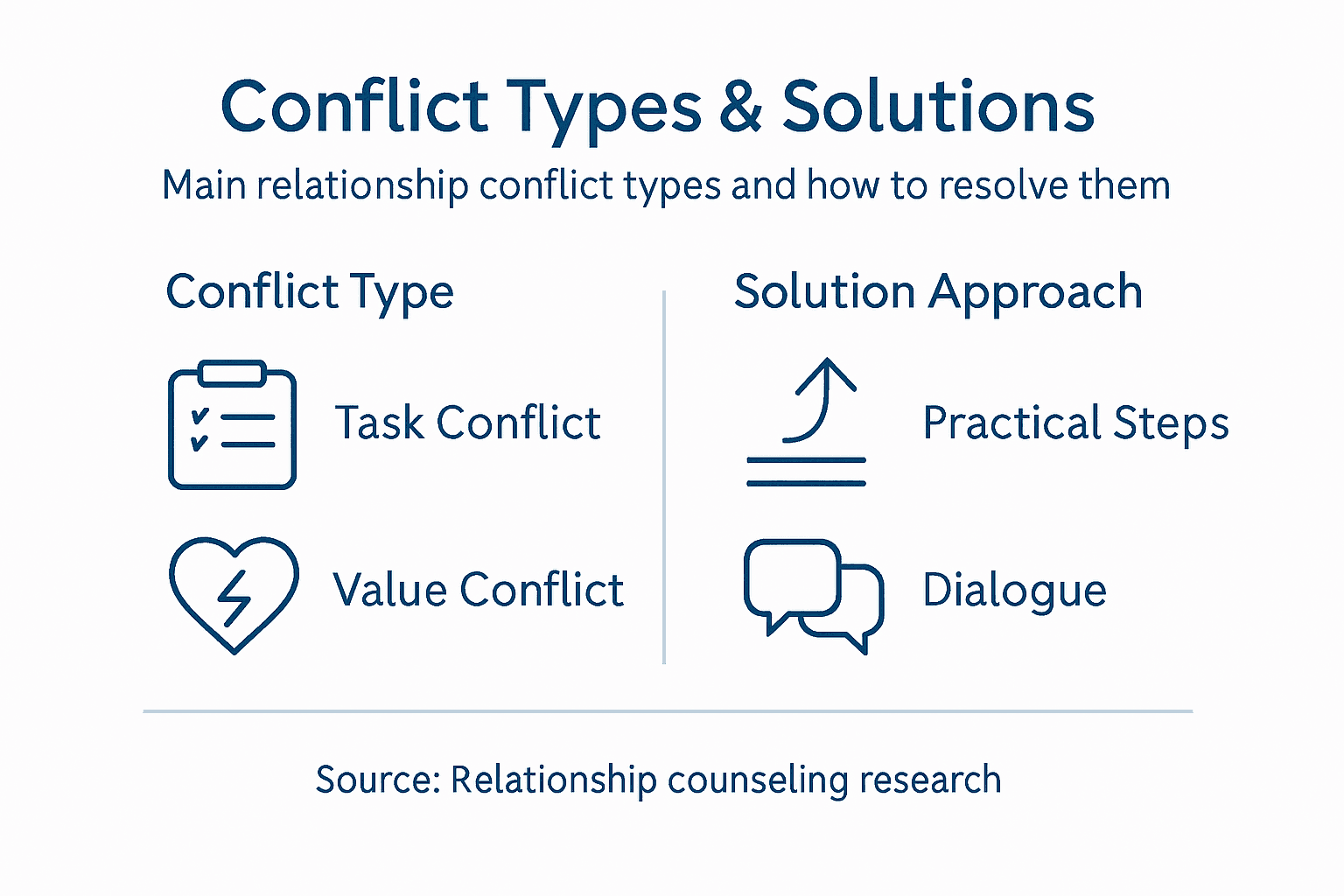
Pro tip: Identify which type of conflict you’re facing before attempting resolution, since task conflicts need practical solutions while relationship and value conflicts require emotional processing and sometimes professional guidance.
Effective Communication and Resolution Techniques
The difference between couples who stay stuck in conflict cycles and those who move forward often comes down to one thing: how they communicate when tension rises. Most people think communication means talking more, but that misses the mark entirely. Real communication requires active listening, empathy, and structured dialogue that creates safety for both partners to express concerns without fear of attack. When you shift from defending your position to genuinely trying to understand your partner’s perspective, the entire dynamic changes. This is not about winning arguments. It’s about solving problems together.
Start with specific communication techniques that prevent conflicts from spiraling. Use “I” statements instead of “you” accusations. Say “I feel hurt when bills aren’t discussed” rather than “You never talk about money with me.” This small shift removes blame and opens space for your partner to listen instead of defend. Pay attention to your tone of voice, body language, and facial expressions, since nonverbal signals often communicate louder than words. If you’re saying you want to work things out while your jaw is clenched and your arms are crossed, your partner reads the physical signals as hostility. Maintaining a calm tone, even when frustrated, signals that you view your partner as someone worth talking to respectfully rather than someone to defeat.
Active listening transforms conversations from debates into actual exchanges. When your partner speaks, resist the urge to plan your response or interrupt. Instead, listen to understand their point fully, then paraphrase back what you heard: “So what I’m hearing is that you feel unsupported when I work late without checking in. Is that right?” This technique does three things at once. It proves you actually listened, it gives your partner a chance to clarify if you misunderstood, and it slows the conversation down enough that emotions don’t hijack the dialogue. Many couples in the Carolinas who work with counselors at Mastering Conflict report that this single practice breaks patterns they’ve repeated for years. The goal is mutual problem-solving where you brainstorm solutions together rather than taking sides. This might mean compromising, or it might mean one partner yields on something less important while the other gives ground elsewhere. What matters is that you’re working as a team against the problem, not as opponents against each other.
Pro tip: Before a difficult conversation, agree on a time and place free from distractions, and establish that the goal is understanding each other, not winning the argument.
Role of Counseling and Professional Help
Trying to resolve relationship conflicts alone often feels like attempting to fix your own car engine without understanding what’s under the hood. You might tinker for hours and still end up stuck. This is where professional counseling makes the real difference. A trained counselor provides what you cannot give each other in the moment: neutrality, expertise, and structured guidance. Counseling creates a safe space where both partners can express their feelings and perspectives without judgment or fear of retaliation. This matters because most couples in conflict have stopped listening to each other long ago. They hear accusations instead of needs. They see threats instead of vulnerability. A counselor interrupts these patterns and helps you see your partner clearly again.
Professional counselors bring specific tools that DIY approaches cannot replicate. They help couples identify the root causes of conflict rather than just addressing surface arguments. Many couples argue about money repeatedly without realizing the real issue is about feeling controlled or undervalued. A skilled counselor asks better questions, uncovers these deeper patterns, and helps both partners understand what’s actually happening beneath the conflict. Therapy supports couples by teaching effective communication, empathy, and problem-solving skills that transform how you interact. These are not skills you inherently possess. They are learned behaviors that require practice. A counselor coaches you through that learning process, corrects unhelpful patterns in real time, and helps you build new ways of connecting. Couples at Mastering Conflict often report that after just a few sessions, their arguments sound completely different because they have new language and new awareness.
Counseling also addresses the emotional aftermath of conflict that couples cannot process alone. Unresolved conflicts leave wounds that deepen over time. Trust erodes when you feel unheard, dismissed, or attacked. Professional support helps you address these injuries, rebuild trust, and strengthen the relationship foundation. The goal is not just stopping arguments. It is creating a partnership where both people feel genuinely safe, valued, and understood. This transformation takes time and professional guidance, but couples who commit to counseling report significantly higher relationship satisfaction. Whether you work with an anger management specialist, couples therapist, or family counselor through services like those at Mastering Conflict, the investment in professional help often saves relationships that would otherwise deteriorate beyond repair.
Pro tip: Seek counseling early, before resentment builds to crisis levels, and choose a therapist who specializes in your specific conflict type, such as couples therapy versus family counseling.
Common Mistakes in Conflict Resolution
Most couples make the same predictable errors when trying to resolve conflict, and these mistakes often make things worse rather than better. Understanding what not to do is just as important as knowing what to do. One of the biggest traps is avoiding the conflict altogether. You convince yourself that ignoring the problem will make it disappear, but it never does. Instead, unaddressed tension festers beneath the surface like an infection. Meanwhile, small irritations compound into deep resentment that becomes harder to resolve the longer you wait. The opposite extreme is equally destructive. Jumping into conflict while flooded with emotion leads to accusations, blame, and defensiveness that shut down any real dialogue. You need timing and emotional regulation, not just willingness to talk.
Another critical mistake is using absolute language that triggers defensiveness instantly. Statements like “You never listen to me” or “You always prioritize work over our relationship” feel like character attacks because they are. Your partner immediately goes into defend mode rather than actually hearing your pain. Cognitive distortions such as mind reading and catastrophizing exacerbate stress and prevent productive dialogue. You assume your partner’s intentions are malicious when they might simply be overwhelmed or distracted. You imagine worst case scenarios where one argument signals the relationship’s end. These thought patterns are understandable but they hijack your ability to communicate clearly. Instead of “You never listen,” try “I felt unheard when you scrolled your phone during our conversation.” The second statement describes specific behavior without attacking character, which makes it possible for your partner to actually respond rather than defend.
Many couples also insist on being right, which creates stalemates and prevents resolution. You dig in on your position, your partner digs in on theirs, and neither person is actually trying to understand the other anymore. The conflict becomes about winning rather than solving. Couples in the Carolinas who work with counselors at Mastering Conflict often discover that their partner isn’t the enemy. The problem is the problem. When you shift from battling your partner to joining forces against the actual issue, everything changes. This requires letting go of needing to prove you were right and focusing instead on what you both actually want. Finally, many people fail to listen actively. They wait for their turn to speak while planning their counterargument. Active listening means genuinely trying to understand your partner’s perspective, even if you disagree with it. This single shift transforms conflict from debate into collaboration.
For quick reference, here are common mistakes in conflict resolution and more effective alternatives:
| Common Mistake | Typical Consequence | Better Alternative |
|---|---|---|
| Avoiding conflict | Builds resentment | Address issues early |
| Using absolutes | Triggers defensiveness | Use specific behaviors |
| Insisting on being right | Stalemate, ongoing tension | Focus on shared goals |
| Failing to actively listen | Poor understanding | Paraphrase partner’s concerns |
Pro tip: When you notice yourself using absolute language or feeling emotionally flooded, pause the conversation and agree to resume when you’re both calmer and can listen without defensiveness.
Take Control of Relationship Conflict with Proven Solutions
Relationship conflict can feel overwhelming when arguments repeat and emotions run high. The article highlights how unresolved tension affects your emotional well being, communication patterns, and trust. If you recognize familiar struggles like task, relationship, or value conflicts that cause frustration and distance in your partnership, you are not alone. The pain points of feeling unheard, defenseless in discussions, and stuck in damaging cycles show the urgent need to address these issues with expert support rather than trying to manage alone.
Start transforming your relationship today by exploring the professional services at Mastering Conflict. Our experienced counselors and therapists provide personalized couples therapy, anger management classes, and conflict resolution coaching tailored to your unique challenges. Whether you are in North or South Carolina, Florida, or beyond through online therapy, we offer evidence-based approaches led by Dr. Carlos Todd, designed to help you rebuild trust, communicate effectively, and break free from repetitive conflict patterns. Don’t wait until resentment grows deeper. Visit Mastering Conflict now to schedule a consultation and take the first step toward lasting peace and connection.
Frequently Asked Questions
What are the main types of relationship conflicts?
Understanding conflict types can help in resolution. The three main types are task conflicts, which focus on practical disagreements; relationship conflicts, which stem from personal incompatibility; and value conflicts, which involve fundamental differences in beliefs and ethics.
How can effective communication help resolve relationship conflicts?
Effective communication facilitates understanding and problem-solving. Techniques such as using “I” statements, active listening, and maintaining a calm tone can create a safe space for dialogue, allowing both partners to express concerns without defensiveness.
When should couples seek professional counseling for conflict resolution?
Couples should seek counseling when conflicts persist without resolution, lead to emotional distance, or create chronic stress. Professional guidance can help identify root causes, improve communication skills, and restore trust in the relationship.
What common mistakes should couples avoid when resolving conflicts?
Couples should avoid ignoring conflicts, using absolute language, insisting on being right, and failing to actively listen. These mistakes often escalate tensions. Instead, they should focus on addressing issues early and understanding each other’s perspectives.