
Clinical Supervision Essentials: Elevating Practice Outcomes

Mental health professionals across North Carolina and South Carolina routinely face situations where client needs, team dynamics, and ethical questions intersect. Quality care depends not just on clinical expertise but on strong supervision and the ability to resolve conflicts with skill. By focusing on clinical supervision as a goal-oriented relationship, practitioners can strengthen their decision-making, enhance conflict resolution approaches, and ultimately improve outcomes for those they serve.
Table of Contents
- Defining Clinical Supervision In Mental Health
- Major Models And Approaches Explained
- Core Responsibilities And Supervisor Roles
- Ethical, Legal, And Cultural Considerations
- Common Challenges And Effective Solutions
Key Takeaways
| Point | Details |
|---|---|
| Clinical Supervision is Essential | It fosters the development of mental health practitioners by enhancing skills and ensuring high-quality client care. |
| Multiple Models of Supervision Exist | Understanding various supervisory models enables practitioners to select an approach that fits their learning style and professional goals. |
| Core Responsibilities of Supervisors | Supervisors play crucial roles in ensuring competence, ethical practice, and multicultural sensitivity, impacting both supervisee development and client care. |
| Addressing Challenges Proactively | Identifying common challenges and implementing structured strategies can enhance the effectiveness of clinical supervision. |
Defining Clinical Supervision in Mental Health
Clinical supervision is a structured, collaborative professional development process essential for mental health practitioners seeking to enhance their clinical competence and deliver high-quality client care. Clinical supervision fundamentals represent a critical educational strategy that supports ongoing professional growth and ensures ethical practice across diverse healthcare settings.
At its core, clinical supervision involves several key components that distinguish it from other professional interactions:
- A goal-oriented relationship between a more experienced practitioner and a less experienced clinician
- Systematic feedback and performance evaluation
- Professional skill development and knowledge enhancement
- Ensuring client welfare and maintaining high standards of care
- Promoting ethical decision-making and self-reflection
The theoretical foundations of clinical supervision reveal a multidimensional approach that transcends simple oversight. It serves as an educational intervention designed to support clinicians in developing advanced competencies, processing complex clinical scenarios, and maintaining professional well-being.
Cultural competence and ethical responsibility are integral to effective clinical supervision. Supervisors guide practitioners in understanding diverse client backgrounds, navigating interpersonal dynamics, and applying evidence-based interventions with sensitivity and expertise.
Pro tip: Document your supervision sessions comprehensively, focusing on specific clinical interactions, challenges encountered, and professional growth objectives to maximize your learning experience.
Major Models and Approaches Explained
Clinical supervision encompasses several sophisticated theoretical models designed to support mental health professionals in their ongoing professional development and skill enhancement. Distinctive supervisory models provide structured frameworks for guiding practitioners through complex clinical landscapes.
Key clinical supervision models include:
- Discrimination Model: Focuses on three primary supervisory roles
- Teacher role: Instructing and transferring knowledge
- Counselor role: Supporting emotional and professional development
- Consultant role: Collaborative problem-solving
- Developmental Model: Emphasizes staged professional growth
- Systems Approach: Integrates organizational and interpersonal dynamics
- Competency-Based Model: Targets specific skill development and performance metrics
The Discrimination Model stands out as a particularly versatile approach. It enables supervisors to flexibly adapt their interactions based on the supervisee’s specific learning needs, focusing on multiple dimensions including counseling skills, cognitive capabilities, self-awareness, and professional behaviors.
Supervision approaches are not one-size-fits-all. Each model offers unique strategies for supporting clinicians’ professional journeys, recognizing that individual practitioners develop skills and insights through different pathways and experiences.
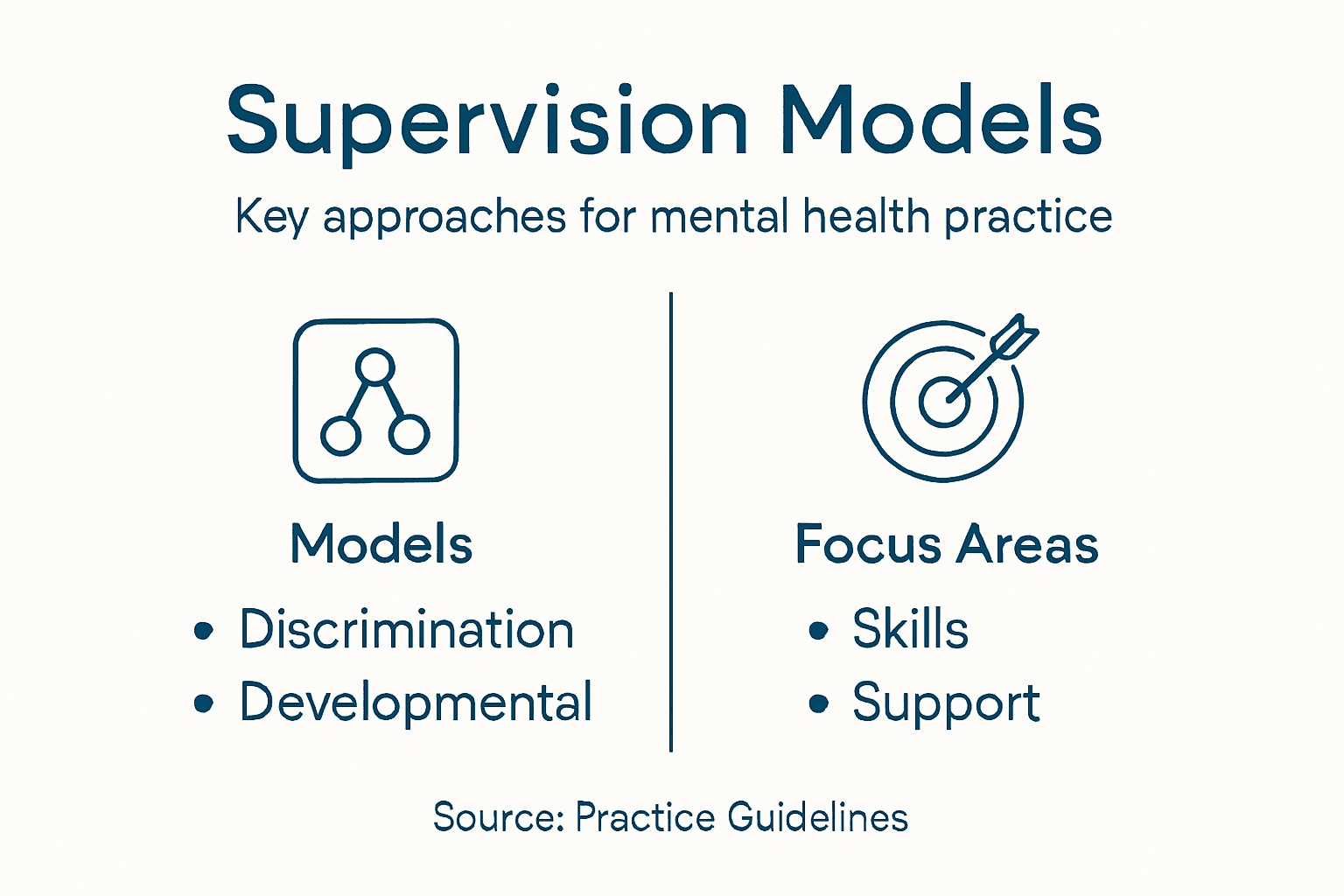
Here’s how the major clinical supervision models compare in structure and focus:
| Model Name | Core Focus | Structure Type | Notable Strengths |
|---|---|---|---|
| Discrimination | Learning needs | Flexible roles | Adapts to supervisee context |
| Developmental | Growth stages | Sequential framework | Tracks practitioner progress |
| Systems Approach | Organizational | Interpersonal networks | Considers team interactions |
| Competency-Based | Skill mastery | Performance metrics | Ensures measurable outcomes |
Pro tip: Select a supervision model that aligns closely with your personal learning style and professional development goals to maximize your growth potential.
Core Responsibilities and Supervisor Roles
Clinical supervisors play a multifaceted role that extends far beyond simple oversight. Supervisor responsibilities encompass a complex array of professional duties designed to ensure high-quality mental health care and support practitioner development.
The core responsibilities of clinical supervisors include:
- Ensuring Competence: Systematically evaluating supervisee skills and knowledge
- Ethical Practice Oversight: Monitoring adherence to professional ethical standards
- Professional Development: Facilitating continuous learning and skill enhancement
- Client Protection: Maintaining the highest standards of client welfare
- Multicultural Competence: Supporting diversity-sensitive clinical practices
Clinical supervision roles are dynamic and multidimensional. Supervisors must seamlessly transition between several critical functions: educator, mentor, evaluator, and gatekeeper. This requires a nuanced approach that balances supportive guidance with rigorous professional standards.
Supervisors must create goal-directed learning environments that adapt to individual supervisee needs. This involves providing constructive feedback, supporting case conceptualization skills, enhancing counseling techniques, and promoting self-care strategies. The ultimate aim is to develop competent, ethical, and reflective mental health practitioners who can provide exceptional client care.

Use this summary for a quick reference to supervisor responsibilities and related impact:
| Responsibility | Impact on Supervisee | Impact on Client Care |
|---|---|---|
| Competence Assurance | Confidence improvement | Safety and effective support |
| Ethical Oversight | Guidance in dilemmas | Trust and risk reduction |
| Professional Growth | Continuous skill updates | Better outcomes and services |
| Multicultural Support | Increased sensitivity | Respectful, relevant treatment |
Pro tip: Develop a flexible supervisory approach that can dynamically shift between supportive mentorship and objective evaluation to maximize supervisee growth.
Ethical, Legal, and Cultural Considerations
Clinical supervision demands a sophisticated approach to navigating complex ethical, legal, and cultural landscapes. Culturally responsive supervision has emerged as a critical framework for ensuring comprehensive and sensitive professional practice.
Key ethical and cultural considerations include:
- Boundary Management: Maintaining professional relationships
- Confidentiality Protocols: Protecting client and supervisee privacy
- Cultural Competence: Recognizing and respecting diverse backgrounds
- Power Dynamics: Addressing inherent supervisory relationship complexities
- Informed Consent: Establishing clear expectations and limitations
Supervisors must proactively address potential ethical challenges, including:
- Navigating dual relationships
- Managing cross-cultural communication
- Preventing unintentional bias
- Ensuring client protection
- Supporting supervisee professional development
Ethical decision-making guidance emphasizes the importance of creating a reflective environment that promotes ongoing ethical awareness. This requires supervisors to model professional integrity, engage in open dialogue about ethical dilemmas, and provide constructive guidance that supports both client welfare and supervisee growth.
Pro tip: Develop a structured ethical reflection process that encourages supervisees to critically examine their cultural assumptions and professional practices.
Common Challenges and Effective Solutions
Clinical supervision challenges reveal complex dynamics that require sophisticated intervention strategies. Mental health professionals frequently encounter multifaceted obstacles that demand nuanced, strategic approaches to maintain high-quality clinical practice.
Common challenges in clinical supervision include:
- Inconsistent Supervision Practices: Lack of standardized approaches
- Role Confusion: Balancing evaluative and supportive functions
- Communication Barriers: Misaligned expectations and communication styles
- Professional Burnout: Emotional exhaustion and reduced effectiveness
- Limited Professional Development: Insufficient skill enhancement opportunities
Key strategies for addressing these challenges involve:
- Implementing structured supervision frameworks
- Developing clear communication protocols
- Creating individualized professional growth plans
- Establishing regular feedback mechanisms
- Promoting self-care and resilience strategies
Systematic review insights suggest that organizations can significantly improve clinical supervision by investing in comprehensive training programs, fostering supportive relationships, and developing adaptive supervisory methods that respond to diverse professional needs.
Pro tip: Develop a personalized supervision strategy that combines structured assessment with flexible, empathetic guidance to maximize professional development.
Enhance Your Clinical Supervision Skills to Elevate Mental Health Outcomes
Clinical supervision is essential for mental health professionals striving to provide ethical, competent, and culturally responsive care. If you face challenges like role confusion, inconsistent supervision, or balancing evaluative and supportive functions, you are not alone. This article highlights the importance of adopting flexible supervisory models and developing strong ethical awareness to support your professional growth and protect client welfare. Mastering these elements can transform how you approach supervision and clinical practice.

Take the next step in advancing your clinical supervision expertise and delivering superior care. At Mastering Conflict, we offer tailored mentoring and supervision opportunities designed for mental health practitioners across North and South Carolina, Florida, and beyond. Whether you seek to refine your skills in ethical decision-making, manage supervisory challenges, or increase cultural competence with diverse populations, our evidence-based coaching programs and clinical training can help you achieve your goals. Visit Mastering Conflict today to explore how our support can empower your professional journey.
Frequently Asked Questions
What is clinical supervision in mental health?
Clinical supervision in mental health is a structured, collaborative professional development process where a more experienced practitioner guides a less experienced clinician. It focuses on enhancing clinical competence, ethical practice, and client care.
What are the core components of effective clinical supervision?
Effective clinical supervision involves a goal-oriented relationship, systematic feedback, skill development, and promoting ethical decision-making. It emphasizes client welfare and encourages self-reflection among practitioners.
What are some major models of clinical supervision?
Major models of clinical supervision include the Discrimination Model, which focuses on different supervisory roles; the Developmental Model, which emphasizes growth stages; the Systems Approach, integrating organizational dynamics; and the Competency-Based Model, which targets specific skill development.
What responsibilities do clinical supervisors have?
Clinical supervisors are responsible for ensuring competence, monitoring ethical practice, facilitating professional development, protecting client welfare, and supporting multicultural competence among their supervisees.