
Dealing With Difficult People: Proven Strategies for Resolution

Tempers flare easily when a co-worker’s harsh tone or a relative’s criticism hits close to home, leaving many in North Carolina and Florida feeling drained and unheard. Emotional triggers hijack rational responses and can make every disagreement feel personal, especially for minority communities facing unique pressures. Learning to recognize these emotional cues and respond strategically empowers you to protect your well-being while improving relationships at work and within your family.
Table of Contents
- Step 1: Assess Common Triggers And Your Reactions
- Step 2: Practice Active Listening With Empathy
- Step 3: Set Healthy Boundaries Calmly
- Step 4: Communicate Clearly To Reduce Conflict
- Step 5: Review Results And Adjust Strategies
Quick Summary
| Key Insight | Explanation |
|---|---|
| 1. Identify Your Emotional Triggers | Keep a journal to track and assess situations that provoke strong emotional reactions, enhancing self-awareness. |
| 2. Master Active Listening | Engage with the speaker’s emotions through active listening and reflection to create a safe communication environment. |
| 3. Set Clear Boundaries Calmly | Communicate your limits in a calm, assertive manner to protect your emotional well-being and prevent conflicts. |
| 4. Practice Clear Communication | Use specific language and ‘I’ statements to clearly express feelings while minimizing misunderstandings and conflict escalation. |
| 5. Reflect and Adjust Strategies | After interactions, review outcomes and note observations to improve your communication techniques over time. |
Step 1: Assess Common Triggers and Your Reactions
Recognizing your emotional triggers is the first critical step in effectively managing interactions with difficult people. Understanding how certain situations provoke intense reactions allows you to develop strategic responses instead of falling into reactive patterns.
The process begins with self awareness. Emotional triggers hijack rational responses by activating your brain’s limbic system, which means you might experience fight, flight, or freeze reactions without conscious control. Common triggers include raised voices, specific tones of communication, personal criticism, or situations that remind you of past painful experiences. These are deeply personal and vary significantly between individuals.
To effectively assess your triggers, start by keeping a detailed journal. Document specific interactions that spark strong emotional responses. Note the context, your physical sensations, and immediate emotional reactions. Look for patterns like increased heart rate, tension in your body, or sudden anger. By tracking these experiences, you create a map of your emotional landscape that helps you understand your unique trigger points.
Pro tip: Create a simple tracking system on your phone or in a notebook where you can quickly record emotional trigger moments to build self awareness without overthinking the process.
Here’s a summary of common emotional triggers and helpful self-assessment strategies:
| Emotional Trigger Example | Typical Physical Response | Self-Assessment Method |
|---|---|---|
| Raised voices | Increased heart rate | Journaling your emotions |
| Personal criticism | Tension in neck/shoulders | Tracking context and reactions |
| Dismissive tone | Sudden anger | Noting physical sensations |
| Interruptions | Feeling of helplessness | Identifying recurring situations |
Step 2: Practice Active Listening With Empathy
Active listening is your most powerful tool when navigating difficult conversations, transforming potential conflicts into opportunities for genuine understanding. By mastering this skill, you can create a safe space for communication that reduces tension and builds mutual respect.
Active listening goes beyond hearing words by fully engaging with the speaker’s underlying emotions and message. This means paying attention not just to what is said, but how it is said. Key techniques include maintaining steady eye contact, using open body language, and offering subtle verbal affirmations like “I understand” or “Tell me more”. When someone feels truly heard, their defensive walls begin to crumble, making productive dialogue possible.
To practice effective empathetic listening, focus on reflecting back what you hear without judgment. Paraphrase the speaker’s key points to confirm understanding: “So what I hear you saying is…” This approach demonstrates that you are actively processing their perspective. Avoid interrupting or preparing your rebuttal while they are speaking. Instead, listen with genuine curiosity, asking open-ended questions that invite deeper exploration of their thoughts and feelings.
Pro tip: Practice active listening by setting a personal goal to listen without formulating your response until the other person has completely finished speaking.
Step 3: Set Healthy Boundaries Calmly
Setting healthy boundaries is critical for maintaining your emotional well-being when dealing with difficult people. By establishing clear and calm limits, you protect your personal space and prevent potential conflicts from escalating.

Healthy boundaries balance safety and respect in interpersonal relationships. They are not about building walls but creating clear guidelines for acceptable behavior. Begin by identifying specific interactions or behaviors that make you uncomfortable. This might include someone consistently interrupting you, making disrespectful comments, or crossing personal space boundaries. When communicating these limits, use a calm and neutral tone that communicates firmness without aggression.
The key to setting boundaries is using clear, direct language that leaves no room for misinterpretation. Instead of apologetic or aggressive statements, use assertive phrases like “I feel uncomfortable when…” or “I need you to…” Practice delivering these statements with a steady voice and confident body language. Remember that setting boundaries is an act of self respect, not a punishment for the other person. If someone consistently disrespects your boundaries, you may need to limit your interactions or seek additional support from trusted friends or professionals.
Pro tip: Practice your boundary setting statements in front of a mirror to build confidence and refine your delivery before real world conversations.
Step 4: Communicate Clearly to Reduce Conflict
Clear communication is your most powerful strategy for defusing tense interactions and preventing misunderstandings with difficult people. By mastering precise communication techniques, you can transform potentially explosive conversations into opportunities for mutual understanding.
Effective communication mitigates conflict by creating a space for genuine dialogue. Start by managing your tone of voice and body language carefully. Use a calm and steady speaking rhythm that communicates confidence without aggression. Focus on using specific language that describes behaviors and impacts rather than making broad accusations. For instance, instead of saying “You always make me feel bad,” try “When you interrupt me during meetings, I feel my contributions are not valued.”
Employ the powerful technique of ‘I’ statements to express your feelings and needs without triggering defensiveness. This means framing your communication around your personal experience rather than attacking the other person. For example, “I feel frustrated when deadlines are missed” works better than “You never complete anything on time.” Pay attention to your nonverbal cues as well. Maintain an open posture, make appropriate eye contact, and keep your facial expressions neutral. Remember that communication is a two way process that requires both speaking and listening with genuine respect.
Pro tip: Practice your communication approach by recording yourself and listening back to identify areas where you can sound more clear and compassionate.
Compare how active listening, setting boundaries, and clear communication each reduce conflict:
| Approach | Primary Benefit | Key Technique |
|---|---|---|
| Active listening | Lowers defensiveness | Reflect and paraphrase |
| Healthy boundaries | Preserves emotional safety | Assertive statements |
| Clear communication | Prevents misunderstandings | Use “I” statements, specifics |
Step 5: Review Results and Adjust Strategies
Successfully managing difficult people requires ongoing reflection and strategic adaptation. By systematically reviewing your interactions, you can continuously improve your approach and build more effective communication skills.
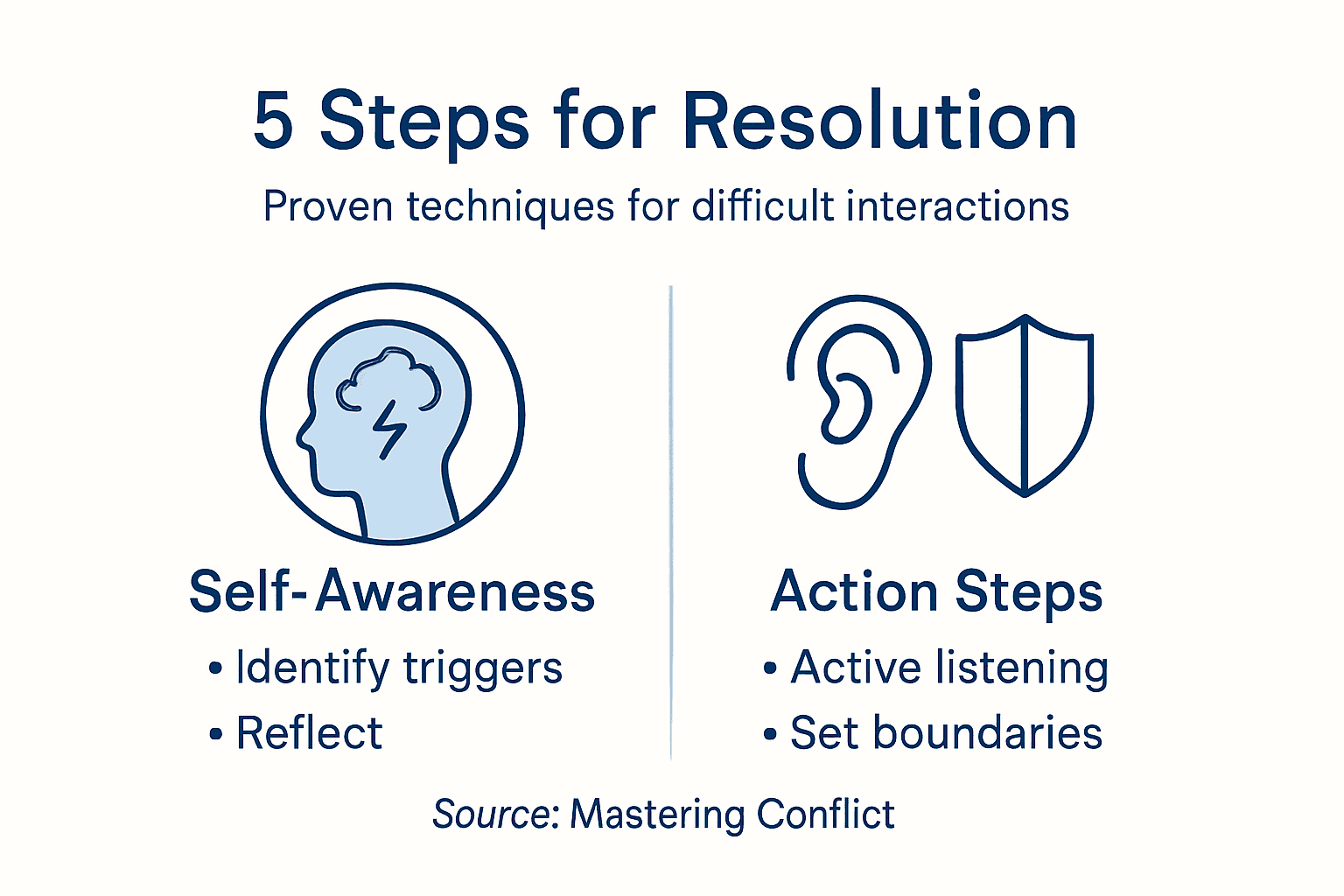
Reviewing outcomes helps manage difficult conversations by providing crucial insights into your interaction patterns. After each challenging encounter, take time to reflect objectively. Ask yourself specific questions about what worked well and what could be improved. Consider the emotional dynamics of the interaction identically intense moments and your response. Were you able to maintain composure? Did your communication strategy help de escalate tension or inadvertently escalate the conflict?
Document your observations in a structured manner. Create a simple log that tracks the context of difficult interactions, your initial strategy, the actual outcome, and potential alternative approaches. Look for recurring patterns in your responses and the other person’s reactions. This systematic analysis allows you to develop more nuanced and effective communication techniques over time. Remember that personal growth is an iterative process self reflection is your most powerful tool for improving interpersonal dynamics.
Pro tip: Set aside 10 minutes after each challenging interaction to write down three specific observations and one actionable improvement strategy for future encounters.
Unlock Lasting Peace by Mastering Difficult Interactions
Dealing with difficult people can trigger overwhelming emotions that leave you feeling drained and misunderstood. This article highlights key challenges like managing emotional triggers, setting healthy boundaries, and communicating clearly to reduce conflict. If you recognize these pain points and want to transform tense exchanges into opportunities for growth and understanding you are not alone.
Take control of your emotional landscape today by exploring personalized support at Mastering Conflict. Whether you need anger management classes, tailored counseling, or expert coaching to build resilience and effective communication skills our professional services guided by Dr. Carlos Todd help you build confidence in handling difficult people calmly and assertively. Visit Mastering Conflict now for proven solutions designed to improve your relationships and overall well-being. Your next step starts here.
Frequently Asked Questions
How can I identify my emotional triggers when dealing with difficult people?
Recognizing your emotional triggers involves keeping a detailed journal of interactions that provoke strong reactions. Track the context and your physical sensations during these encounters, allowing you to identify patterns and understand your emotional landscape.
What strategies can I use to practice active listening during difficult conversations?
To practice active listening, focus on fully engaging with the speaker’s emotions and message by maintaining eye contact and using open body language. Reflect back on what they say and ask open-ended questions to foster deeper understanding.
How do I go about setting healthy boundaries with difficult people?
Set healthy boundaries by clearly communicating specific behaviors that make you uncomfortable. Use assertive phrases like “I feel uncomfortable when…” to express your needs calmly and firmly, ensuring your boundaries are respected.
What are effective communication techniques to reduce conflict in difficult conversations?
Effective communication techniques include using “I” statements to express your feelings and needs without blaming others. For instance, say “I feel frustrated when…” instead of making accusations, which helps prevent misunderstandings and keeps the dialogue constructive.
How can I review my interactions with difficult people to improve my strategies?
After each challenging encounter, take 10 minutes to reflect on what went well and what could be improved. Document your observations, focusing on emotional dynamics and potential alternative approaches, to enhance your future interactions.
Recommended
- How to Deal With Parenting Conflicts
- Effective Conflict Resolution Steps for Couples, Families, and Professionals 2025 – Mastering Conflict
- Conflict Resolution for Adolescents: Parent Strategies That Work – Mastering Conflict
- Conflict Resolution Skills for Teens: Building Healthy Relationships – Mastering Conflict
- Role of Mindfulness in Therapy: Real Impact on Anxiety and Depression – ReviveHealthTherapy